On the Doorstep: Whitchurch ~ Wood and Stone

We left the earthworks of Bolebec castle in peace… which is more than can be said of Oliver Cromwell’s army when they passed this way during the Civil War. The Battle of Aylesbury, between Cromwell’s forces and Prince Rupert of the Rhine, was fought at Holman’s Bridge, just a few miles down the road, on 1st November 1642. The story goes that around this time, Cromwell gave orders to destroy the castle, the largest of eighteen in the county. With stone strewn across the village’s green spaces, it is not surprising that many of the castle’s stones are now part of the fabric of the village.
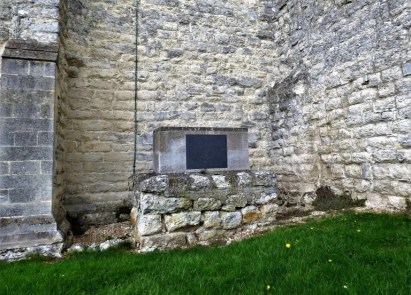
mass grave of soldiers from Battle of Aylesbury. Image Sue Vincent

A mile down the road, in the next village, there is a monument to some of the men who died during that battle. Their bodies were found on the battlefield, over a hundred and fifty years after their death and they were reburied together in a mass grave at Hardwick.
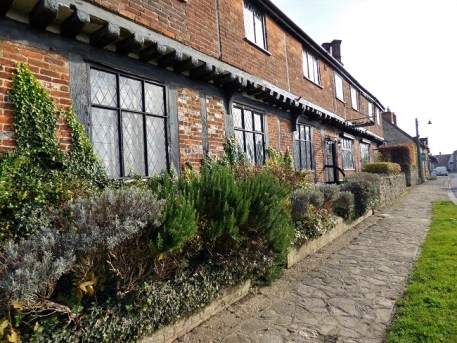
Our footsteps, though, took us further back into history as we passed between thatched cottages, timber-framed buildings and pale stone to the site of the old market square. Whitchurch was granted the right to hold a market in 1245, probably because of the presence and proximity of Bolebec Castle. Not only would the market enjoy the protection of the castle and its lord, but also its business, supplying the castle’s needs by bringing in goods from the surrounding areas. While the market is no longer in operation today, the granting of the charter is still celebrated every May.
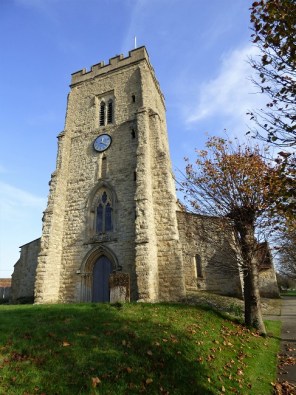
It takes very little imagination to populate the empty space between the houses with the raucous cries of the sellers, the pungent smells of the livestock and unfamiliar wares and all the colour and life of a busy settlement. You might even see the white mantle and red cross of a Templar Knight, walking to the church from the preceptory at Creslow… or ‘Christlow’… just outside the village.

Creslow Manor from Whitchurch. The manor was formerly owned by the Knights Templar and, following their suppression, the Knights Hospitaller. Image: R. P. Marks (Flickr: CC BY-NC-ND 2.0)

Crossing the road, you reach the Church Headland… which seems a strange name for an inland site, although it seems to fit neatly with the idea of the sacred spring named the Head Well, especially when Knights Templar are in the area and known for their use of head-based symbolism.
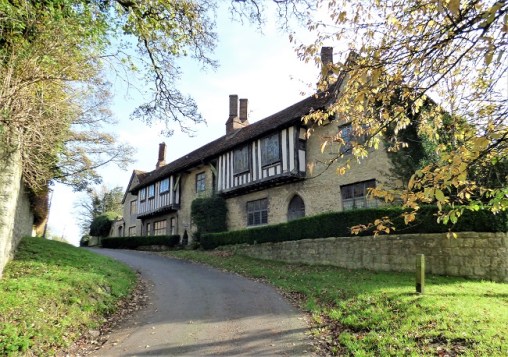
On the corner of Church Headland is the aptly named Old House, dating back to around 1400. Around that time, the parish church was taken over by the monks of Woburn Abbey and it is thought they are responsible for building the half-timbered house. In after years, the building was split into five ‘tenements’, known as Lime Cottages, before becoming one single dwelling place again in the 1920s.
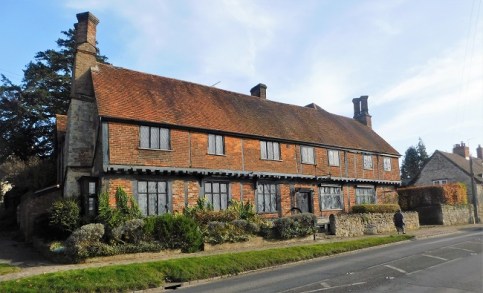
Image: Stuart France

A little farther down the main road and you pass the old courthouse, where the stocks once stood and behind which was the workhouse. Built around 1360, it remained the courthouse until 1900. I was lucky enough to be able to explore the building one evening, during its incarnation as the Priory Hotel… a magnificent old place, full of oak and mahogany, doors that stood open to rooms decked with tapestries and four-poster beds… and with a price tag for dinner that would have choked me had known what was being paid… no matter how good the food and service!
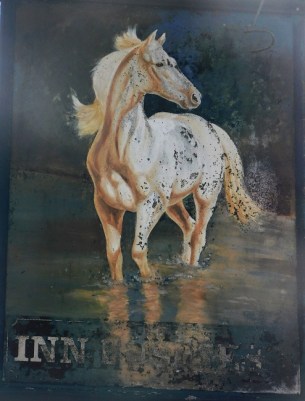
Image: Stuart France

The old White Horse Inn would have been more my style. There had been an inn on the spot since before 1683, but the pub sadly closed in 2011, leaving just the White Swan at the far end of the village to serve its needs. The Swan was known as the Queen’s Head until 1785 and dates back originally more than five hundred years.
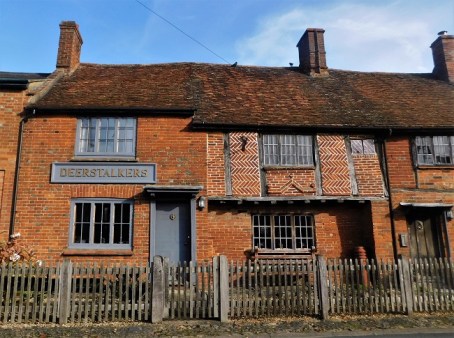
Image: Stuart France

The pub garden was once an apple orchard and the apples were used to make cider that was sold in what then became the inn. Behind the inn there is also a duck pond that was it home to the village ducking stool, used to punish scolds or disorderly women. Local tales say that witch trials were also conducted there… although that might just be a village myth, designed to encourage travellers to stay for one more pint of cider…

Posted in albion, Books, Churches, Don and Wen, England, france and vincent, History, Photography, Templars, travel | Tagged , , , , , | 14 Comments

Homeward #midnighthaiku

Into the unknown

Following where the path leads

Trusting tomorrow

Marking neither time nor place

The journey carries you home

*

Posted in Photography, Poetry | Tagged , , , , | 7 Comments

Pals Regiments: An Experiment Never Repeated ~Judith Barrow #WW1

Reblogged from Judith Barrow:

As members of the human race we feel safest with those we know and trust. And we choose who to trust; friends and those members of our families with whom we can empathise. Those who think like us, who, on the whole, believe in the things we believe in, who share group values.

Even if those ideals are instigated by someone else, we can sometimes be persuaded to take them onboard. To consider them as our own core principles. And, as such we cooperate; we work together towards a shared goal.

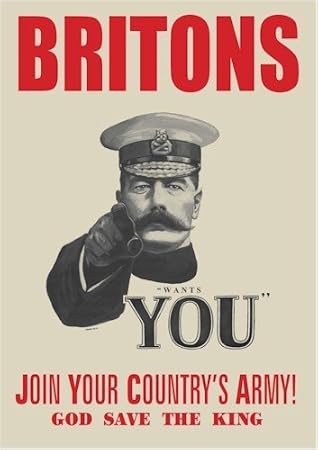
It was this theory; that man has evolved to cooperate within a trusted group and so is able to achieve more than any one person could ever accomplish alone, that in nineteen fourteen led to the formation of the Pals Battalions.

Continue reading at Judith Barrow


Posted in reblog | Tagged , , , , , , , , , , | 2 Comments

Solstice of the Moon: The Butcher’s Stone…

““Culloden,” he said, the whispered word an evocation of tragedy.”
Outlander: Voyager, Diana Gabaldon

We had turned off the main road to Inverness, and were heading down the ‘B’ roads in search of an ancient site we wanted to visit. As we drove, a young stag leaped out into the road in front of us, his emerging antlers still rounded and covered with velvet. I was glad that I was not driving at speed as we followed the brown signs that said ‘Culloden’; there have been more than enough deaths there without adding to their number. But that was  one place we were not going. The battlefield of Culloden has too many tales of horror and too many uneasy ghosts still haunt moor and memory. I had no desire to feel them again… and, as a sassenach myself, there is a lingering sense of shame for the actions of the Duke of Cumberland.

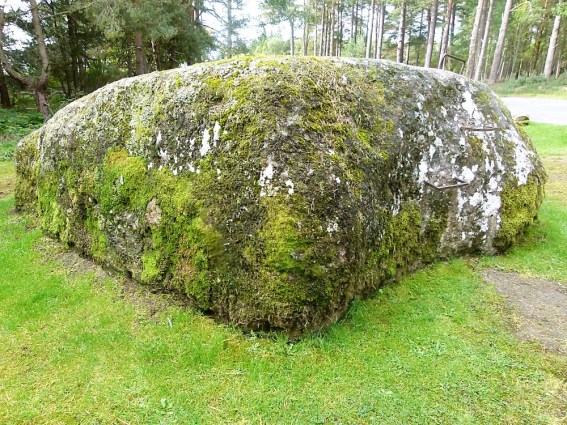
As it was, our road led us too close for comfort to the place where so many were slaughtered in battle and with cruel and merciless abandon in the aftermath. All unsuspecting, we pulled into a parking spot beside a huge boulder, over five feet high and over fifty-three feet in circumference… and just a few hundred yards from the battlefield of Culloden.

On the 16th of April, 1746, ten thousand English troops, met the Highlanders who fought for Charles Stuart… Bonnie Prince Charlie… at Culloden. The English foot soldiers and cavalry, under the command of the Duke of Cumberland, were heavily armed with artillery. The Jacobite Highlanders were weary, weakened by sickness and hunger and numbered less than half the English force.  The level ground at Culloden was unsuited to the Highlanders’ fighting style and their army was decimated.

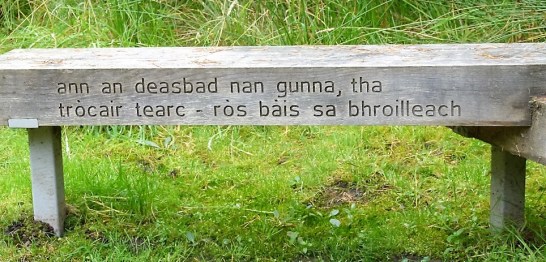
Charles Stuart, his cause lost, managed to escape the field with a small band of followers. Few Highlanders escaped… on Cumberland’s orders, the wounded and those not slain in battle were shot in a sickening episode of brutality. Cumberland would follow the battle with the harrowing of the Glens, laying the Highlands bare and earning for himself the name of the ‘Butcher’.

Continue reading at France & Vincent

Posted in Ancient sites, historic sites, History, Landscape, Memory, Photography, Scotland, scotland road trip, Solstice of the Moon, Stuart France and Sue Vincent | Tagged , , , , , , | Leave a comment

The City and the Stars (1) – Skara Brae ~ Steve Tanham

With the Pictish Trail weekend a long car journey and a boat ride behind us, we had awakened in Stromness to the early morning of an overcast Orkney day – The excavated and intact Neolithic village of Skara Brae was a few short miles away…

(1300 words, a ten-minute read)

We had not expected to be here at all. Visiting Orkney for the second part of our Pictish Trail workshop had seemed impossible because of Covid restrictions. But there were signs that things were relaxing and even re-opening. Our potential companions for the extended weekend had urged us to keep trying, so we’d put ourselves on every visitor ‘notification list’ possible.

Continue reading at The Silent Eye

Posted in reblog | Tagged , , , , , , , , , | Leave a comment

A Fatal End?…

*

The Druids of Erin, so the story goes,

Long prophesied the coming of St Patrick.

They told it in this way…

*

Continue reading at France and Vincent

Posted in albion, Ancient sites, Art, Books, Poetry, Stuart France | Tagged , , , , , , , | 4 Comments

On the Doorstep: Whitchurch ~ Earth and Water

It was a lovely day. We needed to get out and about… get some exercise in the fresh air and sunshine. And yet, there we were in lockdown again. My own village offers few unexplored possibilities, so, instead of moping around indoors, we decided to drive five miles and a couple of hamlets over to the village of Whitchurch for a wander.
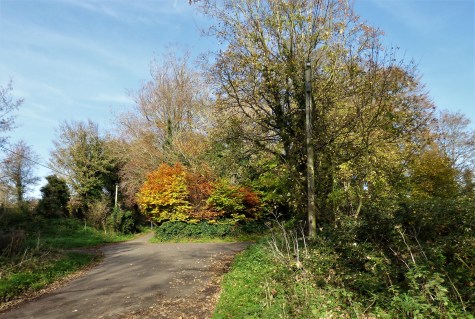
It is often the way that the things on our doorstep are the easiest to ignore. We are always ‘going to’ investigate and seldom do.  I have known about the sites at Whitchurch for over twenty years, but aside from visiting the church as we researched the area for our books, I have not taken the time to explore the village. A quiet Sunday, with few people about, seemed the perfect opportunity.

I have already written about the wartime connections of the village… of the young artist, Rex Whistler, who painted the Vale from his garden and was killed in action during WWII. Of Jan Struther, who wrote of Mrs Miniver, a fictional housewife whose story helped bring America into the war,  and of the secretive Ministry of Defence offices at The Firs,  known as ‘Churchill’s Toybox’, where experimental weapons were developed. But the history of Whitchurch goes back much further than a mere hundred years. Although the original settlement appears to have begun in Anglo-Saxon times, like so many of the villages in the area, what chiefly remains in Whitchurch is mediaeval… and we were on the hunt for sacred springs, holy wells and a castle.

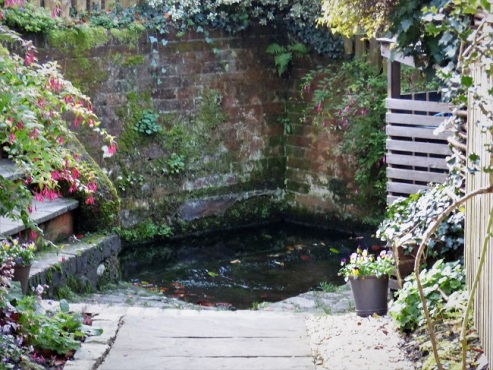
Whittle Hole as the first of the springs to present itself. Vast quantities of crystal clear water… up to a hundred gallons a minute in a wet season, we are told, flow into a wide and fairly practical stone trough, before dropping to the stream below. This water, according to Joseph Holloway, lecturing in 1889, was not held to be as sacred as that of the other three wells in the village, but was nonetheless “blest and given to and for the free and good use of the inhabitants.” It is said that, no matter what the season or weather, these springs have never dried up or foundered.

The two most sacred wells we did not visit on this occasion as it would have involved a fair walk over the fields… and there are limits to what I can do. We do need to try to find them though, as they are both reputed to be petrifying wells, where the contact with water with unusually high mineral content appears to turn objects left within the water to stone. This was once thought to be the result of magic and miraculous and curative powers attributed to the waters, as at Whitchurch Holy Well and the intriguingly named Head Well.

Given all the legends of beheaded saints who have picked up their heads and walked with them until they come to a place where a sacred spring wells from the ground, I have to wonder if there is a missing legend in the area? Or does this hark back to an older veneration such as the so-called Celtic ‘head-worship’?

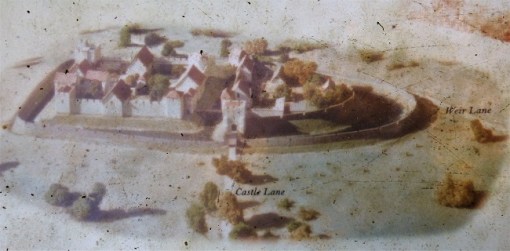
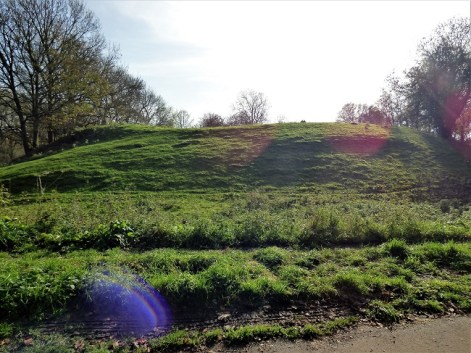
The fourth well is Fair Alice Well, named for one of the inhabitants of the castle at whose base it rises and who had, perhaps, drunk and been healed by its waters. To be fair, I wasn’t expecting much of the castle. I had never come across any pictures of it… only the legend on a map that proclaims it to be a ‘motte and bailey’, in other words, a couple of hummocks of earth which might be no more than a disturbance in the ground… It was a  surprise, then, to find that what remains of Bolebec Castle are two substantial mounds and the very clear course of the castle moat.

The castle was built in during the period known as the Anarchy, a civil war in England and Normandy that took place between 1135 and 1153. Following the drowning of William Adelin, the only legitimate son of Henry I, the succession to the throne was thrown into disarray and widespread lawlessness took over. That there was some controversy over the building of the castle seems clear as in 1147, Pope Eugenius specially referred to castle works with censure as being wrongfully built. It  is also quite possible that when Hugh de Bolebec decided to build his castle, he used a pre-existing mound, left behind by the Saxon Thegn ousted by the Norman conquerors. Such mounds might have been part of the area’s defences, or even part of its inner life, used as a ceremonial place, with tendrils of history stretching back beyond memory. What better way for an invader to stamp authority on an area that to take over its heart?

All speculation aside, what remains is impressive enough considering all but the stone footings have long since disappeared. The motte, a huge mound that would have led the stone keep, with its courtyard, lordly housing and drawbridge was surrounded by a moat, doubtless fed by the Fair Alice Spring. The bailey, a secondary mound, now located in a private garden across the lane, would have hosed the horses, livestock and soldiers. It was a really surprising find. Knowing something is ‘there’ is a far cry from walking the ground and seeing it for yourself. I was astonished at how much of the castle’s earthworks were still intact, showing the impressive scale of work.

I caught a waiting buzzard on camera, just before it swooped from the trees…the camera was a good excuse to pause. After a fair walk, a couple of small hills and three stiles, I was struggling a bit with the walking… and we still needed to cross the main road and walk up to the church…

Posted in albion, ancient mound, Books, History, Photography, Sacred sites, travel | Tagged , , , , , | 37 Comments

Free #midnighthaiku

Beyond the shadows

Inner illumination

True colours break free

*

Posted in Photography, Poetry | Tagged , | 12 Comments

Calling All Indie Authors! ~ Lucy Brazier

Reblogged from Lucy Brazier:

Despite whatever nonsense is thrashing about in the world right now, it is an inescapable fact that Christmas is coming – and there is no better present than a book, yes? So while the usual suspects will no doubt dominate the literary charts once more this year, there are many other, less well-known, scribes out there whose works and talents may not be world renowned but can give the big names a run for their money any day of the week. I might be one of them. I’m pretty sure a lot of you fellows are, too.

Continue reading at Lucy Brazier 

    Posted in reblog | Tagged , , , , , | Leave a comment

    Solstice of the Moon: the Battle Stone

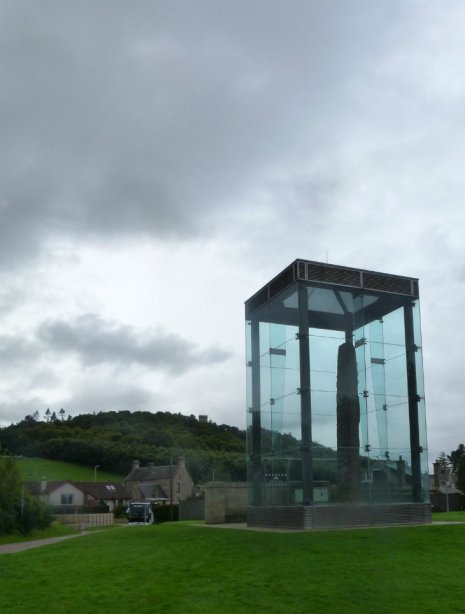
    The road carried us towards Forres, on the way to Inverness. We were, fairly predictably, on the trail of a stone. Not just any stone, though, this one is rather special. It is also quite a large one…though quite how large we did not realise until we parked the car and stood looking up at the thing. At twenty-one feet, it is the tallest carved stone of its kind in Scotland.
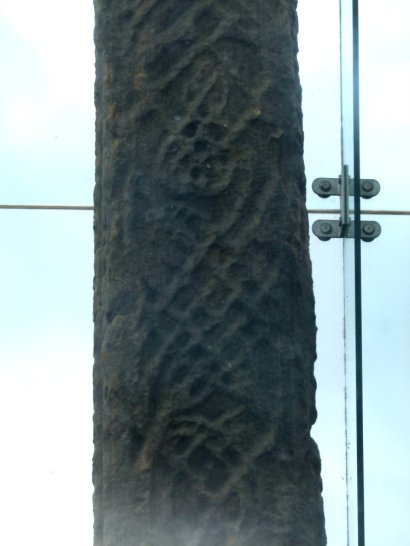
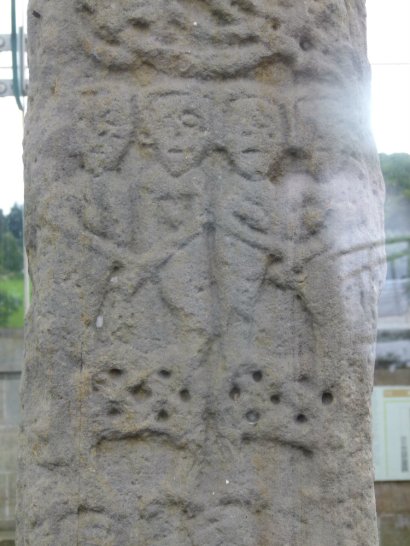
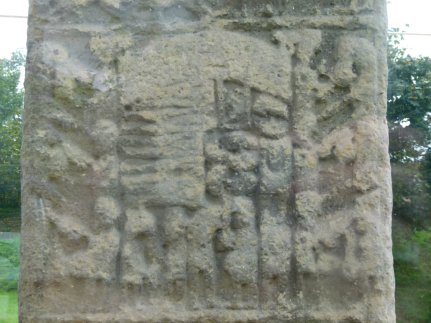
    Sueno’s Stone stands at a crossroads where three roads meet.Legends tell that it was on this spot that the infamous witches met Macbeth, and their spirits were imprisoned within the stone, waiting to be released should it ever be broken. The only problem is that   Shakespeare wrote Macbeth  many centuries after the stone was first raised, but it does give a good reason for the glass case in which the stone now sleeps.
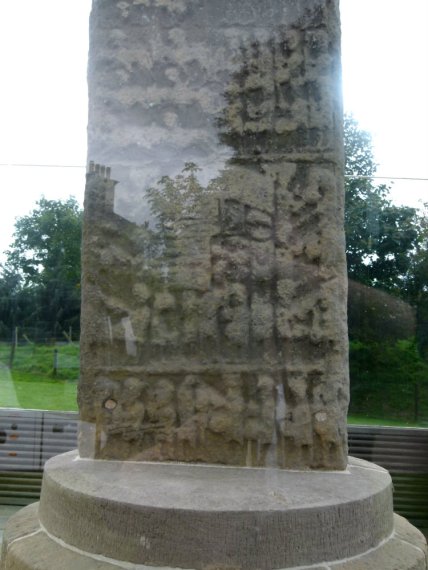
    Another and more plausible legend suggests that the stone marks the death of Dub mac Maíl Coluim, king of Alba, who was killed by the Scots in 967 and that the stone was erected by his brother, Cináed mac Maíl Coluim. No-one really knows for sure who is really represented here, but what is certain is that while one side depicts an interlaced Celtic Cross, the other depicts a battle scene in surprising and gory detail.

    Archers, swordsmen and horses in serried ranks are accompanied by piles of  severed heads, including one that seems to be singled out from the rest, beneath the arch of a structure and encased in a square frame as if it is of more importance than all the others.  It has to be that of a battle chief or king, one would think. Dating back to the ninth or tenth century, it does make you wonder about its story. It must have been seen as a magnificent victory or a dire loss to warrant such a monument.

    We were not, it seemed though, going to get a great deal of time to ponder the stone or its stories. Almost as soon as we arrived, so did a coach-load of tourists, all laughing and talking and just as intent on taking in this ancient wonder as we were. Outnumbered, we retreated to read the information panel and allow them to get their photographs… we, at least, were not time-constricted and could wait, and the stone has been waiting patiently for well over a thousand years.

    Continue reading at France & Vincent

    Posted in Ancient sites, historic sites, Photography, Scotland, scotland road trip, Solstice of the Moon, Stuart France and Sue Vincent, symbolism | Tagged , , , , , , , | 6 Comments