Liz Gauffreau Reviews: Sacred Mounds by Jim Metzner

Jim Metzner’s historical fantasy Sacred Mounds opens with a man who has lost time and gained a tattoo on the palm of his hand. Meet Salvador Samuels, a middle-aged man of no particular distinction, except for being the “only Jew on the planet answering to this name.” But don’t call him Salvador; call him Lewis.

Nine months previously, Lewis had awoken from a coma in Mississippi with no idea how he got there, a chunk of his memory missing, and the tattoo of an eye on his right hand. He is now driving home to Kingston, New York when he hears a call for help over the car radio on behalf of a public radio station fundraiser gone awry in the Hudson River. The chapter ends with a cliffhanger to propel the reader into the mystery of Lewis’s lost time.

Continue reading at Liz Gauffreau

Posted in reblog | Tagged , , , , , , | Leave a comment

Solstice of the Moon: Mysteries on Loch Ness

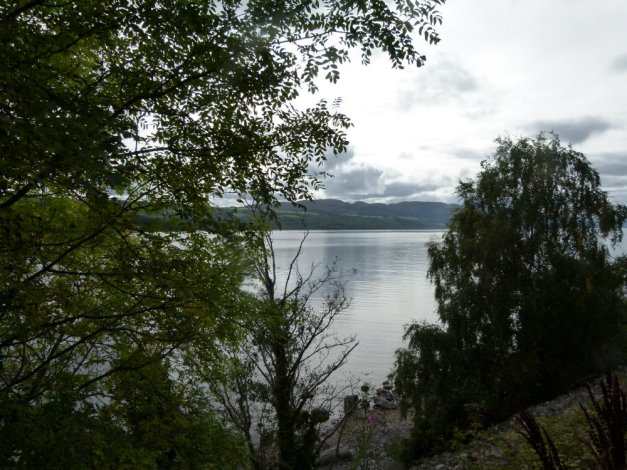
After the incredible experience of Clava Cairns, it was probably just as well that our next destination was not far and would offer no more than beauty to bewitch us. I have camped on its shores and ‘showered’ in its icy waterfalls, but it is many years since I last saw Loch Ness. There is a geological fault in the land here that runs right across the north of Scotland. Aeons ago, glaciers found the weak point and carved the Great Glen out of the earth, almost separating north from south. Loch Ness is the most famous of the interconnected lochs that follow the faultline and, for size alone, the most impressive. It is around twenty-three miles long and 755 feet deep, holding more water than all the lakes in England and Wales together. It also holds a world famous mystery… the Loch Ness monster. Perhaps.

Stories of the monster go back a very long way. The earliest recorded sighting dates back fifteen hundred years to the Life of St. Columba by Adomnán. He records that the saint came upon Picts by the River Ness who were burying the body of a man slain by the monster. Columba sent Luigne moccu Min, one of his followers, to swim in the waters. When the monster emerged and was about to attack, the saint made the sign of the Cross and cried, “Go no further. Do not touch the man. Go back at once.” The beast obliged and the Picts hailed it as a miracle.

Stories, photographs… some spurious, others simply mysterious, have emerged over the years. Opinions are divided about what the monster might, or might not be… or if it exists at all. Scottish waters abound with kelpies, selkies and other magical creatures, after all. But regardless of the authenticity of the stories, ‘Nessie’ is now a major tourist attraction. Sceptical by nature, I am inclined to dismiss a good proportion of the tales, though some remain intriguing… but I defy anyone to stand on the banks of the loch and not scan the waters hopefully for some sign of the monster’s presence.

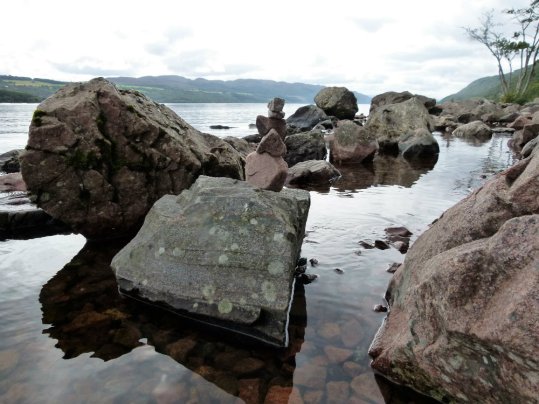
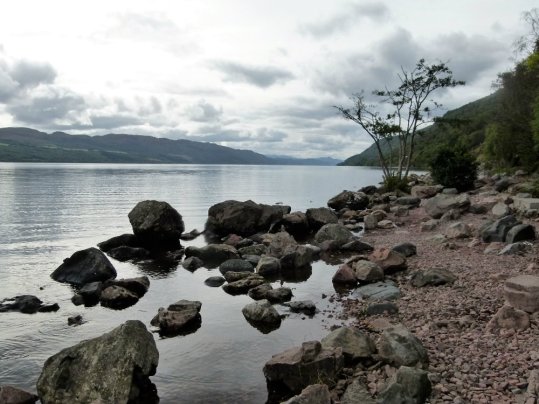
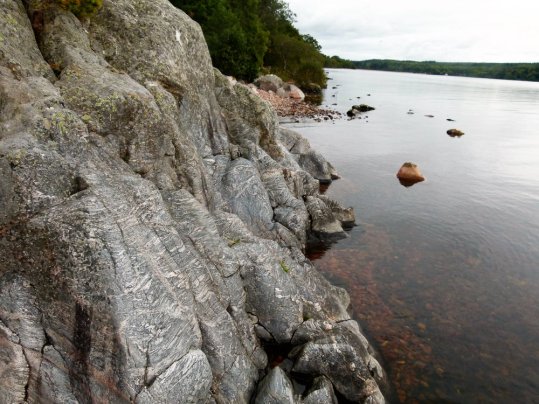
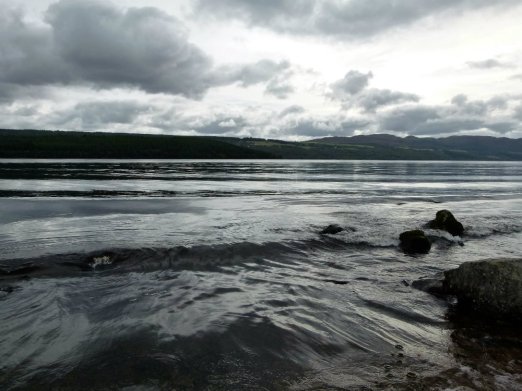
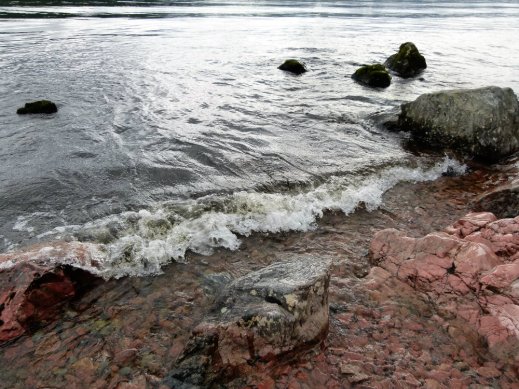
We looked out over the silky calm of the deserted loch, exploring the rocks, some a beautiful pink that seems to glow when the setting sun touches it, others folded, poured and streaked by the forces of planetary evolution. An incredible number of them seemed to echo the shape of the monster, even on our little patch of shore and it is very easy to see how some of them could be misinterpreted in the half-light. Especially when, out of nowhere, and for no reason at all, a long, high swell arises in the smooth, silken water… as if something very large were swimming just below the surface…

We scanned the loch for any sign of a boat, or anything else that could have created the unexpected swell… but there was nothing to be seen. As we watched, the swell rose again, as if a second ‘something’ had passed by, sending waves to disturb the serenity of the shoreline… There has to be some explanation for it… a perfectly rational one… doesn’t there?

We watched until the water subsided and became once again a silent sheet of silk, looking across the loch and wondering where the notorious Boleskine House might be. Its notoriety comes largely from its association with the occultist and writer Aleister Crowley whose reputation meant that tales of orgiastic rites and sacrifices in the woods were inevitable, whether or not they were entirely deserved.

Continue reading at France & Vincent

Posted in adventure, Ancestors, Ancient sites, historic sites, Landscape, Photography, road trip, Sacred sites, Scotland, Spirituality, Stuart France and Sue Vincent, travel | Tagged , , , , , , , | 3 Comments

Mary Smith ~ Writing under lockdown

Reblogged from MarySmith’sPlace :

I’m excited to be a contributor in a new anthology which provides a unique record of life in my Galloway, my own wee part of Scotland, during the first 12 weeks of lockdown.

Writedown: Lockdown in the Galloway Glens at the Time of Covid brings together the work of 22 writers, each with a Galloway connection. It is a collection of prose and poetry, hopefulness, hopelessness, anger, humour and quiet endurance in which the writers tell the story of a community dealing with life in unprecedented times.

The idea behind the project came from author Margaret Elphinstone, when her writing classes could no longer meet. Inspired by the Mass Observation project which encouraged ordinary people to keep wartime diaries, she invited anyone interested to contribute – 22 of us did.

Margaret said: “In times of trouble people want to be together but with lockdown people had to isolate, sometimes living alone. Writing met their need to communicate. Through our writing we entertained and supported each other, sharing fears and unexpected joys and daring to hope for a better future.

Continue reading at MarySmith’sPlace 

Posted in reblog | Tagged , , , , | 6 Comments

Whirling Limbs…

*

…As Abadam and Yva made their way out of the garden in the

east, it seemed as though the leaves of the trees themselves

were whispering: “I will put enmity between you and the

woman, and between your seed and her offspring.

*

You shall bruise his head

as he shall bite your heel,

and he shall bruise your head

as you shall bite his heel.”

*

Continue reading at France and Vincent

Posted in Art, Books, france and vincent, Mythology, Stuart France | Tagged , , , , , | 2 Comments

On the Doorstep: Whitchurch ~ Shadow and Light

No visit to a rural village is complete without exploring the church, especially when these old places frequently date back to Norman times and beyond. Each one of them is not only a place of worship that has stood at the heart of its community for generations, it is also a time capsule crammed with the social history of the area, its art and artists, and memories of the great, the good and the lowly.
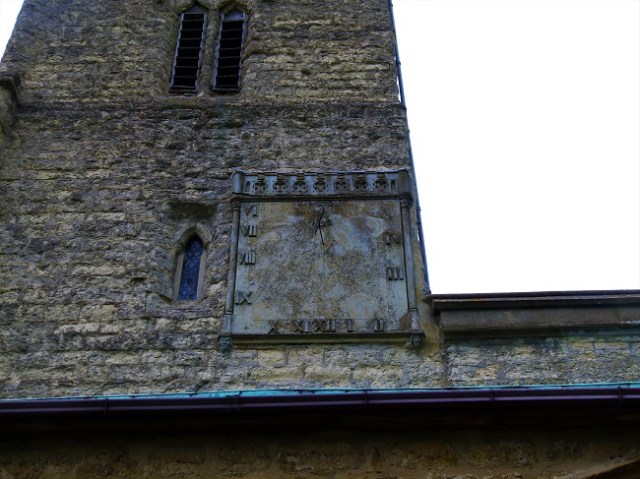
Sadly, the virus and the lockdown has closed the doors of our churches and, given that new ways have had to be found for the Church to reach out to its parishioners, we are concerned that many of the smaller, less well-known, well-attended or well-funded places may never reopen their doors. Covid will cast a long shadow…
Over the past years, Stuart and I have visited and documented hundreds of sacred sites and places of worship, creating a photographic archive upon which we have drawn for the blogs and our books, as well as a written record of our personal impressions for many of them.  We could not revisit the Church of St John the Evangelist at Whitchurch in person, but we could go back to that very first year of our adventures in the landscape and dig out the photographs… at least one of which was mentioned in Heart of Albion, our second book together.
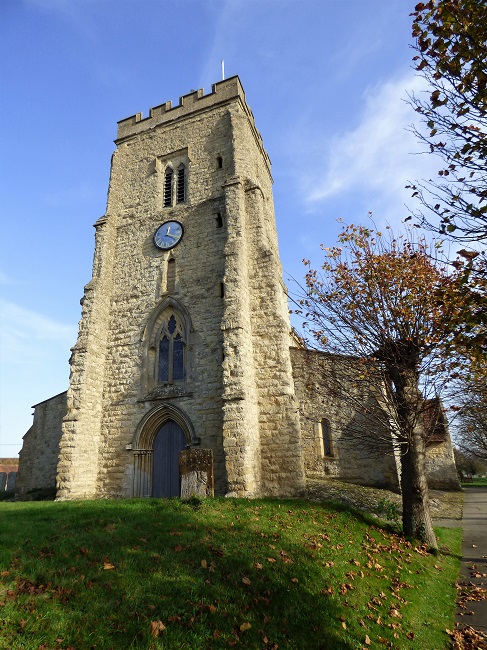
There has been a church on the Headland above Whitchurch since at least the end of the tenth century… and for who knows how much longer than that. The current church, though, dates only to the thirteenth century, with all the usual later alterations and additions.
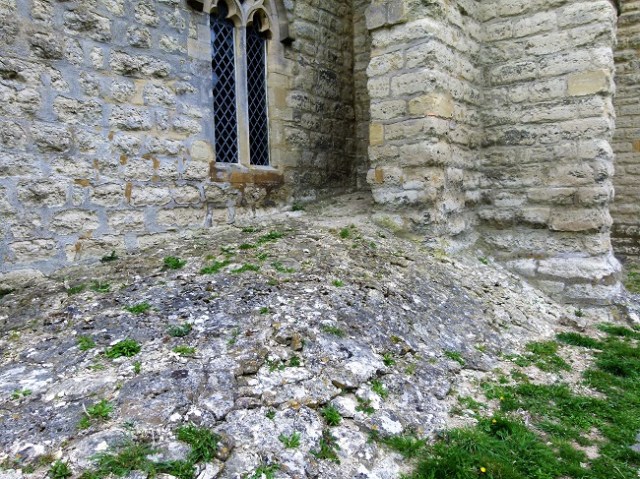
Outside, you cannot help but be struck by the two apparently random upwellings of rock that appear to hold the fourteenth-century tower in their grasp. I have never seen anything quite like this before, and the nearest I have seen since is the rocky outcrop at St Clements on the Western Isles. But whereas the latter is natural, I have a feeling the mound at Whitchurch is man-made… as some kind of buttress, perhaps.
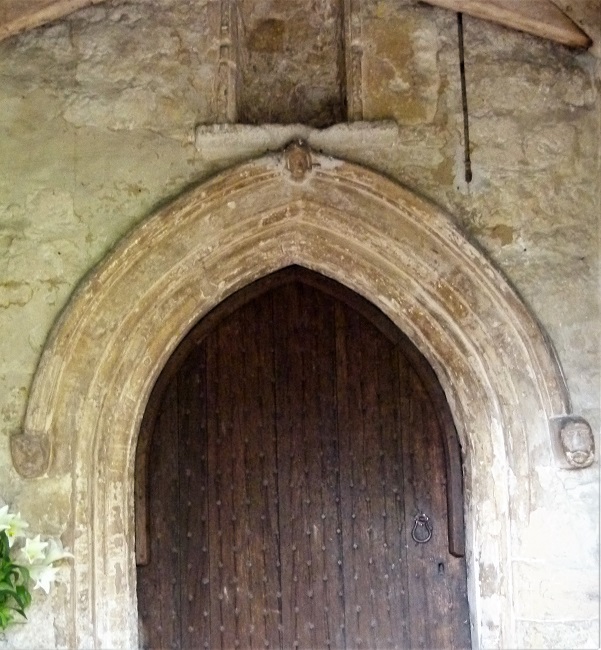
The hooded doorway, with its niche above and three heads is protected by a much later porch and you can trace the progression of the centuries through the styles and additions of each era. Many of these renovations and changes were paid for by the local gentry and were very much subject to the changing whims of fashion.
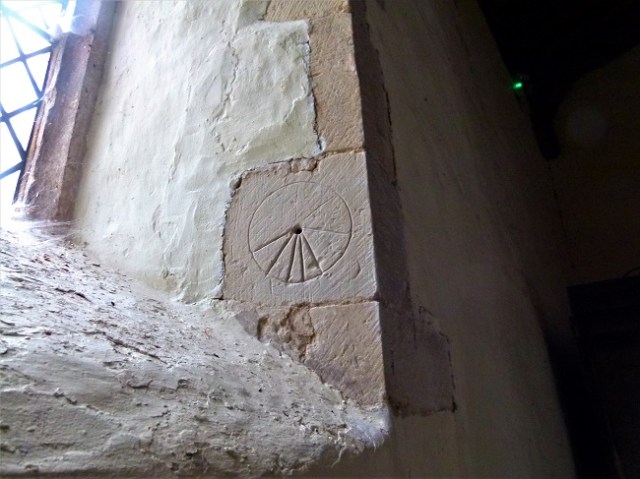
On that first visit, we knew nothing and had all this to learn. I can still rememberhow excited I was, finding yet another of the strange dials carved into the wall. We had worked out that it was some kind of mini-sundial…and probably used for marking periods of  worship. It was only later that we learned how common the scratch dials or Mass dials were in the mediaeval era.

Whitchurch is a large church for its current village, but it was built to serve a population with a castle and a thriving industry, at a time when everyone went to church and was subject to its rule.
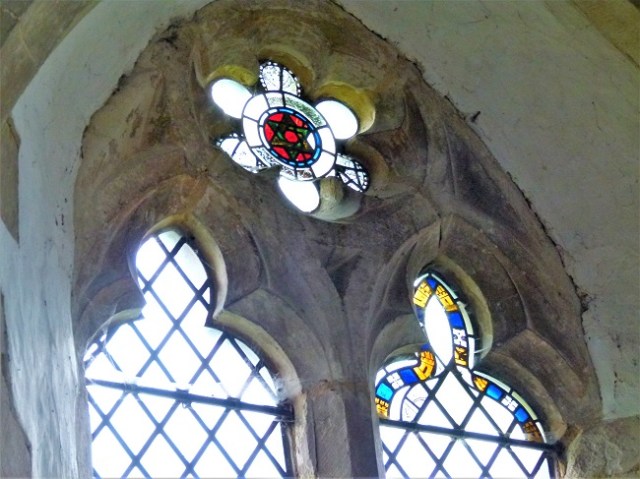
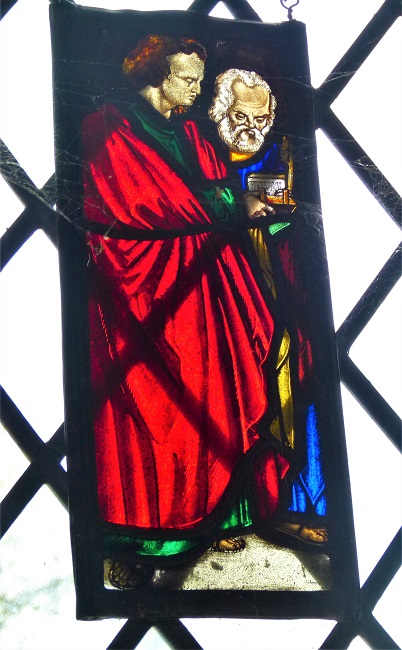
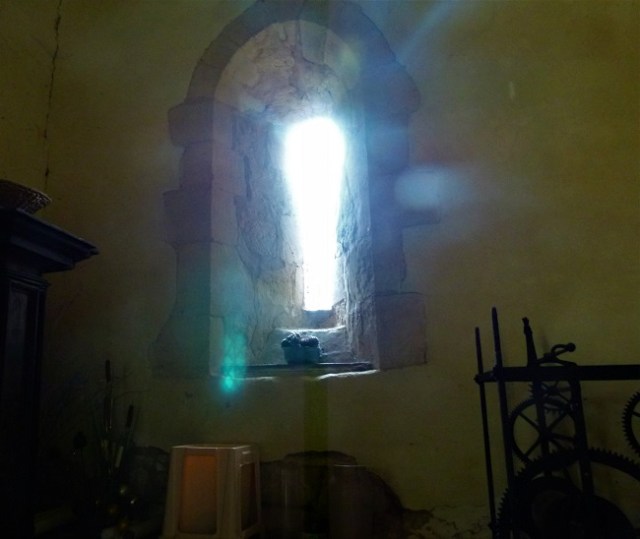
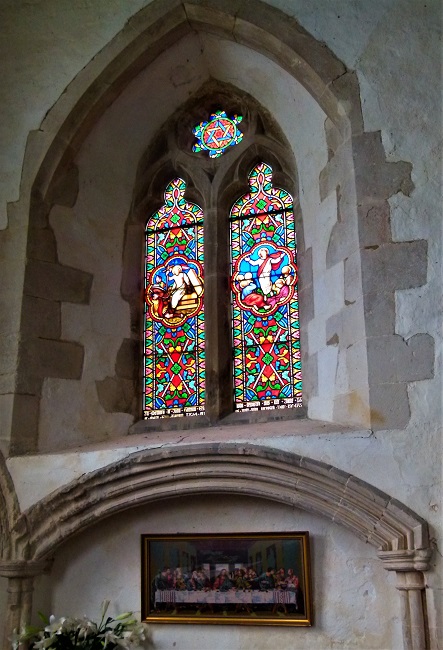
We wandered around, taking in details like the missing memorial brasses in the flagstones of the aisle, the traces of mediaeval wall paint and fragments of older glass lodged within the tracery of the windows. You have to wonder if Cromwell’s lot were responsible for smashing the glass here as they did at so many other ‘idolatrous’ churches throughout  the land… and realise that yes, they probably were.
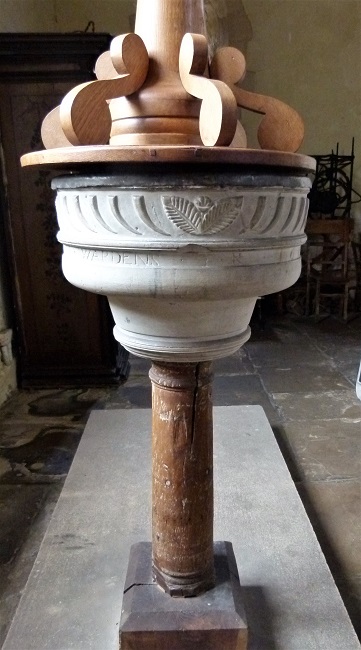
The font is a curious affair, looking hugely top-heavy beneath its modern confection of a cover. And to inexperienced eyes, that was probably all there was to see. Which just shows how wrong you can be. Quite apart from all the details we had yet to learn about… like the difference between a sedilia and piscina… are all the things you can only learn by “being there.”
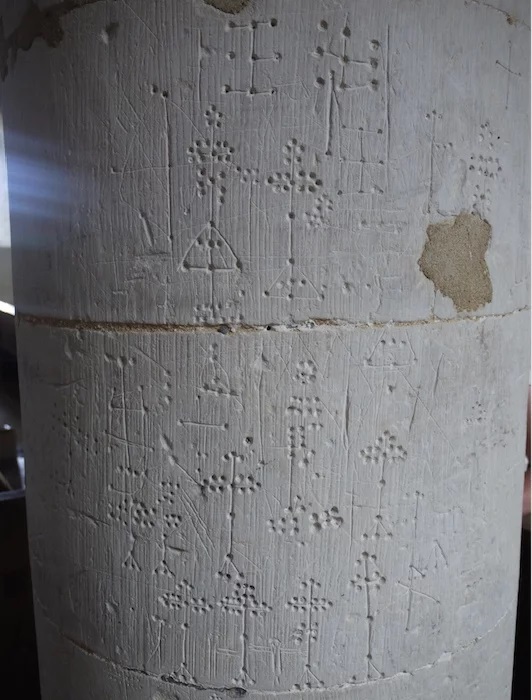
And sometimes, years later… researching the basics… you come across something that you had missed completely, that makes you squeal and means you really do have to revisit yet again… as soon as the church reopens. The local guides say the patterns were carved by Jesuits. Some of them look like the simple games that were played behind the pillars during boring sermons. The photographer and author of the article where I found the picture suggests the Templars…

Copyright © Jerry Glover at Lost Grafitti of the Templars

And then your head is reeling with possibilities, thinking of the Templar holdings just half a mile away at Creslow… of the Headland and the Head Well and all the other Templar associations… and wondering this if all this is on the doorstep, why on earth would you need to go farther?
 

Posted in Photography | Tagged , , , , , | 15 Comments

Peace #midnighthaiku

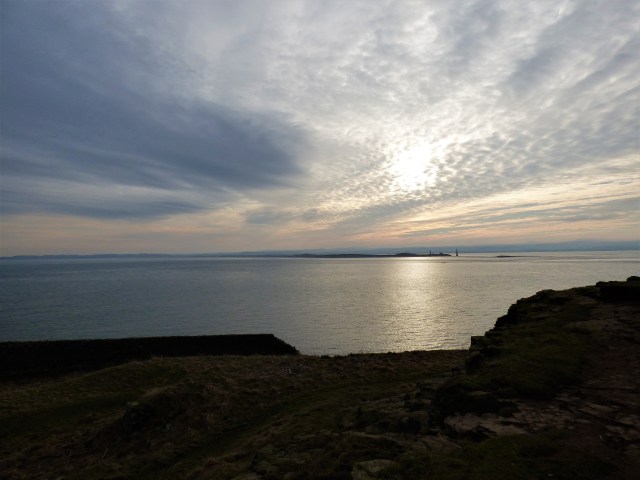
Opalescent calm

Within and without aligned

A pearl beyond price

*

Posted in Photography, Poetry | Tagged , | 11 Comments

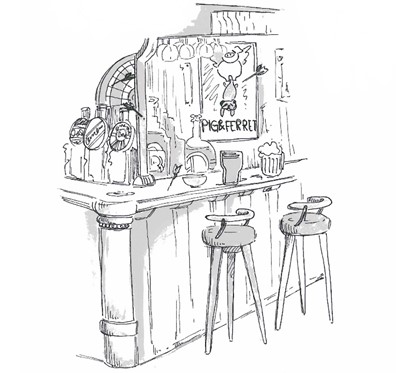
Quick Pint at the Pig and Ferret Pub ~ Usual Muttwits


“Checkers? Who’s askin’ then?

Useless mutt. Was normal when ‘e ‘ad four pins, lyk, but now..? There’s a reason I never bring him down the P and F. Three legs! Enough to put yuz off your pint and scratchlings, init!

But ‘is talents lie elsewhere, know wot I mean? Wot helps with the lawful apprehensions of street mutts, trainings of sheep dogs, and security of me valuables – erh guests wotz living on me farm and lookin’ out for happy families to buy ’ems.

Nah, Checkers does alright if I keep him to the straight and narrows with a light kicking.

Coming 18th November…

a new story from the Usual Muttwits!

Posted in Guest post | Tagged , , , | 6 Comments

Solstice of the Moon: Circles Within Circles

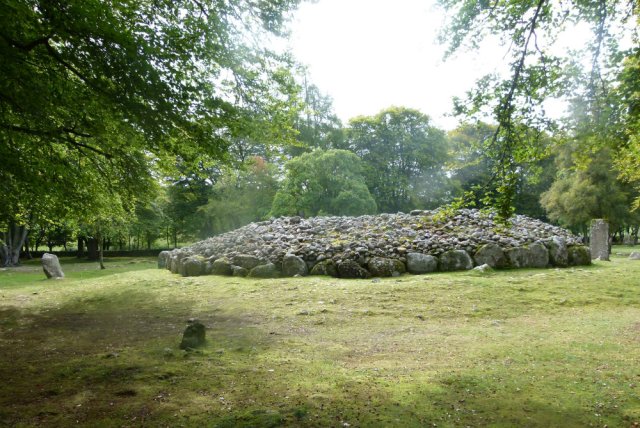
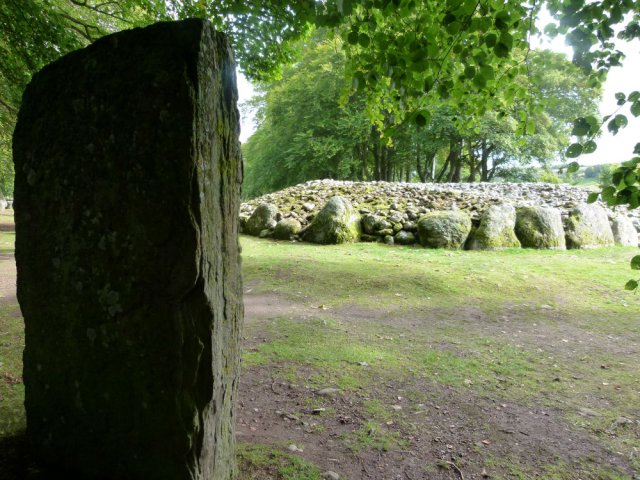
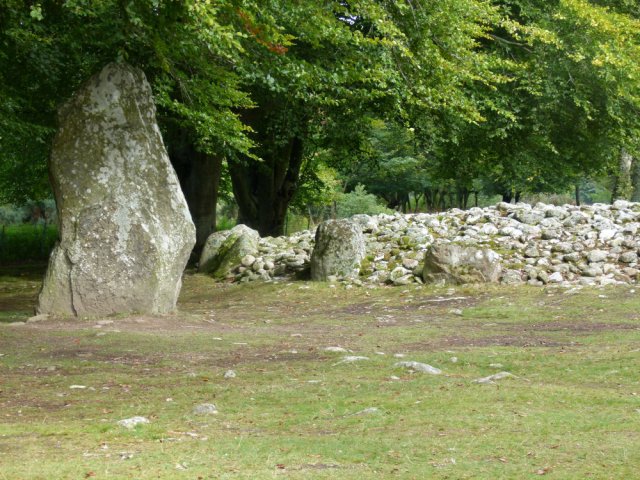
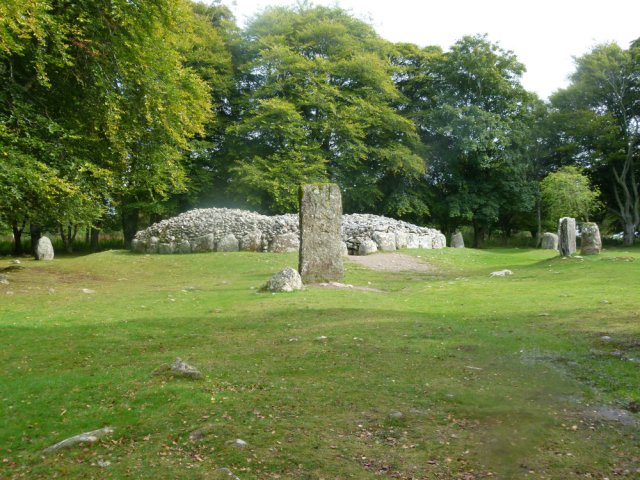
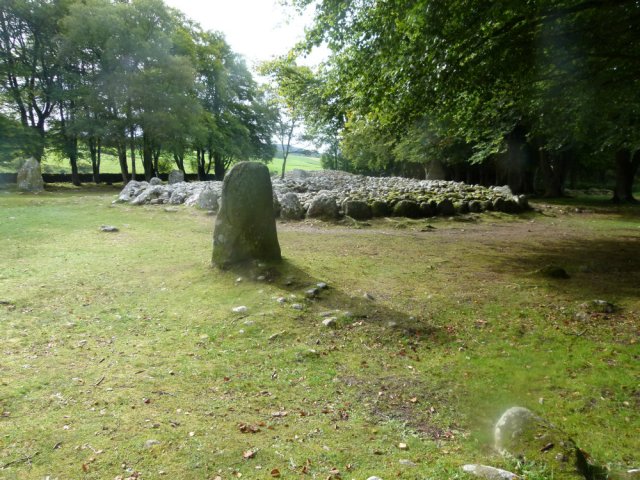
“I don’t know how you have the temerity to even think about writing up Clava… The place is on a different planet… galaxy… something…” All true. I have no idea where to start… it is a place that needs more than words, but words are all I can bring to the page. It is beautiful too, with the white stones contrasting with the green of the grove of trees in which the cairns now stand. In many ways, I’d just like to forget all the factual stuff and wax lyrical about the place, but it does have to be seen in a historical context before the sheer awesomeness of the place can even be touched.

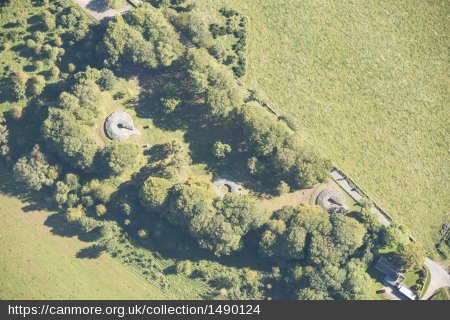
The problem with Balnuaran Of Clava, the Clava Cairns, was immediately obvious… in spite of the fact that it lies just outside of Inverness and therefore over five hundred miles from my home, we would need far more than one flying visit to even begin to get our heads around it. It is a big site, with a group of three principal cairns, all with circles of standing stones around them. Sounds simple enough… but that is far from the truth.

A cairn is a burial mound raised over the dead. Some have a central chamber, others are more in the nature of simple grave markers. They are made by piling up stones and some may then have been covered with earth or turf.

Most of the cairns we encounter these days are small; the larger cairns have all too often been robbed for building stone over the centuries, or are in such disarray that it is almost impossible to get a true sense of how they would once have looked. Here, there is no such difficulty… nor are they just simple piles of stone.

They are beautiful and complex feats of monumental architecture that date back to the Bronze Age. There are many similar cairns of this design still dotted around the landscape of the area. A central chamber, walled with carefully laid stones, held the remains of the dead. Where those remains have still been present when the tombs were excavated, it seems that these great cairns were designed to hold only one or two people.

The Neolithic passage graves which were their forerunners were places of communal burial and communion, where the bones were carefully stored and ritually revisited. Here, many of the surviving cairns seem to have been built with no entrance, reflecting a change, both in the way the dead were viewed and the way they were treated within the community.

Continue reading at France & Vincent

Posted in adventure, albion, Ancestors, ancient mound, Ancient sites, france and vincent, historic sites, Photography, road trip, Sacred sites, Scotland, Stuart France and Sue Vincent, travel | Tagged , , , , , | Leave a comment

The Incomparable Comper…

*

The nearest church is St Nicholas’ of Great Kimble so we head off there.
“Why blue specifically do you think?”
“Well, we’re sort of assuming that it’s a healing energy but if we follow the Theosophists then I suppose it could be devotional.”
“And what are we expecting at St Nicholas’s?”
“To be honest I’ll be surprised if there is anything.”
“What, nothing at all?”
“We were given Our Blue Chapel, remember and I just think that it is special.”
“Well it certainly feels special but it will not be the only church built on an old site, I mean it went out as a definitive edict, to ensure the populace kept coming to the old sites they built their churches on top of them.”
“It very much depends on what has happened in the meantime.”
I hasten along the gravel path, and enter the church porch, pause, look back at Wen as mysteriously as I can, and then twist the iron door ring with a yank and lean into the heavy oaken door.

The door yields…

Continue reading at France and Vincent

Posted in albion, Ancient sites, Books | Tagged , , , , , , , , , | Leave a comment

The Alchemist… Stuart France

L'Alchimie de Notre Dame de Paris – La Nuit / La Nuit

A drawing by Julien Champagne.

*

Why would the Mediaeval Stonemasons sculpt figures

on the top of their buildings which no one can see from the ground?

*

Like some church towers, it was possible to scale

the towers of Notre Dame and acquire a closer view

of the sculpted forms which adorned its roofscape.

*

Continue reading at France&Vincent

Posted in alchemy, Art | Tagged , , | Leave a comment