 It was a familiar church, one into which we had eventually been able to gain access twice. A third visit, with plenty of time to look around, would have been wonderful. On the first occasion we had managed to get inside, we had been privileged to have the ancient door unbarred for us by the gentleman showing other visitors around the building. On the second occasion, we had once more entered that way, although this time, we had arrived as the church was being dressed for the Harvest Festival. But COVID has closed our churches, for both worshippers and visitors alike, and this time we would have to make do with a walk around the outside and a rummage through my archive of photographs.
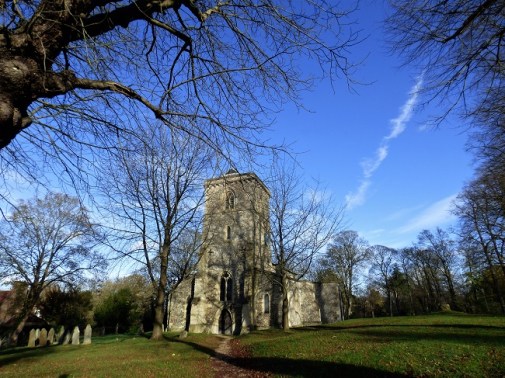
Holy Trinity church dominates the little village of Bledlow. Tall, stately trees border the churchyard, but do nothing to hide a building that seems too large for its setting. We find this often, and the smallest of villages may hold a church whose size and style hint at a shift in the political importance of a place or its people over time.

Bledlow today is a small place, boasting a manor and some lovely old houses. Its name is thought to come either from the Old English for “Bledda’s burial mound” or from “Bled-Hlaw” meaning “Bloody Hill” in reference to a battle between the Saxons and Danes. If it refers to the former, then there is an ancient burial mound on Wain Hill, near the chalk-cut cross half hidden now on the hillside.
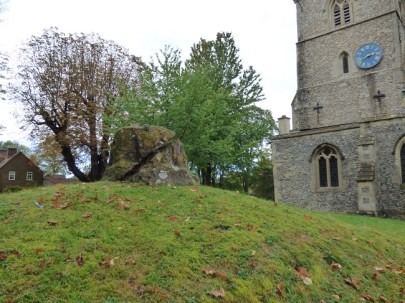
Outside of the church, on land raised by the number of burials it contains, stands the base of an old stone cross dating to the fourteenth century. In the early days, when churches were seldom built of stone, these crosses were often placed outside the poorer churches to mark them out as places of worship. Holy Trinity, though, has been well endowed and maintained, probably by the lords of the manor across the centuries.
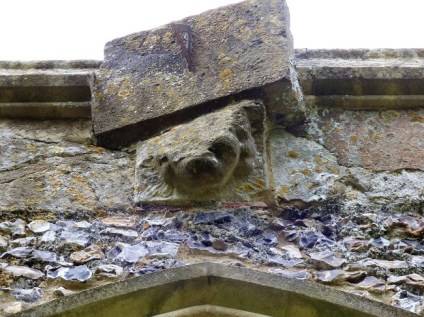
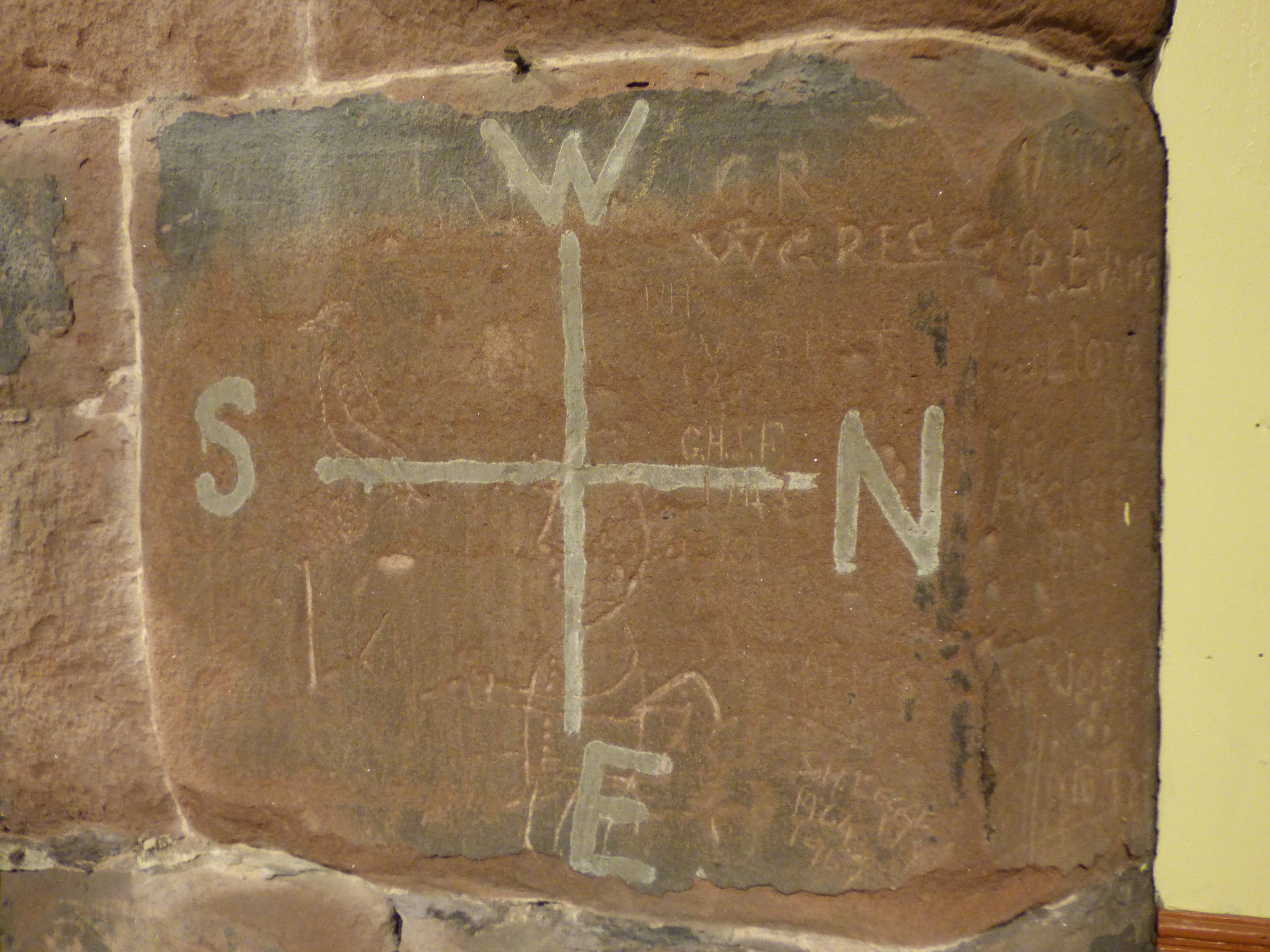
There is plenty to see outside, though, if you take the time to look. The porch on the south side appears to be the main entrance, although it is usually locked and barred. Above the porch is a small sundial and a worn head that looks to be a lion mask.

Within the porch, there is a holy water stoup tucked away in a corner, from the time before the Reformation when all churches followed the Catholic rite and the holy water would have been used to make the sign of the Cross before entering the church. Like the statuary and medieval stained glass in many of our older churches, many of the stoups were destroyed by Oliver Cromwell’s troops, but this one has survived.
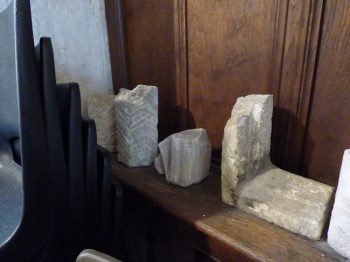
The nave of Holy Trinity dates back to the 1100s and an earlier church on the site. The aisles were added in the twelfth, the clerestory (the small, high windows above the nave) in the thirteenth and the porch a century later. Most of the building remained untouched until the inevitable Victorian restoration carried out by Sir George Gilbert Scott, but from outside you can see where the pitch of the roof has been altered.
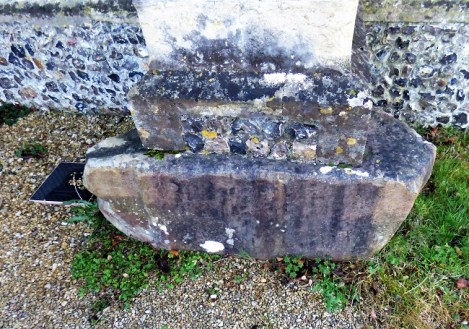
There are a couple of features outside, though, that should be mentioned. One is the sarsen stone, used as a footing for one of the buttresses. It looks completely out of place, being the wrong size and shape to go unnoticed. The suggestion is that it was a large, random stone they just used ‘because it was there’. This makes no sense to me at all. Why, when such care was taken over the rest of the church, would the builders incorporate a random boulder? Why would they not move it or work it, carving it into something more appropriate… or at least hiding it within the foundations?
At Chesham, not too far away, there are similar stones, forming the foundations of St Mary’s church. These are recognised as being part of an ancient stone circle, predating Christianity by millennia. It is well documented that Pope Gregory, in the sixth century, instructed his missionaries to adopt the old pagan sites, rather than destroying them completely, incorporating them into the new places of worship. It is also true that sarsen stones were used in the building of many of the ancient sites, including Stonehenge.
It makes more sense to me that the sarsen stone built into the base of the buttress is a survival from an earlier, pre-Christian site of worship or celebration. Not only would its inclusion in the building associate the site permanently with its previous gods, but building into the base of the church, with the whole weight of the edifice resting upon it, would symbolically put such pagan beliefs firmly in their place… a message the locals would not miss.

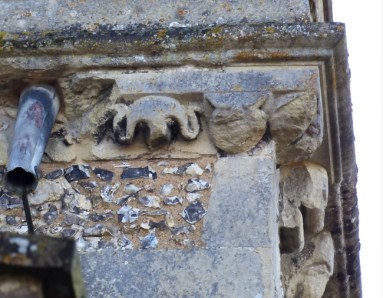
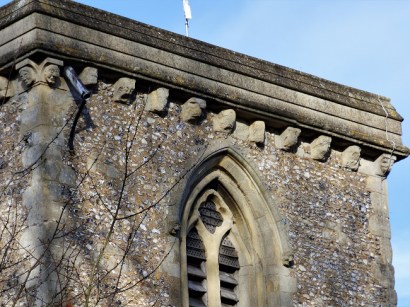
The other feature is the corbel table around the top of the tower. Many churches have carved heads as part of their decoration, whether as gargoyles… part of the plumbing to carry rainwater away from the building, or as grotesque masks. Inevitably, over time, the weather erodes the stone and many of these carvings are simply washed away. We have seen many corbels that are portraits…and occasionally caricatures… of local dignitaries, their names and stories lost to antiquity. Lord Carrington, the lord of the manor until his recent death, now adorns the tower. I wonder if the church will still be standing… and if his lordship will still be remembered in another thousand years?

Press a button or two to share... go on, make my day :)






 Dear Santa,





















 Sue Vincent's Daily Echo