I’m in bed, desperately trying to get to sleep. It is after midnight, I’m warm and cosy, I’m more than tired, I have a long day ahead… and I am going to have to get up and get back on the computer. Words and images are dancing on the inner screen and giving me no peace.
I know what did it… We had been talking about censorship… the banning of books, the tearing down of statues, the demonisation of past heroes because they no longer meet our strict criteria of modern mores. It had been compounded by opening a book I love but which was written well over a century ago. The language, by modern standards, is hard going, although the ideas expressed are crystal clear.
We forgive the archaic forms of speech, knowing them to be the literary language of the time… taken in context, there is no other way in which the prose could have been written. In spite of the wording being as heavy as lead, I read the book sometimes and quite specifically for its main subject matter and clarity of thought, but, like any book written in another time, it has also become something of a mirror, highlighting a raft of social conventions which would not be acceptable in today’s world.
The book’s modern copies carry a disclaimer, pointing out that the author, some of the terms used and a few of their social beliefs were, quite simply, a product of their times. Times that have changed and, in many ways, moved forward, making many once – acceptable, even widespread beliefs, seem either absurd or downright offensive. While we readily forgive a writer for using outmoded language in books written when such usage was the norm, we are less able to forgive the discrepancies between then and now where social mores are concerned.
Can we dismiss knowledge and wisdom… or even talent… because the artist uses a phrase we would now expunge or condemn? Condemn the artist for the accepted normality of his era? Dismiss the work because the artist lived a century before us? Even where we now see a gross injustice or appalling wrong, I don’t think we can afford to do that… all change has to begin somewhere, and it cannot begin until enough of us take notice and say ‘no more’.
The book in question was written as fiction, yet the story conceals and reveals truths we can explore by engaging both the imagination and the emotions… a method of storytelling we also use in our books today. Thinking about it reminded me of yet another vintage book, one of my very favourites, The Little Prince, written and illustrated by Antoine de Saint-Exupéry.
The illustrations are deceptively simple. One of the first pictures in the book looks like a hat…
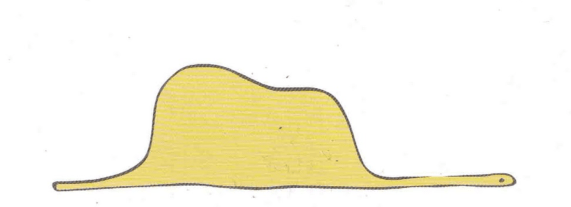
It is, of course, not a hat, or what would be the point of it? But any grown-up casting no more than a cursory glance at the image could be forgiven for thinking that it is a hat. They might even make unconscious and snap judgements about what kind of hat, or even, by extension, the person who might wear it, their social bracket and potential occupation. They would probably forgive the lack of skill and symmetry, deciding that the artist must have been a child who knew little better, instead of taking a closer look and paying attention.
For the hat is not a hat. It is an elephant. But it looks nothing like an elephant…until you realise that it has been swallowed by a boa constrictor. Due to the limited nature of many adult imaginations, the illustrator made his point quite clear…
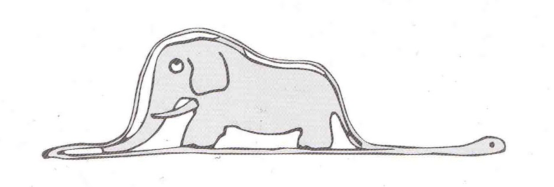 By this time, I have risen from bed and am trying, with the half-awake brain to capture the clarity of thought of the half-asleep one. It had all made sense in the dark…
The grown-up who pays attention, not only to the drawing, but to the source of the drawing… the artist… might learn a good deal about both the subject and about the life and times of the artist.
These days, for example, few people wear structured hats, so a hat might not even be the first thing you think of on looking at the image. Back then, desert hats, trilbys, Panamas… hats were common. A social necessity… a product of their times. We wouldn’t decry the writer or artist’s work because fashions have changed.
By the same token, I don’t think we can afford to dismiss or to arbitrarily censor works from the past in which characters hold views diametrically opposed to our own or to modern perspectives. It is from the shock we might feel, for instance, on reading a hitherto favourite character express themselves in terms we find objectionable, that we will start to take notice of how such views are still being expressed and sadly, believed in our so-called and overly ‘PC’ world.
We need to see how insidiously the written word can shape our prejudices… as well as how it can highlight them in order to allow them to be excised and eventually healed. We need to know and remember, not erase from the past, the horrors humankind has perpetrated on itself through misjudgement and a misplaced sense of superiority. We also need to separate the fact from the fiction, the writer from the work. Few of our greatest artists have led blemishless lives, in fact, many of our greatest artists have pushed the boundaries of outrage… and yet their works have become treasures.
We can condemn the acts of another human being as being wrong, and yet appreciate their talent in holding up a mirror to a time, a place, or even our own faults. We can allow their blindness to open our eyes, for it is from the mistakes and the errors that we learn. And if someone has made and highlighted those mistakes, however unconsciously, in the time before we were… is it not better to learn from them than to have to commit the same mistakes ourselves?
Press a button or two to share... go on, make my day :)




















 Sue Vincent's Daily Echo