Little gems – All Saints, Burton Dassett I

fenny compton 001

Frankly, this is another where I don’t know where to begin. I suppose I ought to begin at the beginning. Monday I was back from the north, Tuesday I was driving northwards again… not as far this time, just an hour up the motorway to meet friends for lunch. They were visiting from the US and it was their last day… so we arranged to meet at the Merrie Lion, in Fenny Compton for lunch. Then they had something they wanted to show me. On their last visit, our time together had been cut short by the notorious exploding coffee pot incident. It was noticeable that we stuck to cold drinks this time. I had, however, had time to show them Rollright and a little of the Cotswolds. This time we were just south of Coventry and they were to be my guides.

fenny compton 008
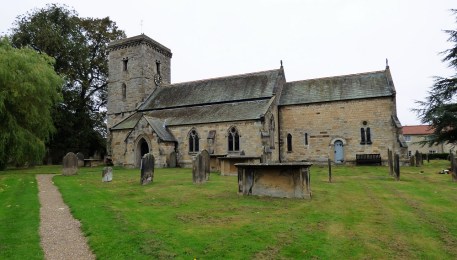
I followed their car down a winding lane with interesting bumps in the fields and we pulled up outside a church in the middle of nowhere, or so it seemed. Obviously, this had not always been the case. The first thing you see is spring rising from the earth, sheltered by a well house, then you walk between the trees to what might, at first glance, look like a pretty, but unremarkable parish church. But if the outside looks ordinary, the inside is anything but!

fenny compton 169

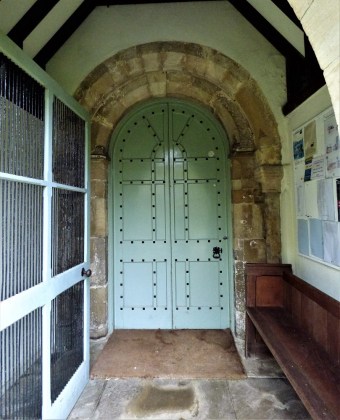
Inside the porch you are faced with a Norman arch… fairly late and less ornate that the older ones, but still Norman and marked on the uprights with centuries-old pilgrims’ crosses. At this point an Ani lookalike bounds out of the church to say hello… smaller, but almost identical in expression and demeanour. By the time you have stroked the dog to its ssatisfaction, you are inside the church. From the door there is, at first glance, nothing remarkable… then you start looking, and seeing, and the place becomes an incredible treasure trove.

fenny compton 171
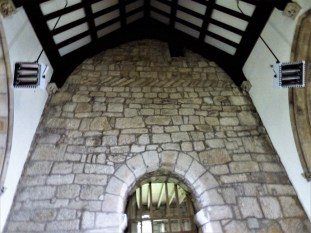
The church of All Saints’, Burton Dassett, dates back to the 12thC, with additions made in the 13th and 14th centuries… and although it has witnessed the many changing faces of faith in this country, it remains completely unspoiled and beautiful.

fenny compton 070
The owner of the dog turned out to be one of the church wardens and he kindly shared some of the history with us. By this time I had spotted the carved capitals, the medieval floor tiles and a dark patch on the wall of the aisle opposite that was unmistakeably early wall painting. I couldn’t hold it together any longer and was almost squealing with excitement… I excused myself, switched on the camera, and indulged.

fenny compton 025
From the door, it was the capitals that got me. Facing me ‘a kind of green man’, said the warden. Birds and beasts populate the other pillars of the north aisle… hares and foxes, all the animals of the countryside… and some I would not expect to meet in the English landscape this side of the Veil. Of particular note was the scaly figure with the human head and a dragon’s head on its tail that looks like a cross between a harpy and a manticore.

fenny compton 033
Around the corner is a side chapel holding an ancient tomb, littered with prayer requests. Beside it stands an altar, though to be the original altar slab and bearing a bible open at the Gospel of John. In the corner, halfway up the wall, the old stairs to the rood loft remain. All of which would have been enough without the wall paintings…

fenny compton 048
The whole wall is covered in layers of patterns painted in earth tones against the white, but the window embrasure quite literally takes the crown. On one side a kingly figure, holding what may be a reliquary or a gift.

fenny compton 041

It is thought to be one of the Magi… though why this should be so, and why only one, is not explained. Other experts suggest it could be St Oswald (c 604 –642AD) the Northumbrian king and saint, killed fighting against Penda of Mercia, the last pagan king… both of whom featured heavily in our research for the Doomsday series, the final volume of which, Scions of Albion, we had just published.

fenny compton 128
On the other side is a curious figure of another crowned figure, holding his own severed head and coming eye to eye with it. I have to say, the severed head doesn’t look too pleased about it either, in fact, their joint expressions seem to tell a bit of a story. This one is thought to be St Ethelbert, beheaded when he tried to woo the daughter of Offa, king of Mercia. And all that was only half an aisle and the north transept…I took a lot of pictures… and only a few are shown here. There was yet more to see…

This slideshow requires JavaScript.

Posted in Ancient sites, Art, Churches, England, History, painting, Photography, travel | Tagged , , , , | 13 Comments

Di from pensitivity101 reviews Midnight Haiku

What can I say?
I started and carried on until I’d finished.
I have always enjoyed walks in the forest, along the beach, or through parks. We miss so much in our daily lives, taking it for granted and not really paying attention.
The way Sue has put the collection together takes us from our surroundings into a world of Nature and awareness of everything around us.
I turned out the light feeling relaxed and mellow, any tension having just melted away.

Continue reading at pensitivity101

Posted in Books, Photography, Poetry | Tagged , , , | 9 Comments

‘Fly away home…’

derbyday 490The ladybird was swimming desperately as I scooped it out, feeling that little rush of warmth at having rescued the tiny creature from a watery death. It wasn’t happy, but I placed it on the side of the sink to dry out while I soaked. I would take it outside when I was clad in something more decorous than a towel.

From my supine position in the steam, I could see it begin to move, flexing its legs and shifting on the slippery surface; a tiny splash of colour against the porcelain. I like ladybirds. As a child, they always fascinated me and I was almost offended when I read that they could bite. Surely… they wouldn’t?

They are called ladybirds, apparently, for the Virgin Mary, who was often shown cloaked in red in the early paintings. The seven spots of one of the commonest types were said to symbolise her joys and her sorrows. There is an older association, with the Norse goddess, Freya too; it is said the ladybird came to earth riding a bolt of lightning There is a lot of old lore about them… as predictors of weather, for instance. It would rain if one fell into your hand. It is true they do not fly when the world is chilled.

Continue reading at The Silent Eye

Posted in consciousness, Spirituality | Tagged , , , , , , | 15 Comments

Small #midnighthaiku

small miracles poised

waiting for acknowledgement

engineered for flight

perfection designed

inspiring awe and wonder

vive la difference…

their diversity

we do well to remember

just echoes our own

Posted in Photography, Poetry | Tagged , , | 23 Comments

Smorgasbord Stories – A return to Tales from the Irish Garden – Winter: Chapter Four – The Flight to the New Land – Sally Cronin

Reblogged from Sally Cronin at Smorgasbord:

As I am going to be in full on writing mode for the next couple of months and it is a over two years since I last shared Tales from the Irish Garden.. I thought I would it bring it out of mothballs for those of you who might have missed the first time around..

Last Sunday The pigeon messengers returned from The Emerald Isle with an offer of a new home for the royal court in the magic garden of The Storyteller…time is running out and now the court has to move, lock, stock and barrel…

Winter: Chapter Four – The Flight to the New Land

Back at the Palace it was pandemonium, with fairies flying around in a discordant symphony of gossamer wings. Finally, after a day of panic, Queen Filigree ordered her advisors to bring all the members of the court to the ballroom so that she could address them. She also summoned Jacamo the pigeon master, the Queen Bee from the royal hives and Sir Gregory’s chief butterfly messenger; all of whom were essential to the planning of this massive migration to the new land.

‘I want you all to sit down on the chairs provided and close your eyes for a few moments to compose yourselves.’ Queen Filigree looked around the ballroom to make sure all complied with her order. When all the fairies were sitting calmly, she took a deep breath herself, and then issued the following edict.

Continue reading at Smorgasbord

Posted in fiction, reblog | Tagged | 6 Comments

Annette Rochelle Aben reviews Midnight Haiku!

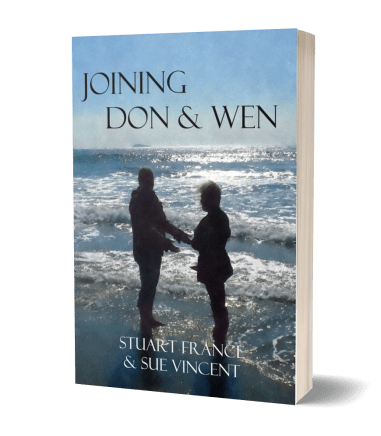
A lovely first review for Midnight Haiku… from Annette Rochelle Aben, herself the author of “A Haiku Perspective” and many other books… Thank you, Annette!

Allow yourself to explore nature through the words of a most gifted poet, Sue Vincent. Haiku’s format is designed to paint a word picture and Vincent does this with more than skill, she does it her heart. Through her intuitive connection to the world around her, Vincent brings us into that world and we are immediately at home. Each time you read this book, you will find a new favourite, so please, read it over and over. Feeding the soul, Midnight Haiku is a banquet!


Midnight Haiku

Sue Vincent

The photographs and the three hundred and sixty five poems within this book collate a year’s journey in poetry through the seasons and the intermingled landscape of mind, body and spirit.

fragmentary thoughts

seeds borne lightly on the breeze

pen captures whispers

The poems were originally published as “midnighthaiku” every night at the appropriate time, leaving behind, like Cinderella, a trace of a day’s passing and a glimmer of the day yet to come.

Each poem can be read alone and simply ‘on the surface’. Many can be read in sequences that add an extra dimension to the wider human tale contained within these pages.

But each poem has its own layers of meaning too, waiting to be discovered by those who turn their attention to the heart.
Available in Paperback and for Kindle via Amazon.uk, Amazon .com and worldwide.

Posted in Photography | Tagged , , , | 15 Comments

Little gems – Burton Dassett Hills

Six years ago, when we could still travel the land and explore wonderful old places, friends came over from the US and we spent a day in the hills. It is a strange place… and I have since learned of various even stranger links to a Grail mystery. There is also a church there that s more than worth a visit, so over the next few days, wander out with me to revisit Burton Dassett…

burton dassett hills

I still couldn’t get over the church. My friends were beaming… they had certainly found a beauty to share with me. But they hadn’t quite finished. Tracey, an Englishwoman, had grown up in the area and knew it well. She suggested we have a look at Windmill Hill, so we piled back into the cars for the short drive. The landscape either side of the track was very strange; rutted and rippled like the surface of a pond.

burton dassett hills

We drove between two hills and parked by a third where a round tower stands proud on the summit. Though to have been a grain store at some point in its history, it is this that gives the hill its name. The doors are blocked now, filled in with stone and modern mortar. My friend recalled being able to go inside as a child.

burton dassett hills

The view, however, is still there and spectacular, looking right out across Warwickshire. On an adjacent hill, a farmer was herding his sheep. Below us, a few people were flying model aeroplanes… or attempting to in the blustery wind. The wheat in the fields looked like billowing silk or blown water in the wind. It is an old landscape, almost untouched, it seems, apart from our fields and lanes. Flint tools have been found here, evidence of a Romano-British settlement and traces of an Iron Age village.

burton dassett hills

To the other side we could just see the tower of the church peeping above the trees. Looking at the lansdscape on the top of the ridge, it seemed obvious that it had been worked. Quarry trenches and fragments of old walling are responsible for the odd appearance. Tracey pointed out the mound known as Gibbet Hill. Thirty-five Anglo-Saxon skeletons were found in an excavation of one of the trenches, thought to be the remains of criminals, possibly executed, but certainly gibbetted here. A further skeleton was found near the grain store.

burton dassett hills

But the afternoon was drawing on and my friends had an early morning flight back to the States. Failing to find a cream tea (look, it’s allowed on their last day!) we reapaired to a pub next to the canal. A pub, moreover, that, if it lacked Stowford’s, sold Old Rosie… and did a nice line in strawberry pavlovas with ice-cream. It had been hours since lunch…

fenny compton 236

Over the excessive and delicious calories, we talked, catching up on the news. There was not a lot of time… nowhere near enough to really catch up. That is the trouble when friends live the world over. The shrinking world of technology allows us to meet people from across the globe in a virtual environment, but when those avatars become people, and friends, distance makes itself felt.

fenny compton 239

Then it was time for the goodbyes and the hugs and promises of ‘next time’. I could probaly hug my way across America these days, greeting friends I see too seldom, if I ever manage to get there. It had been a lovely afternoon, but it was time to head home and get back to work… even the barges were in on that…

fenny compton 243

Posted in Ancient sites, England, Friendship, Photography | Tagged , , | 38 Comments

Magic #midnighthaiku

random memories

conjured from dusty archives

giving birth to smiles

*

Posted in Books, Photography, Poetry | 26 Comments

My Mother’s Hands

A repost of an old poem in honour of Mother’s Day here in the UK… perhaps more poignant this year than ever…

Study of hands - Leonardo da Vinci


I see my mother’s hands before my eyes

The first caress that I had ever known,

And with a thrill of wonder realise

The hands I see before me are my own.

*

Where did the decades go, I have to ask,

At what point did my springtime slip away?

Is this mid-summer sun in which I bask

Or has the autumn brought a shorter day?

*

A mellowing has softened me, I know,

Yet coloured me with richer hue and shade,

And written on my face a map to show

The world the choices I have made.

*

I too can read the story as I look

Of all the things of which I am a part,

The journey traced in lines upon the book

Within the mirror of an open heart.

*

There read the fearless laughter of the child,

The joys and grief, the lovers I have known,

The windswept glory of a heart gone wild,

The maiden’s tears, the mother’s love, the crone.

*

But as I journey on and turn the page

Not knowing what will come or what will be,

Or even if true wisdom comes with age,

I see adventure beckoning to me.

*

I know my winter holds a longer night

And seasons turn for all things on this earth,

The snowy shroud will cover all in white

That it may sleep, and there await rebirth.

*

Posted in Life, Motherhood, Poetry | Tagged , , , | 69 Comments

The tomb and the missing skull

If the only way I can get out and play at the moment is to revisit old haunts, then so be it. Four years ago, I stumbled across a church with some wonderful stories and a fantastic tomb…

In the tiny church of St Bartholomew at Blore Bay, there are secrets.  Some are easily discovered, if you read the signs. A tell-tale lumpiness beneath the carpeting of an aisle revealed  15th century brasses commemorating William Bassett II and his wife Joan.

A glass case contains a set of ornately embossed medieval tiles about which little is known. They were found within the other Bassett  tomb that occupies a side chapel, separated from the main body of the church by a carved wooden screen. Perhaps it was once a Lady Chapel, but these days it is entirely occupied by a single tomb. It was when the tomb was dismantled for cleaning and conservation in 1995 that the tiles were found as rubble within the central structure. There are three patterns and although the supposition is that they once formed the floor of the little chapel and perhaps the north aisle, no-one knows their origin.

The tomb itself is enormous and almost completely fills the tiny chapel, leaving barely enough room around it as a walkway and certainly no vantage point from which to take a decent photo. Made of alabaster, it would once have been gilded and painted after the manner of the times. It holds life-sized portrait statues of members of the Bassett family who once lived at Blore Hall and from whom the Queen is descended.

There were a number of burials in the vault beneath the tomb. The central figure upon the raised bier is Sir William Bassett himself. To his left is his wife, Judith, to his right is Henry Howard, son on the Earl of Suffolk and husband to William and Judith’s daughter Elizabeth who kneels behind her husband. Their daughter, also Elizabeth Howard, kneels behind her grandmother. At the foot of the tomb are two small monuments to a stillborn and a young child. The Howard family are the same to whom both Anne Boleyn and Catherine Howard were related who would  both become ill-fated queens of Henry VIII, destined for the headsman’s block.

Sir William Bassett, and his daughter Elizabeth

Sir William, who was the sheriff of Derbyshire, died at Blore in 1601. It was his wife, Judith, who commissioned the grandiose tomb in the style of Queen Elizabeth I’s own monument at Westminster. Now, tombs in themselves hold little fascination for me aside from their undoubted artistry, the historical value of the accurate details of dress and their ability to put a human face on history. Sir William’s, tomb, though, has other stories to tell.

Elizabeth, William’s daughter

Quite apart from the fact that the effigy of Elizabeth’s first husband, Henry Howard, third son of the Earl of Suffolk bears an uncanny resemblance to actor T.J.Thyne, it seems odd that her effigy is here when she later married the William Cavendish, 1st Duke of Newcastle-upon-Tyne and went on to bear him ten children. These people were once of the great families who shaped the face of the nation…yet often, little is left of the real people save a record of those actions that touched the wider pages of history.

Henry Howard

But there is one story, a local legend I read a good while ago, long before I realised that it was connected to this sleepy little church and the family buried in the vault beneath the tomb. The vault was robbed in the early 19th century and the coffins, made of lead, were stolen, leading to the sealing of the vault.

Judith, William’s wife

The story goes that Sir William’s skull resurfaced. It is not known when the skull was taken from the tomb, but it may have been during the robbing of the vault for its lead. A servant of a local farming family took the skull to the farm and showed it to the other servants. The mistress of the house was not in the best of health and suddenly became very ill, finally dying of her ailment. The presence of the skull was blamed, as an unquiet presence removed from its grave. The sexton was preparing the mistress’ body for burial and, according to the tale, removing the rings from her fingers, when she made a remarkable recovery, returning ‘from the dead’ to lead a long life in full health. I can only imagine the sexton’s reaction… and hope his removal of her jewels was legitimate!

Elizabeth, William’s granddaughter

The skull was last known to be in the care of an Ashbourne tradesman back in 1903. Since then, it has fallen out of the stories. Why would Sir William have been blamed for the mistress’ illness and apparent death at all? Strange tales always have their birth in truth of some kind… Perhaps it had to do with the type of man Sir William was in life. When his cousin, Thomas Fitzherbert was running for Parliament, Sir William had him arrested for debt and prevented him from taking office. In retaliation, Fitzherbert had Sir William removed from office by presenting Queen Elizabeth I with documents accusing Bassett of cowardice, Catholicism (outlawed at that time), treason…and necromancy. The political and religious aspects might well pass the country-folk by…but you can bet that the rumour of necromancy spread like wildfire through the villages!

Sir William’s epitaph, composed by his daughter’s husband, Sir William Cavendish, later created Duke of Newcastle.

Posted in albion, Churches | Tagged , , , , , , , , , , | 5 Comments