The fourth post on our visit to the Abbey of St Albans a few years ago. Parts One , Two and Three can be found by clicking the highlighted links.
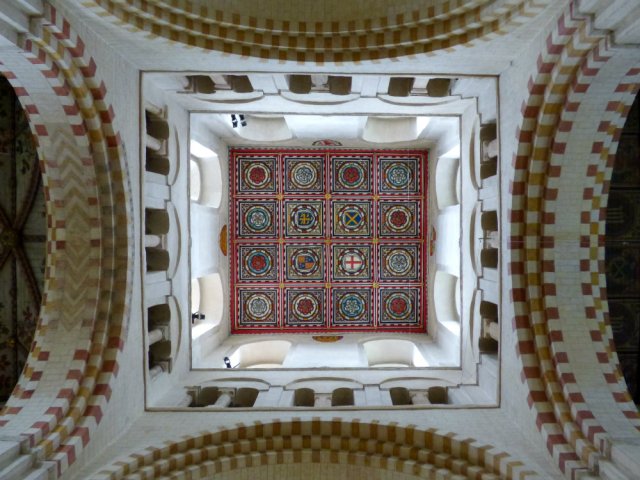
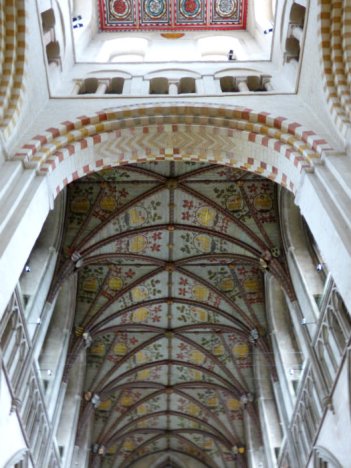
We had finally made it into the Crossing at the centre of the Abbey… you barely remembered that the tiles beneath your feet had been made by Minton when you looked up. One incredible painted ceiling after another stretched away from the Tower Ceiling. The precise outlines of the stones on the white of the walls are an illusion created by mediaeval painters and the Norman arches that have stood a thousand years are decorated in ochre.
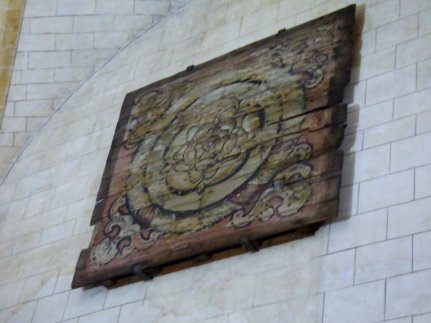
Above them float the roses of St Albans. Although the bright painted panels we now see were only installed in the 1950s, they are an exact copy of the 15th C tiles that are still in place above them, now protected by their presence. One of the original tiles can be seen against the painted stonework of the aisle. The tiles show the red and white roses of the House of Lancaster and York and may commemorate the two battles fought at St Albans during the Wars of the Roses; the first was a victory for the Yorkists in 1455 and the second was won by the Lancastrians in 1461.
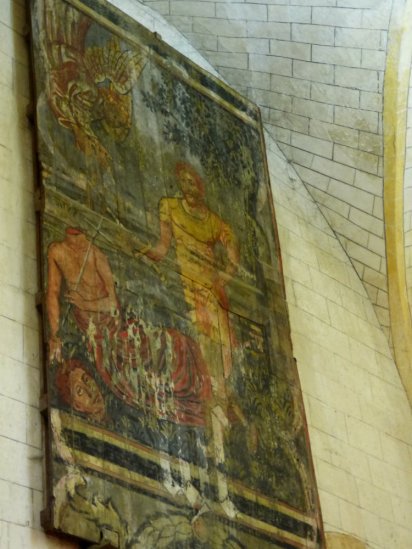
The rose is also one of the symbols of St Alban, and opposite the faded ceiling tile is the martyrdom of the saint, rather graphically portrayed on a Baroque panel that was once part of the ceiling in the north transept.
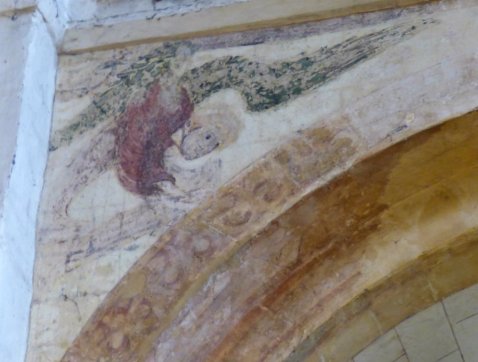
Close by, as if watching over the saint, is a green-winged mediaeval angel, censing the church from the corner of a Norman arch. Time slides together here as ages blend and meld into a single story… a reminder, somehow, that the division of time is a man-made thing that has no place within eternity.
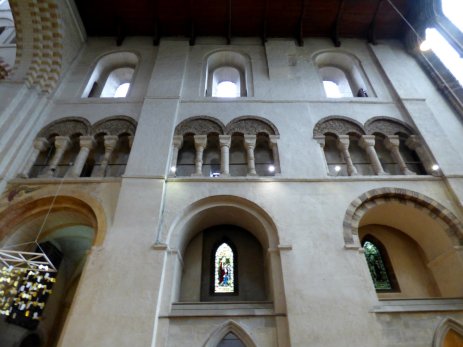
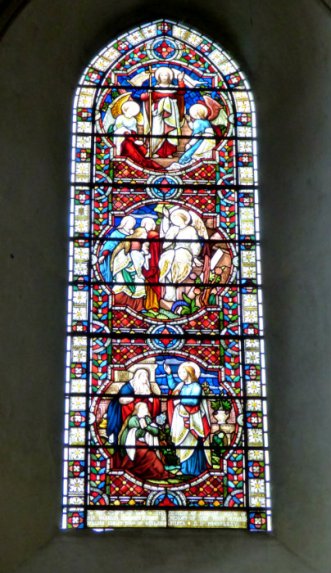
Yet it is time that makes us marvel here too. The huge, central tower is built largely of recycled Roman brick and tiles and has stood unmoved for a thousand years. Saxon columns support arches made of a herringbone of tightly packed Roman tiles, in Norman walls pierced by Victorian glass…
…and a beautiful twelfth-century doorway, moved and ‘amended’ by Lord Grimthorpe during his controversial restorations, sits quietly beside the modern fire alarm and emergency lighting.

Arches rise above the carved wooden screen of the Quire to the west of the tower, where services have been sung for over nine hundred years… but occupied by an educational tour while we were there. The polished wood gleams in the dim light, each stall named for a church dignitary from times now gone.

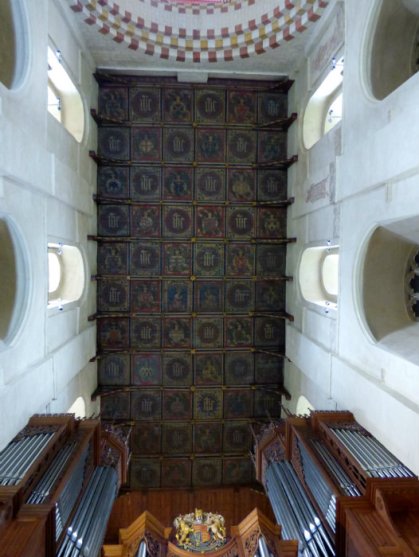
High above, in the shadows, a fourteenth-century ceiling still seems to keep its secrets from the eye. It was only rediscovered in 1875, hidden beneath a poorly painted seventeenth-century ceiling and its panels show the arms of King Edward III, his supporters and religious images.
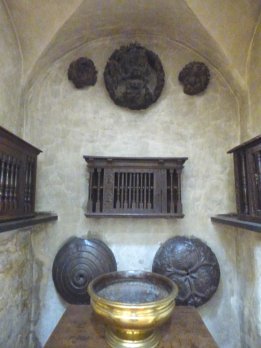
In contrast to the richness of the Quire, with the great, carved Catherdra… the Bishop’s Chair that gives the Abbey its status as a cathedral… a little alcove still holds the dole-boxes for the bread given to the poor and a couple of intriguing bosses, salvaged from an ancient ceiling. One of which looks remarkably like a Green Man. Or St Alban… or both?
There was so much at this end of the Abbey we would be unable to see with the church serving its congregation with a funeral and regular parish service. Not on this visit at least. But we could see another ceiling beyond the reredos of the High Altar, bearing the gilded Lamb against a simple white ground scattered with flowers, sheltering the shrine of St Alban.
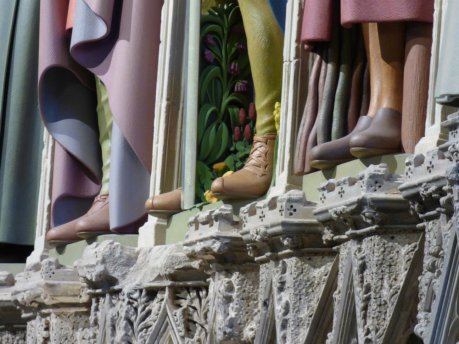
The lace-like stone of the High Altar screen has seen much since it was first carved in 1484 to separate the shrine from the altar. Its statues were destroyed during the Dissolution of the Monasteries, its saints and the image of the Christ replaced in the nineteenth century. For all I know that religious prejudice is still rife today, I cannot conceive how or why anyone could or would destroy the symbols of another’s faith or impose their own with force. Faith can only come from the heart… it is personal. I love these old buildings…the history, the craftsmanship, their stories which are the stories of the little folk as much as the great who leave their names to posterity.
I paused for a moment before the altar. This church is not mine, its religion not one to which I subscribe. Yet nor is it not. I too have my faith in the One… it is only Man that gives names to the Divine over which we can argue. I paused for a moment before the altar in silence and respect… not for dogma, not for the bones that lie in the shrine… but for the hearts and the feet of the thousands of pilgrims, monks and believers who have brought their faith to this spot for a thousand years and worn a path in ancient stone.

Press a button or two to share... go on, make my day :)


 The sun, the sea, the breeze
 Scoral was a handsome mer, graceful and strong, his long hair the color of ripe kelp and his scales the same fiery orange-gold. He was chosen by Lune for his fearlessness and wildness. All mer have that wild edge to their personality, but Scoral was known to test his elders almost to the limit. More than once he was threatened with banishment from the chorus. Although lone mer were not unheard of, in dangerous ocean waters these solitary-minded mer only rarely survived.
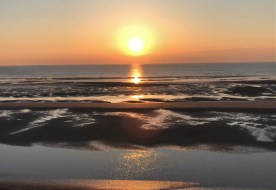 ‘You take it for granted, our time together.’
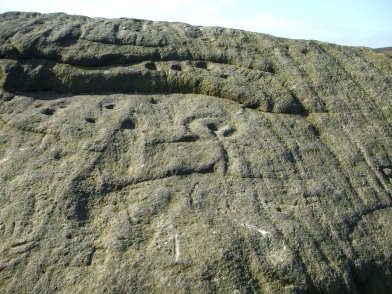


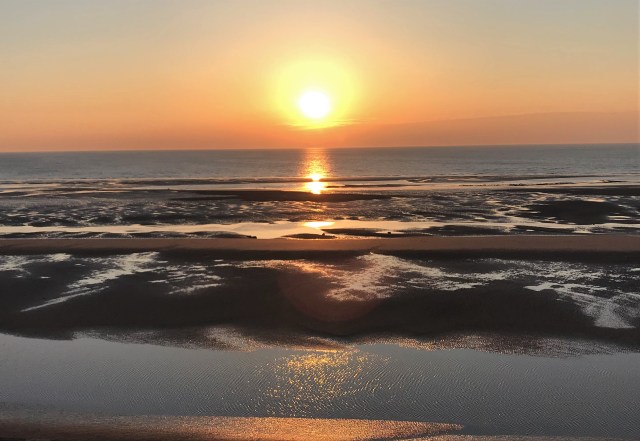 The sand moving under my bare feet makes me feel unstable. I wonder if stories about the end of the world coming soon are true. What will it feel like?





















 Sue Vincent's Daily Echo