
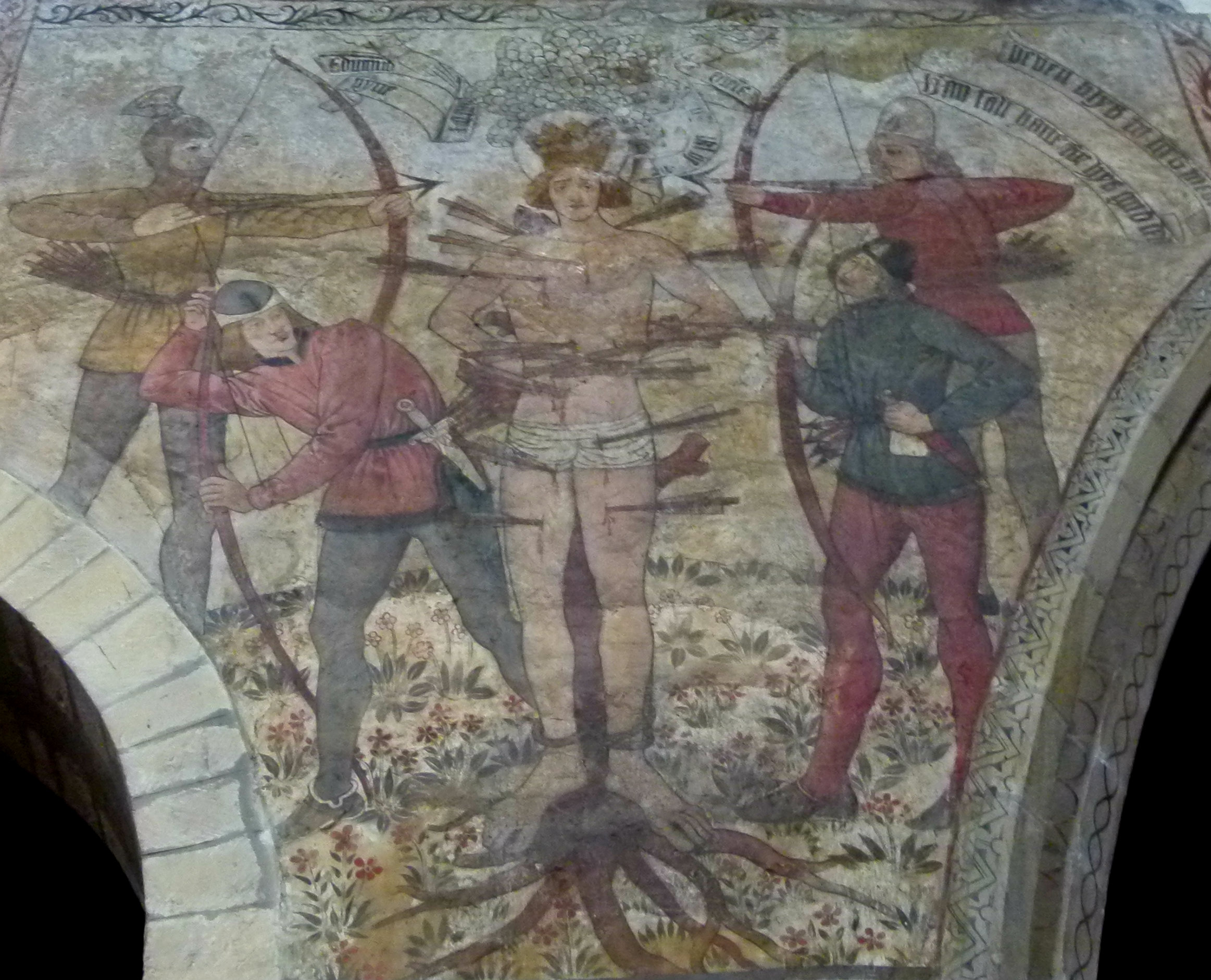
Martyrdom of St Edmund, Pickering
Over the past month or so, we have been revisiting places in my local area in preparation for the April workshop we will be running here. There are so many wonderful sites that we would love to include, but time is limited and we have to choose only the most relevant to the theme of the weekend.
We have, over the years, found some amazing little churches around Buckinghamshire… the rural nature of the area has allowed the villages to preserve the buildings, many of which date back to Norman times.
Sometimes we are lucky enough to find someone in the church with knowledge to share and so find those hidden details we would not have otherwise seen and heard the stories that do not make it into the little guides many churches provide. While we usually prefer to have the places we visit to ourselves, there are times when the one person you really need to speak to just happens to be there. Churches, after all, are not just about the buildings, the art or even the faith but are part of the living history of real people. To meet the daughter of the verger who grew up playing in the tower, hear why an altar cloth was stitched from the grandson of the woman who made it, or have the hidden symbolism of a window explained by someone whose love for the subject is a passion… these are gifts.
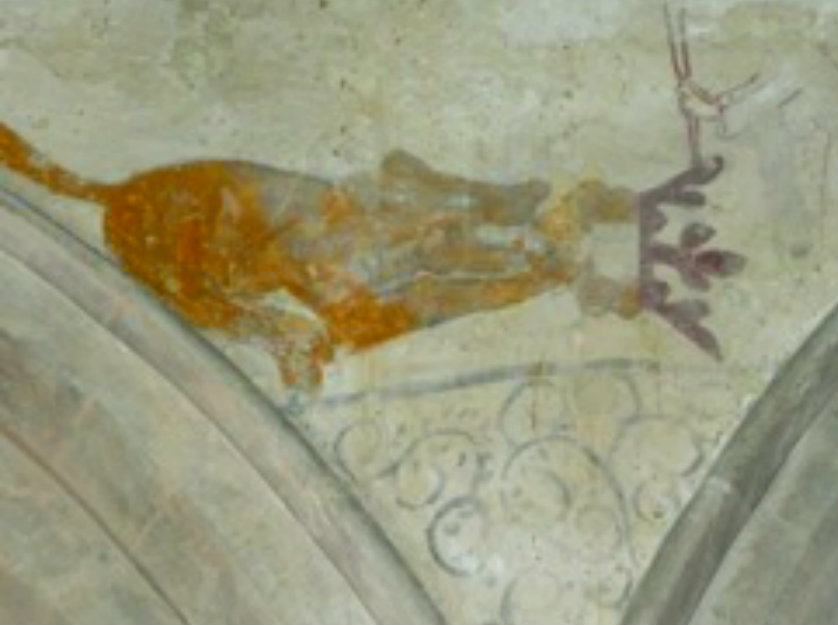
The wolf, Padbury
It astonishes us how many fragments of medieval wall paintings remain in these old places that never get a mention in the scholarly books on the subject. Possibly because what remains is fragmentary, not easy to understand or put in context. There may be a foot, a creature, a face… and the rest has gone, wiped away by time, damp and whitewash. Because they are incomplete and perhaps unrecognisable they are overlooked, as if beauty has to be a complete story that reveals itself all at once.
I’m not so sure that is true, though. Stuart and I love the mystery and the very incompleteness that allows us to think, debate, and speculate on meanings and symbolism. A complete picture tells but one story, though you and I may read it differently. A fragment allows more freedom and engages all the levels of creativity and mind. Take the wolf of Padbury, for example… which looks to modern eyes more like a boar… It tells the tale of St Edmund whose head, once severed, was found and replaced by the wolf. Over the next arch is a fragmentary painting thought to be of another saint… though it is impossible to tell and there has been much debate. To me it makes sense that it would be St Edmund’s story told there, as these paintings read like comic books, scene after scene. That I could be wrong takes nothing away from what is there, beautifully painted over seven hundred years ago.
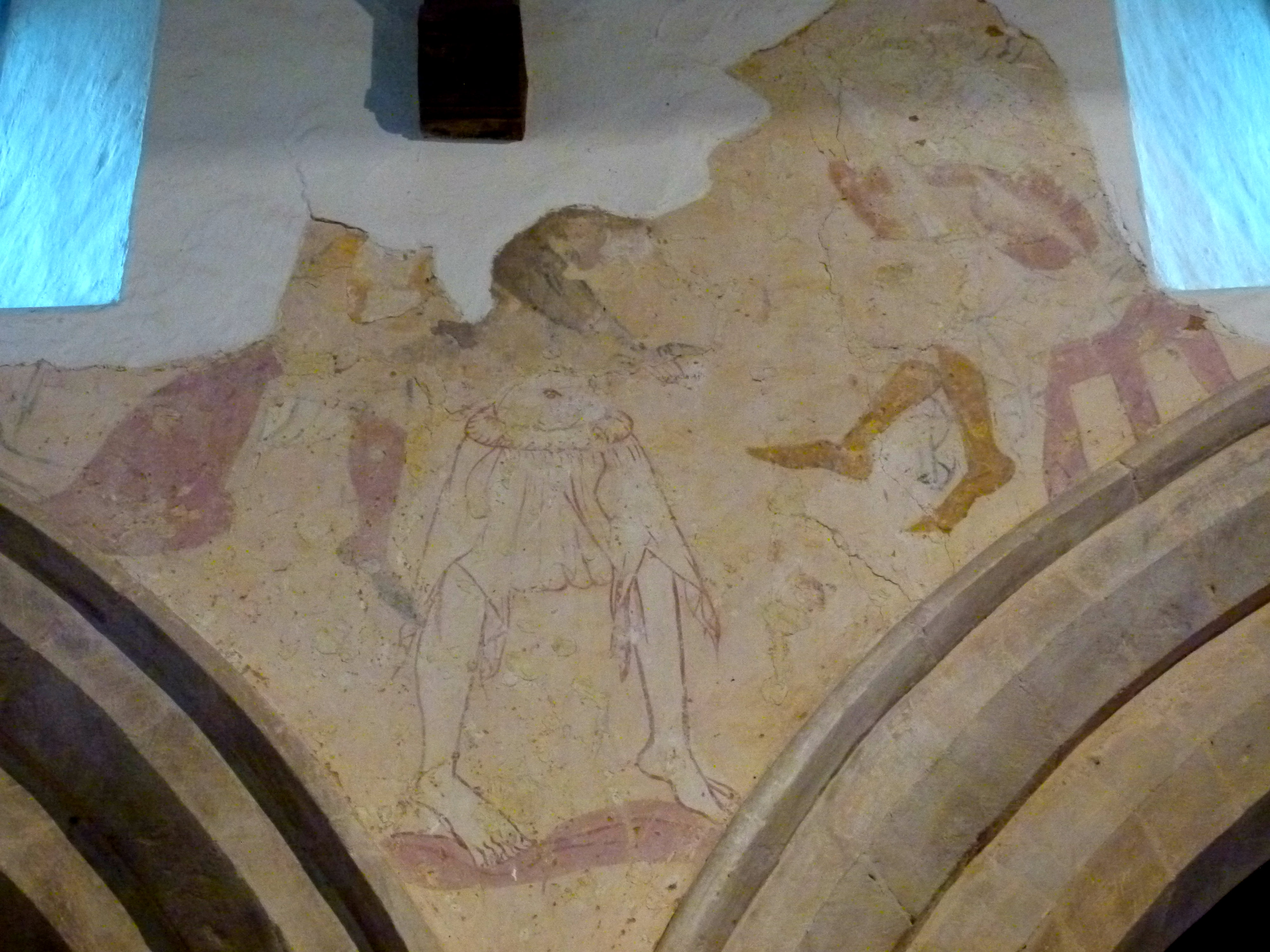
An unknown fragment, Padbury
There are places where the paintings are beautifully and breathtakingly preserved… Pickering, North Yorkshire and Broughton in Milton Keynes, of all places…. Their colours are bright, their stories readable, their beauty intact. Yet should we dismiss the fragments because they are no longer whole? I do not think so.
We do not have the whole picture, but what remains holds its own beauty, a fragment of something that would otherwise have been lost. We have a window into another world, another time and place that is part of us. From each we carry away something that adds richness to our understanding. These fragments, like the events in our lives, show themselves often quite unexpectedly where we never thought to find them. Are we to be disappointed that we cannot see the whole picture in all its glory… or be glad and grateful that we have been gifted with even a fragment of beauty to treasure and for what we may carry away with us in our hearts and memory?
Perhaps when we look back we can see the trail of fragments from which understanding is born. Such things are never wasted. They stay with us, gifts of a moment in time that remain after their moment has passed, becoming part of the rich store of memory and experience that make us who we are. And maybe by cherishing the fragments we will be able to read the bigger picture when we are blessed with a chance to look upon it.

A Mother’s tears, St Mary’s, Thame.






















 Sue Vincent's Daily Echo
This is so beautiful, so in the fragments of stories survive to open our minds, hearts and eyes. They speak loudly. My appetite is truly wetted 💜
LikeLiked by 1 person
We have some of our favourite places lined up 😉 xx
LikeLike
Oh! So excited 😎
LikeLike
🙂 xx
LikeLike
🌈
LikeLiked by 1 person
You encompass a different ‘dimension’ Sue, which must give you such pleasure; a ‘never ending curiosity’ is no bad thing… x
LikeLike
There is always something to learn or explore…and I hope I never lose the excitement of that, Joy xx
LikeLike
This sounds like it will be a great workshop, Sue.
LikeLike
We hope so, Robbie. It will not be for want of preparation 😉
LikeLike
beautiful post! Thank you for sharing the moments in time.
LikeLike
Thank you for reading 🙂
LikeLike
A medial era paintings preserved is astonishing!
LikeLike
There are so many of them around here too.
LikeLiked by 1 person
Even more astonishing!
LikeLike
Many of our churches are eight or nine hundred years old.
LikeLiked by 1 person
I know. It’s really difficult to comprehend. And it’s also wonderful, and humbling.
LikeLike
We don’t tend to see that as being so very old. Odd, really, how differently our perception of time is shaped by a few hundred years of human history, when we all walk an Earth unimaginably ancient.
LikeLiked by 1 person
Well said!
LikeLiked by 1 person
We should never overlook the fragments. They reveal secrets of the past as much as the whole, we may just have to work harder to uncover them. You are so fortunate to live where you can easily access some of the most amazing pieces of history. ❤️❤️❤️
LikeLike
Small things can lead us o wonderful places. ❤
LikeLiked by 1 person