It was the morning after the Riddles of the Night* workshop that I have shared again recently. We wandered out into the landscape. Although the workshop was over, apparently, the work begun on the weekend was only just beginning… Parts One, Two, Three and Four of the day’s adventures can be found by clicking the highlighted link.
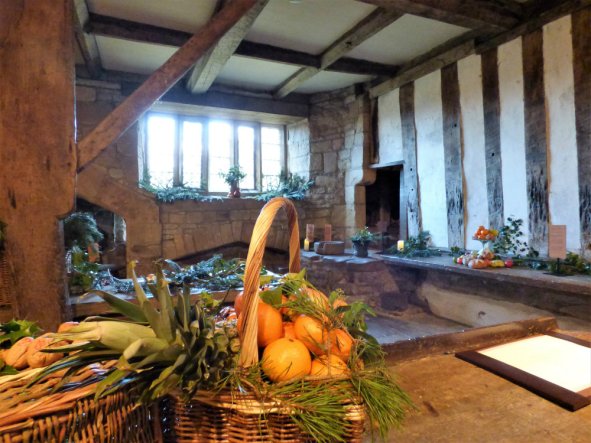
Haddon Hall in Derbyshire is one of the best-preserved Tudor country houses that remain. The history of the Hall goes back almost a thousand years, and for most of that time it has been in the hands of the Vernon and later, the Manners family. When John Manners was made 1st Duke of Rutland in 1703, he and his family moved to Belvoir Castle, leaving Haddon Hall untouched for hundreds of years, thus preserving the medieval and Tudor house from that fashionable modernisation that has altered so many buildings.
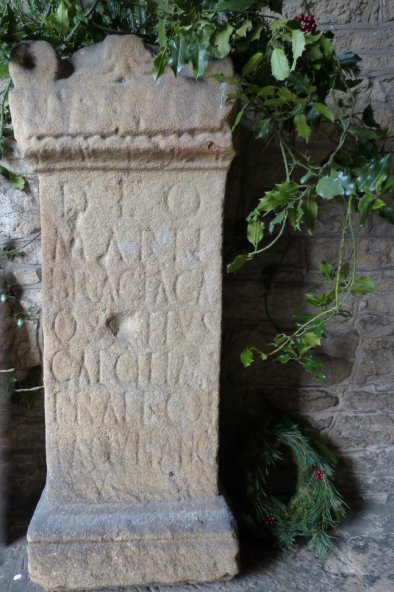
‘To the God Mars Bracacia… Quintus Sittius Caecilianus, prefect of the First Cohort of Aquitanians, fulfilled his vow’
The land upon which the house stands had seen earlier occupation. A Roman altar is a surprising find in the porch. The altar was found in the grounds in the seventeen century. It is dedicated to the Roman god Mars, with the addition of a local theonym, Braciacia, who was a local goddess of beer or malt. The altar was raised by Quintus Sittius Caecilianus, prefect of the First Aquitanian cohort, who had ‘fulfilled his vow’. You have to wonder what his vow entailed to combine the gods of war and beer…
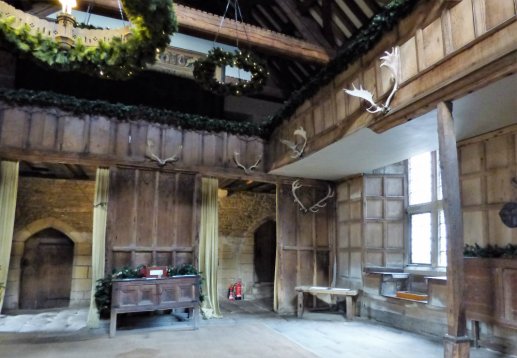
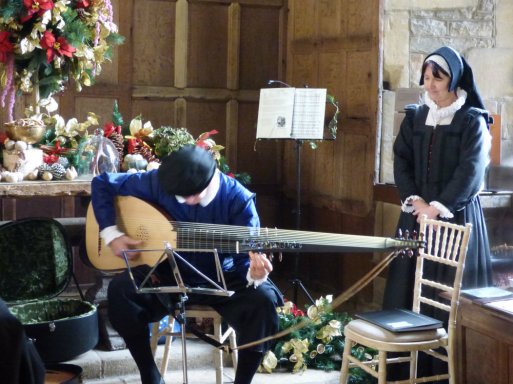
When we visited Haddon Hall, the place was decked for Christmas. Roaring fires blazed in many of the great hearths, filling the air with the fragrance of woodsmoke and home. There were Christmas trees in every corner, covered in natural decorations, with garlands of dried orange slices adding their zest to the scent of pine. The Great Hall, where a huge fire blazed, was hung with garlands of greenery and the high table on its dias was piled with flowers, fruits and festive cheer. I would have loved to go up into the minstrels’ gallery and look down upon the scene… but we were at least able to look back somewhat down the years as a lutist and singer recreated the music of a Tudor Christmas.
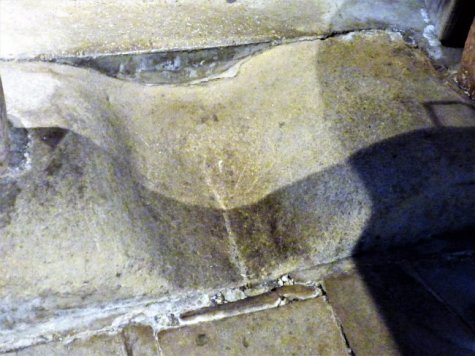
We wandered down the long corridor to the kitchen. The floor of the passageway and the steps between rooms are worn by the passage of centuries and innumerable feet. There is something ‘immediate’ and very intimate about walking where so many others have passed, knowing that most of them have faded into forgotten pages of history. We do not know all their names, nor do we know their dreams. But we still walk in their footsteps.
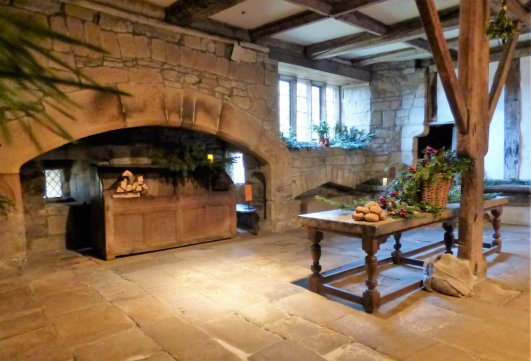
The kitchens, like the Great Hall, were built around 1370, and look much as they would have at the time. But with the enormous fireplaces and bread ovens clean, tidy and quiet, they are a far cry from the bustle of long ago when they served that tables of the Great Hall. Yet there are many small items that remind you that this is still a kitchen where you could work to feed a family.
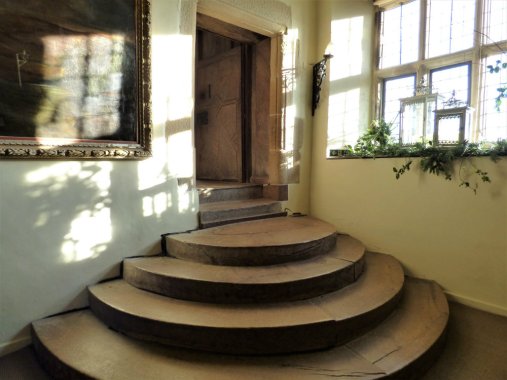
We found our way upstairs to a part of the house built at a later date. You can see the changing styles of architecture, and yet there is still a sense of unity in the house. There is no glaring or obvious change… the styles, like the years, glide into one another gently.
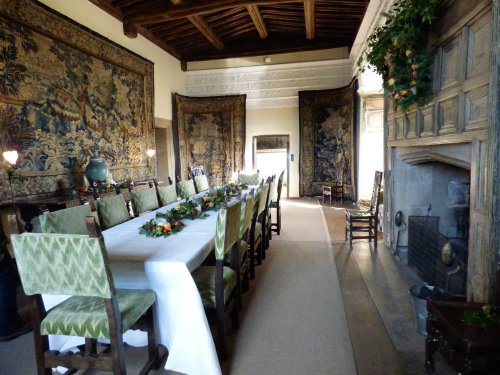
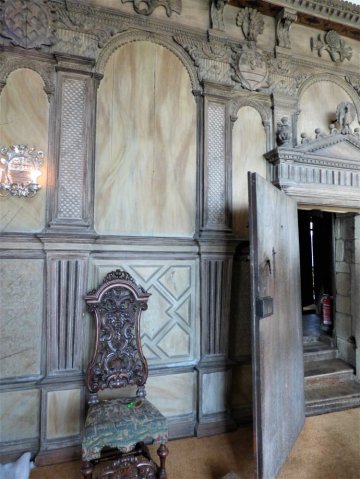
The ‘modern’ dining room, its great table a copy of the far older one in the Great Hall, was added in 1500 by Henry Vernon. The ceiling is painted in a chequerboard of black and white squares, with Tudor roses and the Talbot dog, the emblem of Vernon’s wife, Anne. The warm oak panelling was added forty-five years later and is carved with the Boar’s Head crest and the arms of the family. Over the fireplace, the royal coat of arms is carved above a motto which reads, ‘Drede God and honor the Kyng’.
A little further and we reached the Long Gallery, with one wall full of windows and the other carved and panelled. This too was built in the sixteenth century. The long, bright room would have been perfect for social gatherings, but would undoubtedly have been put to good use by the members of the household. You can imagine children racing up and down the empty space, ladies, kept indoors by inclement weather taking their exercise there or using the sunlit space to read or sew.
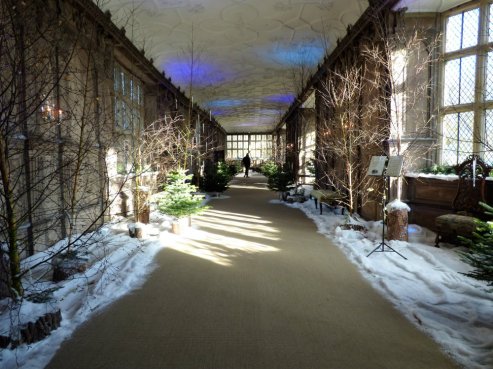
For our visit, the Gallery had become a winter woodland… though I would rather have seen it without the festive flourishes which made it difficult to see the delicately carved woodwork, sporting heraldic peacocks and boars, flowers and love-birds.
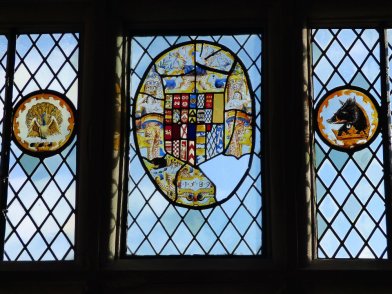
The windows still hold some of the early glass. Here too you can see the peacock and boar crests as well as a shield bearing many armorial details and the date 1589. Glass windows were horribly expensive and would have been the height of luxury at the time. The painted glass even more so.
There are also panels showing arms encircled by the Order of the Garter, with the motto ‘Honi soit qui mal y pense‘, ‘shame be to he who thinks ill of it’. Legend has it that the Order was founded when the king was dancing with the Countess of Salisbury and her garter slipped from her leg. Picking up the garter, the king cried the now-famous motto and by some this has been seen to indicate that the Countess’ garter was a symbol of her involvement in witchcraft… though it is perhaps more likely she was involved with the king…
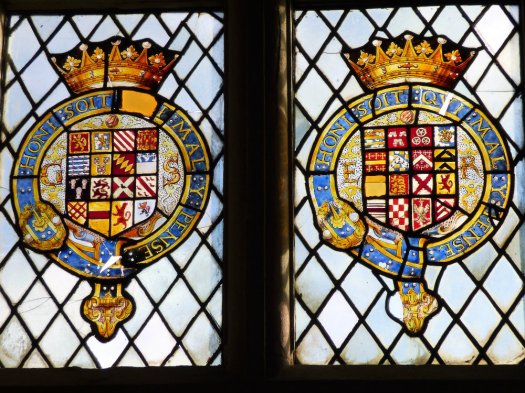
Other legends tie the Garter to Richard I, better known as the Lionheart, who, inspired by St George, had his knights tie garters around their legs before going on to victory in battle. The truth may be more mundane and pertain to Edward IIIs attempt to reclaim the throne of France in the fourteenth century, and there are links to the old tale of Gawain and the Green Knight too, where a version of the motto can be found.
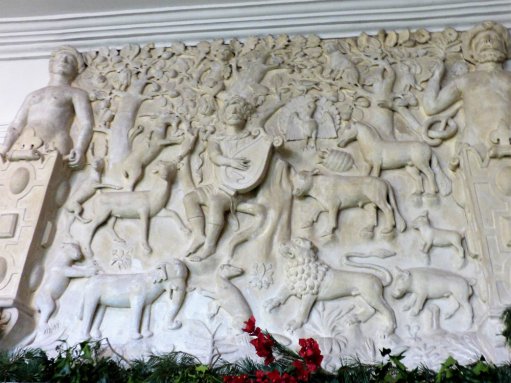
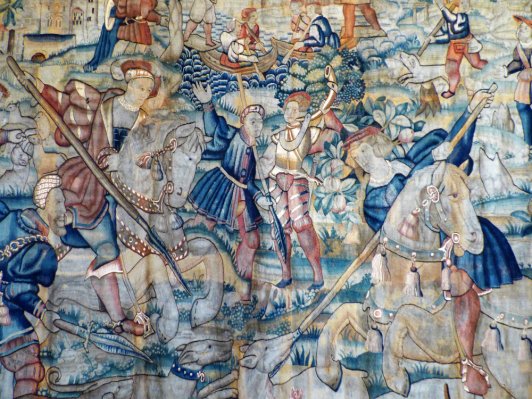
We moved on to the antechamber of the State Bedroom. The antechamber now holds a billiards table and the bedroom is closed for the winter, but the walls alone make the place worth a visit, with Orpheus taming the animals with music over the fireplace and tapestries of hunting scenes covering the walls. Contradictory statements, perhaps, yet this house, with its rich carvings and history, is all about contradictions… for in spite of the grandeur, it is still very much a place you could easily call home.
*Riddles of the Night was a Silent Eye workshop in Derbyshire, in December 2017. Parts One, Two, Three, Four, Five, Six, Seven, Eight, Nine, Ten, Eleven, Twelve and Thirteen can be found by clicking the highlighted links.
Press a button or two to share... go on, make my day :)

 Her scarlet red hair tumbled down her back as she released it, cascading over her pale, white skin.

 My strength doesn’t always show


 First in this week…
















 Sue Vincent's Daily Echo