

*
I sing to the moon.
I pray to the moon.
I cry with the moon,
and she tells me the ‘why ?’
of beauty and the beast…
*
Continue reading at France & Vincent
*
I sing to the moon.
I pray to the moon.
I cry with the moon,
and she tells me the ‘why ?’
of beauty and the beast…
*
Continue reading at France & Vincent
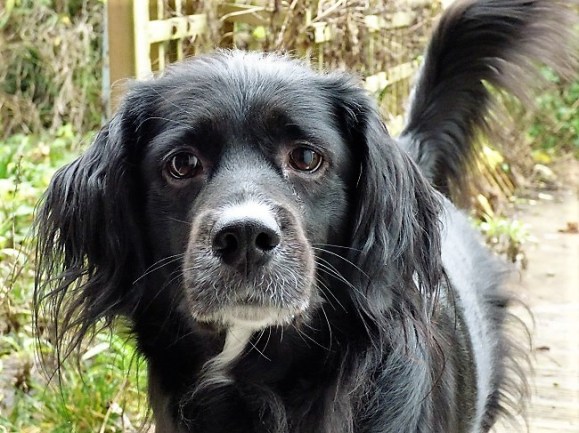 Now, let us be very clear about this. I was tortured.
I am not blaming the lovely young two-legs in the van… she was kind, compassionate, professional and exactly what you want in those horrendous circumstances.
But my two-legs? The one issuing the orders? She knows what I think about “bath”, “ears” and “toes”…
Four letter words. All of them!
Now, I know she’s been fretting about not being able to groom and walk me properly since she got poorly, and if she had really tried, maybe I could have controlled my very ticklish feet. But honestly… it never occurred to me that she would go to such awful lengths…
Continue reading at The Small Dog’s Blog
Wild places calling
Memories whisper of home
Longing torn in two
Cloistered and sheltered waiting
Freedom found only within

It is lovely to have Sally Cronin as my guest today to bring back memories. As I have, like my grandmother, always ‘sewn with burnt thread’ as the saying goes, my dressmaking skills are minimal… although I always loved embroidery which I learned from my great grandmother.
Thanks Sue for your kind invitation to share some family history and also news of my latest collection of stories.

The Sewing Gene
My Grandmother – Georgina
They say that certain talents run in families, and whilst perhaps not genetically passed on through the generations, there is certainly reason to believe that skills passed from parent to child across hundreds of years will be carried forward.
In our family there definitely seems to be a tendency towards sewing crafts, in particular dressmaking, and it was this family trait that I used to embroider the story The Wedding Day in my new collection.
The first needlewoman as far as I know from the records, and the oral history passed on by my mother was Georgina Stephens, my grandmother born in 1890 in Alverstoke in Hampshire. She was the daughter of Samuel Stephens and Mary Anne Tanner who sadly died when Georgina was only thirteen years old. However, the family was reasonably well off as Samuel was a housebuilder with tilers and slaters working for him, so as all young ladies of the time, Georgina was likely taught to sew by her mother from an early age.
Georgina does appear to have been in service as a lady’s maid in Middlesex by the 1911 census and I am assuming that having watched Downton Abbey, a fair bit of sewing was involved in maintaining her mistress’s clothes.
She had returned to Hampshire by the start of the First World War and began going out with an Irish lad, Herbert Francis Walsh who was a slater, presumably working for her father. Herbert had served in the army as a boy soldier for three years, but of course was called up immediately in 1914. They married on his first leave in 1915 and had my mother in October 1917.
From what my mother told me, Georgina supplemented their income by offering her dressmaking skills locally, and it made a big difference. Herbert was killed the week before the war ended in November 2018 when my mother was just over a year old. With a very small army pension, Georgina returned to Hampshire to live in the square in Wickham a market town close to where her own mother had been born.
She set up a dressmaking business here too, and clearly passed on not only her skills, but a love of clothes to her young daughter. Money was still tight but Georgina had cousins in the north of England who owned a mill, and every year they would send down a bolt of material, usually plain and hardwearing. My grandmother would make a dress and coat for herself and for my mother and any leftovers into nightdresses. My mother remembered feeling shameful going to school in some of the outfits being very plain and identical to what her mother was wearing.
When my mother was seven years old, Georgina married the village butcher and he built a house on the hill leading into Wickham and life became much easier for the two of them.
My Mother – Mollie.
My mother loved jackets and shoes and even at 90 was adamant that she bought only the best so that they would last years. She was optimistic that she would be around at 100 and she nearly made it. However, she had made her own clothes including jackets, dresses, skirts, coats and suits from her teens, assisted by her mother, using her treadle sewing machine, before being bought her own Singer machine for her 21st birthday.
Young Mollie loved the fashion magazines and in particular Vogue which had been setting the trends for the better off in society since the British version was launched in 1916. Although Vogue patterns did not become widely available until the 1940s, my mother was a dab hand at copying the designs in the magazine and wearing the resulting finery to dances in the village hall and for special occasions.
Bear in mind that this was a farming community, and the local pub on a Friday night was hardly the catwalk in Milan or Paris. Mollie however was unabashed, and apparently turned up one week in a gold lame turban, satin dress, long gloves and a cigarette holder. She was influenced somewhat by the Hollywood movies of the time, and I am sure caused quite a stir.
She married my father in September 1940 and having hoarded materials for years for this special day, created and made her own wedding dress.
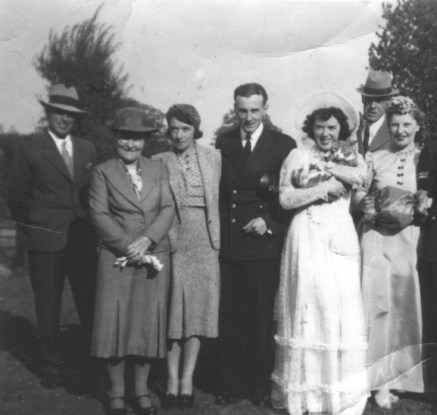
Picture of my parents on their wedding day 1940, grandmother standing next to my father.
As we three girls came along, she made clothes for us all and at the same time passed along her love of sewing to my eldest sister Sonia.
Mollie kept sewing until her 70s when Sonia began making dresses and other clothes for her, but she continued to alter her own jackets and skirts well into her 80s when unfortunately she developed cataracts. When they were removed eventually, she continued with simple alterations although she tended to sew buttons back on to jackets at an angle which gave them a rather funky look.
My generation
When we lived in Sri Lanka, my sister Sonia would have been twelve to fourteen years old but already an accomplished needlewoman. She made beautifully smocked dresses for me matching underwear to match; something that would cause quite a stir when my mother and father entertained. People would admire the dress and I would whip the skirt over my head and announce to everyone ‘with knickers to match’!
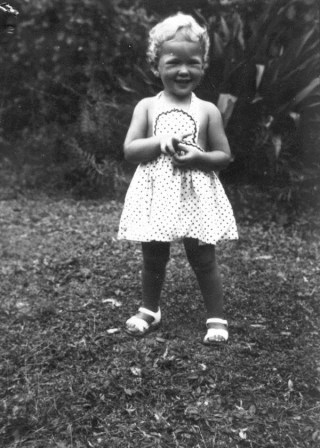
Here is me aged three in one of Sonia’s sundresses
Sonia went on to make wonderful clothes for herself, daughter and the rest of the family from dresses to suits and coats. Today she still whips up lovely summer dresses and I don’t think she has ever bought a ready -made pair of curtains.
I have made my own summer dresses and skirts when much younger and money was tight. Most of the curtains in our house are ones I have made and altered to fit new windows every time we moved. Over the years I realised that I didn’t have the skill of my mother or sister and began to buy my clothes, particularly the more complex projects such as jackets and suits. I did have a side business in my 20s crocheting Aran wool midi skirts which brought in some much needed funds. In my 30s, when I gave up smoking and needed something to do with my hands…I developed a love of tapestry and over the years I have completed twelve large projects, most of which are framed and hung on the walls of our home.

Picture of one of my tapestries
Here is an excerpt from The Wedding Day featuring a very special wedding dress.
Herbert watched from the shadows beneath the oak tree in the orchard as the sun rose, glinting on the windows of the house in front of him. He would have to move soon to a more secure hiding place as the occupants of the house stirred, and began preparing for the upcoming celebration.
His daughter Phyllis was getting married today, and whilst he was banned from attending, he hoped to be able to watch from a distance at the village church, and then here in the orchard for the reception. It promised to be a sunny September day, and he hoped for once the skies would be clear of the dog fights of the last month between the Royal Air Force and Luftwaffe escort fighters, accompanying the bombers pummelling the docks each day.
He had overheard his wife and daughter talking as they sat in the orchard yesterday, sharing a much needed pot of tea and a few minutes respite from their hurried preparations. Unexpectedly the bridegroom was being shipped off tomorrow to France on active duty. They had originally planned to get married in two weeks, but with Jack’s sudden orders, they had been faced with cancelling the wedding until his return. Following his hurried phone call to let Phyllis know the devastating news, she had sat on the stairs, tearfully contemplating not just the change of plans, but the prospect of not seeing Jack for a long time.
Determined that she would do all she could to pull something together for these two young lovers, Georgina rang the vicar, and following their conversation, she contacted several friends in the village. They had known Phyllis since she was a year old when she arrived with her mother who had been born and raised in this house on the hill, and as a community, everyone had come together to make sure this young couple had at least one day of happiness.
Listening to Georgina and Phyllis talking about the new arrangements had brought back memories of his own wedding day in 1915, but at least they had three days before he returned to his unit in France, a brief respite from the relentless fear and danger.
Thank you again Sue for having me over and it brought back many happy memories sharing sewing stories from our family archives.
©sallycronin
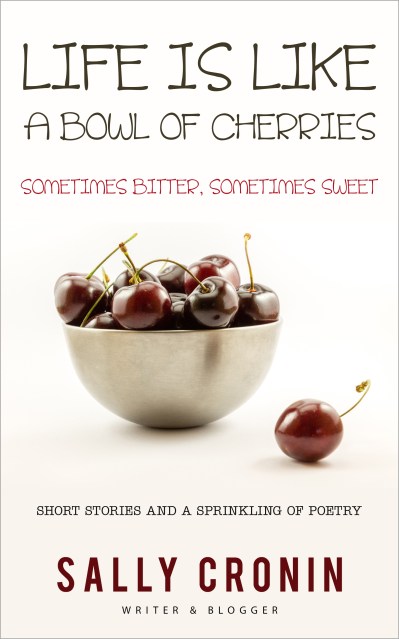
Sally has recently released a new book…
Sally Cronin
Life is Like a Bowl of Cherries: Sometimes Bitter, Sometimes Sweet is a collection of short stories with scattered poetry, reflecting the complexities of life, love and loss.
The stories in the collection dip into the lives of men and women who are faced with an ‘event’ that is challenging and in some cases life changing.
Even something as straightforward as grocery shopping online can be frustrating, and a DNA test produces surprise results, the past reaches out to embrace the present, and a gardening assistant is an unlikely grief counsellor. Romance is not always for the faint-hearted and you are never too old for love. Random acts of kindness have far reaching consequences and some people discover they are on a lucky streak. There are those watching over us who wish us well, and those in our lives who wish us harm.
“
 About the author
I have been a storyteller most of my life (my mother called them fibs!). Poetry, song lyrics and short stories were left behind when work and life intruded, but that all changed in 1996. My first book Size Matters was a health and weight loss book based on my own experiences of losing 70kilo. I have written another ten books since then on health and also fiction, including three collections of short stories. I am an indie author and proud to be one. My greatest pleasure comes from those readers who enjoy my take on health, characters and twisted endings… and of course come back for more.
REVIEWS are so very important for an author and I am very grateful for the feedback that my books receive. If you have purchased or been gifted one of my books I would love to hear what you think about it.
As a writer I know how important it is to have help in marketing books.. as important as my own promotion is, I believe it is important to support others. I offer a number of FREE promotional opportunities on my blog and linked to my social media. If you are an author who would like to be promoted to a new audience of dedicated readers, please contact me via my blog. All it will cost you is a few minutes of your time. Look forward to hearing from you.
 All Sally’s books in Ebook are available: Amazon UK
And Amazon US: Amazon US
You can read more reviews and follow Sally on Goodreads: Goodreads
Please connect to me via my Blog and Twitter

Tell me a story!
If you are a writer, artist or photographer…If you have a poem, story or memoirs to share… If you have a book to promote, a character to introduce, an exhibition or event to publicise… If you have advice for writers, artists or bloggers…
If you would like to be my guest, please read the guidelines and get in touch!
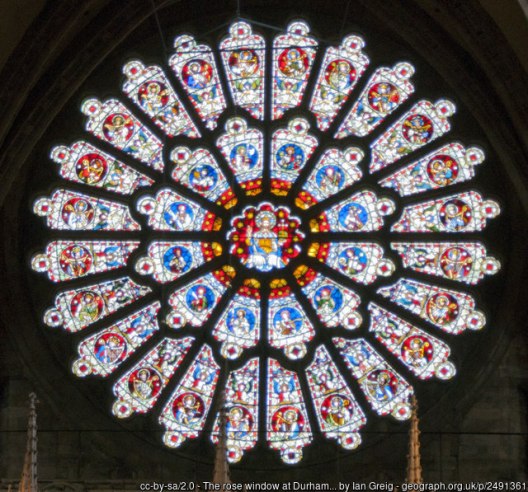
The Rose Window at Durham Cathedral. Image by Ian Greig via geograph (CCL)
The cathedral of Durham is one of the finest Norman buildings and a World Heritage site. It stands on a rocky height above a loop in the River Wear, a perfect place defensively. At the time of its establishment it fell under the protection of the Earl of Northumberland, a kinsman of the Bishop.
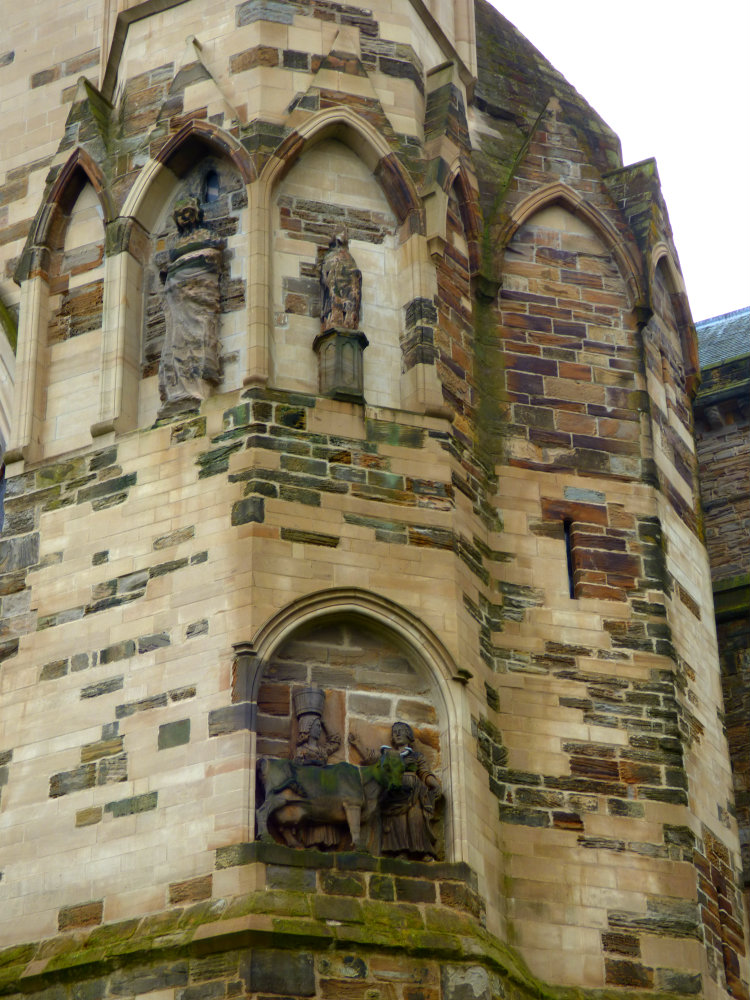
 History tells how the relics of St Cuthbert of Lindisfarne were borne with love by his Brethren to Chester-le-Street when the raids of the Danes forced them to flee Holy Island in 875AD, taking the relics with them. A shrine was set up there to the saint, but they were obliged to leave there too in 995. Legend tells they wandered until, following two milkmaids searching for a dun cow, the coffin became immovable. This was taken as a sign that here the new church should be built. On the external walls a carving can be seen of the milkmaids and the cow… and a nearby street bears the name of the Dun Cow.
 Initially a small wooden structure was raised, then enlarged to house the relics of the saint. In 1080 William of St. Carilef was installed as the first prince-bishop by William the Conqueror and it was he who caused the building of the present Cathedral, which continued after his death.
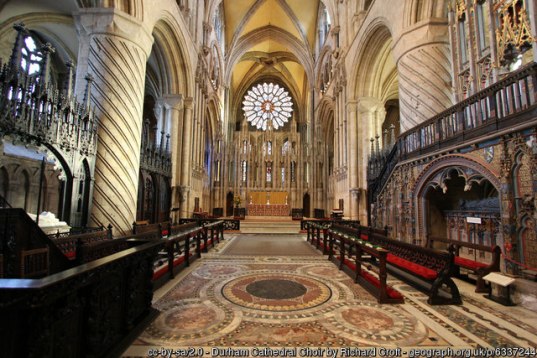
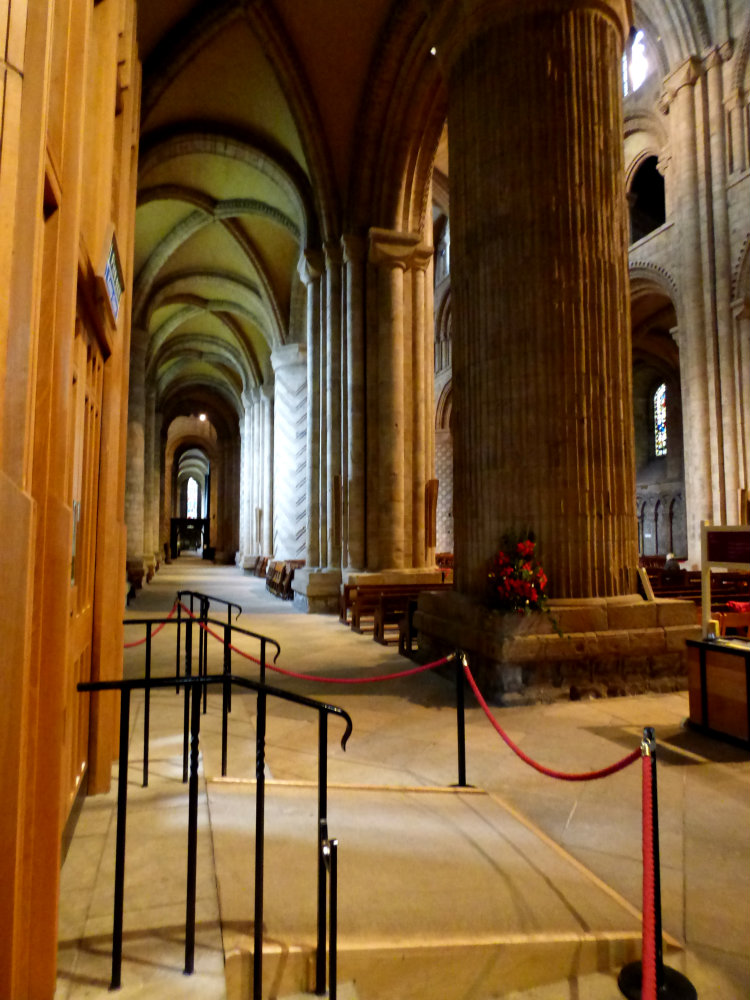
The massive pillars, carved with the distinctive Norman chevron resemble those of Dunfermline Cathedral and as there were ties between the two it is thought the same masons may have worked on both buildings.
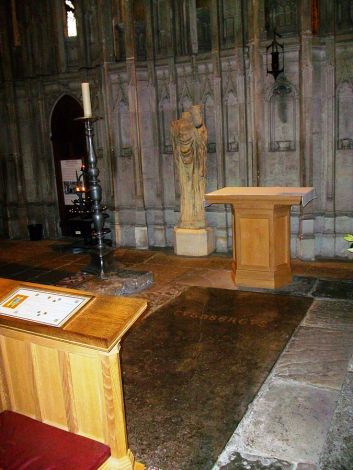
Tomb of St Cuthbert, holding the head of king and saint Oswald, whose head was said to have been buried with Cuthbert. Photo by John Hamilton (PD)
St Cuthbert’s relics were installed in a new shrine behind the altar of the cathedral. When the tomb was opened in 1104 the tiny Gospel that belonged to the saint was removed along with the silk vestments laid there by King Æthelstan in the 10th century. The Gospel is preserved in the British Library, the vestments remain one of the finest examples of Anglo-Saxon embroidery.
Contiue rading at France & Vincent

*
Did Turpin’s Troupe
Drop him
Deep in the Soup?
*
That Devil’s cast of scallywags
and wild haired, grinning hags…
who still adorn the plastered walls
in Glory’s glossy prima-face.
There now to tease and please
the local populace.
*
Continue reading at France & Vincent
 *
*
The prosperous town of Armore was built next to a forest.
Late one night Old-Man-Log came out of the forest and sat down in the middle of the town’s market square.
He opened up the palm of his right hand and started cackling.
The next morning as the sun came up he was still sitting there cackling at the palm of his hand.
The towns-folk of Armore gathered around him to learn the source of Old-Man-Log’s amusement.
There in the middle of his palm was a little red man who was dancing.
“Who is that little red fellow?” asked the townsfolk falling over themselves to get a better look at him.
Continue reading at France & Vincent
My younger son considered the view as I raised the scarf with which I cover the near-naked skin of my scalp. There are but a few wispy strands of fluff and the stubborn remnants of the Tintin-esque fringe with which to cover my baldness. I am not one of those fortunate females on whom it looks like a style choice. Knowing Alex fairly well after a lifetime of being ‘Mum’, I could see both the unspoken grief as he registered the lingering effects of chemotherapy and the twitch of amusement.
We went with the latter.
“You look like an orangutan…”
“Thanks.”
“I like orangutans,” he added, hopefully, as if that might appease my wounded maternal vanity.
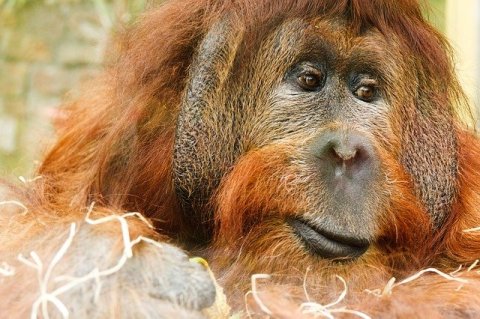
Image: Pixabay
“He’s right,” said his older brother the following day, critically assessing the image on the screen during a video call. The son with whom I shared a love of the Discworld books said, “You should say ‘Ook’ more often.”
According to the medics, the hair loss was inevitable, the loss of my voice is probably not down to laryngitis and the excess of hot, red flesh is not to be blamed on overindulgence in festive fare. They can probably all be blamed on the main vein to the heart being compressed. I believe they call it SVCS… which I assume means something along the lines of ‘squished vein causing swelling’ but in posher, Latin terminology.
The trouble is, I cannot disagree with my sons’ assessment… the mirror tells me that it is fair and as none of my menfolk seem inclined to offer any strategically dishonest compliments, I have to accept that the days when I could look in the mirror without cringing are long since gone and an ‘ook’ may be all I can manage.
It is yet another one of those instances of ‘letting go’ that you stumble across in circumstances like these. And it is surprising how the mind wants to work to deal with the idea. My first intimation of the whole ‘letting go’ thing was realising I would have to say goodbye to all those fictional characters, both read and written, that I have kept in my heart and mind for so long. Now, it takes very little to realise that it was not fictional people that were really bringing the tears to my eyes, but I was not ready to deal with anything more painful at that point. The brain is clever at such subterfuge.
The dog was no better… she still worries the life out of me, because how do I explain? Who will be there for her when I finally go? Knowing full well that she will be very well looked after and will understand what is going on far better than, say, my little granddaughters…
So, bit by bit, you start letting go of the illusions too. And it makes it very hard when others cling to them. I know the statistics… they are wide ranging averages and people do novel things with ‘expectations’ every day. That barely comes into the equation.
But letting go of the things and the roles by which you have defined yourself, that is an interesting and revealing process. That I may have to stop being a ‘carer’ at some point and become a ‘caree’… but that, regardless of what I am able to actually do, I will always be a mother… it shows you what really matters, and what is just a definition, a label applied by both self and society to pin down just a small part of who you are.
My self-image is being challenged daily. I can no longer walk or bathe my dog, for example. Changing the bedding used to take minutes and now takes most of the morning… even with breaks in between. Housework is a major undertaking and I doubt if I will ever be able to mow the lawn again. Even in this tiny flat I am gasping for breath as I dust. Learning to accept help and rely on others does not come easily. Learning that maybe the housework never mattered quite so much as I thought is even harder.
Then you get to wondering about who and what you really are. The body is just a collection of organic components, put together and lent to us by Nature. We use it for a while, like any other vehicle, then when it has outlived its usefulness, its component parts are broken down and returned to earth.
I believe that the ‘driving force’ of that vehicle is not part of it but of another order of being altogether. Look at how we can observe ourselves, often from several ‘steps’ back from everyday consciousness, watch the layers unravel and unpeel… and while I expect most of those layers to dissolve with the body, I am convinced that something survives, especially after having watched an accident unfold as a ‘ghost of myself’ many years ago.
Life, death and the bits in between… we know very little about what any of them actually are, except in physical terms, and yet we accept these amorphous definitions as readily as we do far more concrete concepts. But I wonder what each of us would come up with, were we to ask ourselves, in the unjudged silence of the innermost heart, “Who, or what am I really?”
Other than an orangutan, of course.

Clean or destructive
Water finds its own level
Always pure at heart

Reblogged from The Write Stuff:

Hi, Everybody! Please help me welcome our first guest of 2021, my friend and author, Gwen Plano. Gwen is here to share her latest release, The Culmination, a new beginning with us. I know you’ll be excited to learn about this one, so without further ado, take it away, Gwen!

Thank you so much for inviting me to your blog, Marcia, and for helping me launch The Culmination, a new beginning. With the New Year upon us, this is a perfect time to focus on the book.

What’s it about? The Culmination can best be described as a military thriller. It tackles difficult topics such as denuclearization, the power struggles over oil in the Middle East, as well as the ever-present danger of war.
Continue reading at The Write Stuff

























 Sue Vincent's Daily Echo