Following on from yesterday’s post, that seemed to get people talking, a post from the archives…
I recently came into contact with a writer. Nothing unusual about that around here, but this wasn’t through blogging or any of the usual channels. We talked for a while, establishing that there were a whole load of coincidences leading up to our encounter, which seemed to break the social ice… and then we got down to talking about writing.
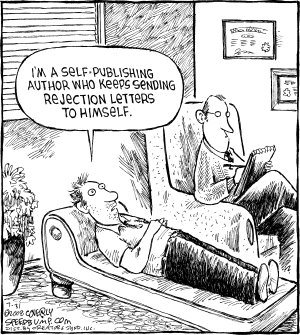
For a number of reasons, this writer had lost confidence in the book they had published… a first novel with what sounded like a great plot. Having read a fair bit of it, I could see the effort that had gone in to producing a gripping story and a well-presented book. The writer, though, had noticed the minor flaws and, as such things do, they had taken over, dulling what should have been justifiable pride.
I remember both those feelings vividly… that moment when you finally hold your first book in your hands is amazing! But the pendulum swings both ways and, when you find the first typo in that glorious product of your imagination, the first really clunky phrase that makes you cringe and the obvious error (that is usually on either the front page or the cover) then you plumb the depths of literary despair.
It doesn’t seem to matter how long, how hard or how carefully you go over that damned manuscript, something slips through the net. This is especially true of our first attempts at Indie publishing. Some of my early covers, for example, are in desperate need of updating. So is some of the editing… and the proofing! But then, I know I am not on my own.
I read a lot. I always have…and I frequently revisit much-loved tomes, finding in their stories a perfect way to read myself to sleep. It doesn’t matter that I know many of these books almost word for word, I can still lose myself in the familiar unfamiliarity of their worlds. Many of these books are classics in their genre, published by some of the most famous writers via the biggest traditional publishers with all their expertise and experience and a team of dedicated, specialised staff.
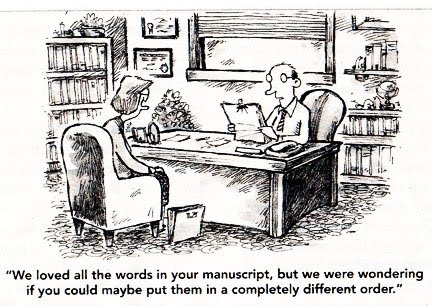
Since becoming familiar with the sharp end of editing, proofing and presentation, I notice things that I never noticed before. Like chunks of transposed text, obvious spelling mistakes, typos and grammatical errors that even a five-year-old should not make. Sentences clunkier than a rusty bike and holes in the plot you could ride the bike through.
Does it matter?
If it were my book… hell, yes, it would bug me no end. As a writer and editorial dogsbody, I can’t help but notice. But as a reader? Not a bit. If the story is good, then the story is good… and when you are reading fiction, it is the story that counts. That ‘willing suspension of disbelief’ kicks in, the critical eye takes a holiday and the imagination carries you to a world where the occasional typo is of far less importance than the dragon you are riding or the marauding orcs on your tail.
It goes without saying that, when you are getting a book out there, you must do all that you can to make it the best that it can be. But you cannot do more than that. If you know that you have done your best, what else can you ask of yourself…except to learn to do better.
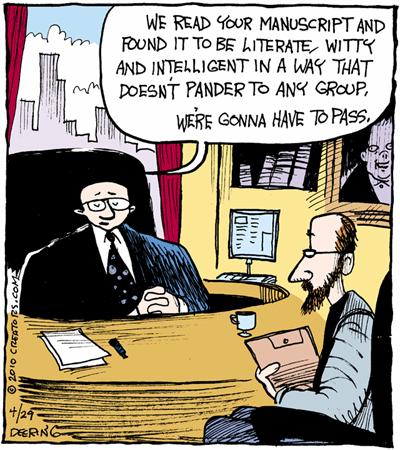
Indie publishing, like writing itself, is a steep learning curve for all who roll up their virtual sleeves and start working. For those who do not have the financial means to employ professional editors, and designers, there is a point beyond which you simply have to accept that you have done your best…for now. Most of us who have followed that route will eventually look back on our first efforts and see the flaws. Some we may simply let stand, as a testament to the learning curve and an acceptance of having learned. Others we can and will put right by going back and doing a better job.
You cannot put right what has yet to be written. Nor can you distance yourself sufficiently from your first book in order to see it with clear eyes instead of rose-coloured lenses until you have progressed on your journey. The main thing is to remember that you had a story to tell and you have told it… you have written that book that so many will talk about writing ‘one day’.
It is easy to lose confidence in your work. A bad review, a good look at your own errors with more experienced and objective eyes, even reading a similar tale by someone who, you may decide, has ‘done it better’… A writer can be their book’s biggest fan and their own worst enemy, all rolled into one, but the bottom line is that a book is written to be read. It was written because you had something to share. And it was written in the hopes that it would amuse, entertain, inform or inspire. The odd typo won’t ruin a good story.
My writer friend said, having thought the problem through, “I need to stop being fearful and just get on with it! It’s not about me and what I feel – it’s how I can make others feel!”
Press a button or two to share... go on, make my day :)

 Her spirit lingered above the water to watch it carry the remains of her body back to the Great Mother. Along the banks her people drummed to the rhythm of Earth and she could feel their love soar into the currents of the wind. She waited with them, in silent reverence to feel the pulse of the flow one more time between the lands of the living and the lands of the dead.
 The woman stood and looked upstream. It was cold but it was February. It was cold but not the cold of the war. That gnawing cold that the Vampires had spread across the world. That winter that had lasted a decade and been the destruction of so many and so much.
 Sanjay grumbled to himself as he followed the path of the stream. The water echoed him in solidarity, a soft grumble of water churning stones against bedrock. Each river spoke with its own voice, and this little stream’s voice was as annoyed as Sanjay.

 One of the hardest things we do in life





















 Sue Vincent's Daily Echo