Interlude ~ Hidden Avebury?

There was a lot we would have liked to have done and seen as we paid our flying visit to Avebury that day. We could have visited all the places we had planned for our ‘Hidden Avebury’ workshop weekend, postposed now until next year due to the COVID crisis, but some things, like the almost forgotten Devil’s Den dolmen, would have to wait for a time when we had no appointment to keep at the end of the afternoon.

So, heading… as we always seem to do, somehow… in completely the opposite direction from our final destination of the day, we left Avebury’s circle of stones in a northerly direction. It was a deliberate choice. It would allow us a quick glimpse of Windmill Hill, the largest causewayed enclosure in Britain, as far as we now know. There is nothing spectacular to see there on the surface, so it is often ignored, and yet our ancestors settled here almost six thousand years ago, leaving behind them traces of their lives etched into the landscape, their bones, their pottery… and so many questions about how the site was used.

We had a chance too to pay our respects too to the local White Horse on Hackpen Hill, just below the five-thousand year old Ridgeway, the track that once crossed much of the country, coast to coast, lined and attended by sacred and significant sites. This White Horse, though, is just a ‘foal’, with the story going that it was cut to celebrate the coronation of Queen Victoria. The horse looked particularly good on this visit, gleaming white, having been scoured single-handedly by John Wain earlier this year…which seems a perfect way to spend virus-imposed isolation time.

From there we went hunting a small statue. Time was pressing, ancient churches that we would dearly love to explore were closed, parking was awkward… so, this time, the little statue remained undisturbed. It is an old one, dating back to Roman times and having, strictly speaking, perhaps no real place guarding the entrance to a Christian Church. For a long time the damaged statue was thought to be a representation, though, of St Christopher. When its Roman origin was finally realised, it was thought to be Aesculapius, the healer. These days it is recognised as a representation of the genius loci.

Continue reading at The Silent Eye

Posted in The Silent Eye | Tagged , , , | Leave a comment

Weep #midnighthaiku

Storm  breaks on the moors

Skies painted in angry strokes

Weep themselves to silk

*

Posted in Photography, Poetry | Tagged , , | 16 Comments

Some Faerie Metaphysics ~ Neil Rushton

Reblogged from Dead But Dreaming:

This article is an amalgamation of some previous posts at deadbutdreaming, a shorter version of which was recently published by New Dawn Magazine. It probably raises more questions than it gives answers, but I wanted to put these ideas in one place before moving on to any further Cosmic interpretations of what the faerie phenomenon might really be about. There has been an upsurge of interest in the potential ontological realities of the faeries in the last couple of years, and it seems as if folklore, Forteana, science, paranormal research and philosophical metaphysics may be beginning to draw together to tease out what has previously been hidden or unimagined. But the faeries remain elusive; always at the periphery of our cultural vision. They are not going to divest their secrets easily – and that’s perhaps as it should be.

What are the faeries? Where do they come from and where do they go when they’re not interacting with their human observers? Faeries have been an important part of the folkloric repertoire for hundreds (perhaps even thousands) of years, and while they are portrayed in the popular imagination through faerietales and have become disneyfied through the 20th century, their main presence is in the myriad of folktales and anecdotes from every part of the globe. They usually (though not always) take a humanoid form, and interact with human societies as amorphous supernatural entities, appearing in our world to both co-operate with people and as general arbiters of mischief, while also living in their own Otherworld, sometimes accessible to humans either through accident or abduction. While the phenomenon is ancient, the belief in these metaphysical beings continues, and there are thousands of encounter reports from all over the world every year, as demonstrated by the recent survey by The Fairy Investigation Society, which includes c.500 testimonies.

Continue reading at DeadBut Dreaming

Posted in reblog | 4 Comments

Circles Beyond Time ~ A Rock and a Hard Place

gardoms-9We left the standing stone and walked back through the gate onto the Edge. Normally we would walk back a different way, but the path is a morass at the best of times and it had rained a lot in the area lately. At least the path would be fairly dry this way. The trouble was, we didn’t know what to expect. It is always a delicate decision… how much should you say, indeed, how much can you say without someone calling for the men in white coats to haul you away?

gardoms-7

The first time we had walked this way hadn’t been so bad. That is a matter of opinion, I suppose and depends largely on how you view the whole process of death. But it is not the first site where the stones suggested excarnation. The idea of stripping flesh from bone to help your loved ones rejoin the ancestors may seem less than palatable to our culture, but it is and has been a common practice both in this country and around the world. Oddly enough, it was something I had never really thought about… though had I done so I must have realised that the practice went on even into the Middle Ages here. When important or saintly people died and their remains had to be transported long distances, the bones would be defleshed to protect against decomposition en route…and to provide relics too.

gardoms-11

I had first been obliged to consider excarnation after a visit to another site… one we would be visiting later that afternoon. It was only afterwards that I had begun to do some digging and found that air burial and other methods of excarnation had been used by our Neolithic ancestors. It made sense of the stacks of long bones and skulls found in so many of our ancient burial places, but it had never occurred to me before and it is not something that the archaeologists tend to mention in general articles or on prime-time TV.

gardoms-2

One theory suggests that the soul was seen as being bound to the flesh and could not be freed to join the realm of the ancestors until the flesh was gone. This would make ensuring rapid excarnation a final act of love and respect. Even in later centuries, there is an echo of this, when Silius Italicus (c. 28 – c. 103) wrote of the deaths of Celtic warriors:

‘to these men death in battle is glorious;
And they consider it a crime to bury the body of such a warrior;
For they believe that the soul goes up to the gods in heaven,
If the body is exposed on the field to be devoured by the birds of prey’.

gardoms-1

So, the first time we had passed this way, in the company of friends, we had done little more than look at the stones and decided that it must have been an area for the preparation of the dead. My companion had moved me along, quite rightly… not the best subject for post lunch conversation perhaps.

gardoms-6

Continue reading at France & Vincent

Posted in adventure, albion, alchemy, Ancestors, Ancient sites | Tagged , , , , , , , , , , | Leave a comment

Field of Sheaves: Flame…

*

…The Clan of the Raven has withdrawn to the hills, to a high place in the sacred lands, nearer the centre.

Their fires are dead, their hearths are cold, the hilltop silent under the moon.

Others come.

Others not known to the Gods

Others who would abuse the knowledge and the power of this sacred place

…Their campfires burn beyond the far hill, a day’s sight from here, they herald both an ending and a beginning.

Within the walls of this highest place, where they have lived in peace, lie deep secrets.

Envy has brought the others.

They do not know as we know.

They are not ready to read the heart of the Land…

*

…The Clan withdrew, beyond sight.

The walls and palisade are stacked with oil-drenched wood.

The bowl shattered into a thousand shards.

The blade is broken.

The sacred flame extinguished.

Only the crackling blaze before them remains…

*

Continue reading at France and Vincent

Posted in albion, Ancient sites, Art, Books, Don and Wen, france and vincent | Tagged , , , , , , | Leave a comment

Wordpower

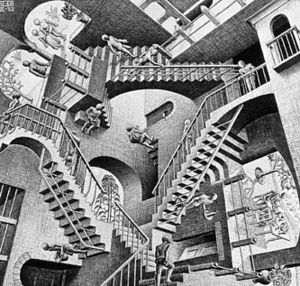
Relativity by M. C. Escher - 1953

Relativity by M. C. Escher – 1953

“Gloriously expert position. I merely bumbled upon your fastidious post and desired to articulate that I have really relished understanding your blog articles.” Genuine spam comment.

Understanding? I wish I could say the same of the comment. The spam box is a constant source of delight as improper comprehension and lack of fluency is added to the obvious misuse of translation software to produce masterpieces such as this.
Of course, in spite of the gloriously ludicrous phraseology, the intent of the writer is clear in the statement. He or she is being very complimentary, even though it is designed simply to flatter the ego, thus gaining approved status and the ability to spam. Even that aspect is clear, opening yet another layer of understanding. We can deduce also that English is unlikely to be their first language… and that they are being paid for their efforts.

It must be a terribly boring job. I dread to think of the criteria for being paid per comment, or indeed the pittance they are probably being paid. Which leads me to infer that regardless of intellect and technical ability the spammer is probably living in relative poverty. However, while I might applaud their industry I would still consign those who pay deliberate spammers to perdition. Except they are providing work and income… it is always difficult to judge when you start looking.

However, I digress.

So, it is possible, as we see, to deduce and infer an awful lot from that single, almost meaningless statement. It is a bit like the classic examples such as estate agent-ese where the words we are given imply a whole other world of meaning… where ‘compact’ means the size of a rabbit hutch and ‘quaint’ implies that while it may have delightful beams and roses round the door, you need to look seriously at the plumbing. Words alone mean very little on their own, they need context and interpretation on far more levels than the surface alone.

Out of curiosity I ran a few things through a readability calculator… as recommended by one of those articles aimed at teaching writers their trade. These things use a number of tests and generally give an age range for which a piece of work is suitable as far as vocabulary and structure are concerned.

One of the pieces was my own and came back with an age range of 14. One was an article on the enneagram from the School website; this had an average age of 18. All well and good. Where it all fell down was Stuart’s Perspectives on Perception, which came back as suitable for 8-9 year olds… and while the language is crystal clear, the concepts behind the words are deep enough to repay profound study. A child could indeed read it, but would youth have the knowledge, experience and understanding to fully grasp the meaning behind the words?

We all bring our own perspectives to the perception of the words we encounter, reading invisible backstories into a tone of voice or a choice or phrase. Words are emotive things… magical creations that can convey exactitude or leave an entire universe of imagination a place in which to play and explore. We colour words with our own emotions, often reading into them what was not there, through desire, fear or inattention.

They are powerful things words and emotions. Like the roast chicken, for example. I, quite accurately said, “We have chicken for dinner.” The dog hears only through her desire “… chicken for dinner…” and my inattention leaves me picking up the decimated carcass when she’s finished…

Posted in Life | Tagged , , , , , | 49 Comments

Simple #midnighthaiku

Simple joys remain

Held lightly in memory

Lifetime of laughter

*


Posted in Photography, Poetry | Tagged , , | 10 Comments

Carrion – Paperback Launch #booklaunch by Graeme Cumming


It’s here at last! And, if you were to look back to when I wrote the first faltering words of that very first draft (too long ago to be absolutely sure how many years have passed since), you’d understand just how relevant the words ‘at last’ are. Nevertheless, this is the last phase in getting Carrion published.

There’s still plenty to do in the future – these books don’t sell themselves, you know – but now the novel is at least available as a paperback as well as eBook. So, if you’re tempted by the prospect of adventure, excitement and, as one reviewer put it, a villain as villainous as they get (I think she was channelling her inner Blackadder there), you can now read Carrion in either format.

Continue reading at Graeme Cumming

Posted in reblog | Tagged , , , , | Leave a comment

Circles Beyond Time~Ancient Lines

derbyshire-heather-gardoms-carl-wark-moon-173

Wading through the wet bracken, we knew, would be worth it, for on the other side of the green fronds there is a stone…and it is something a bit different, in more ways than one. Several examples of Neolithic rock art, or petroglyphs, have been found on this part of the moor. One we have yet to locate, another, found during the excavation of a cairn, has been moved to the museum in Sheffield, and one… a huge, earthfast boulder… remains where it was found. But all is not what it seems.

derbyshire-heather-gardoms-carl-wark-moon-172

Gardom’s Edge carved stone.

The stone, one of the best we have yet to see in the area, was discovered in the 1960s, but it was soon noted that the carvings were rapidly deteriorating. This, sadly, is the case for many of the remaining petroglyphs that have withstood natural weathering for thousands of years, only to be almost obliterated since the Industrial Revolution altered the atmospheric chemistry of the world. One of the best known carvings to have suffered so is the Fylfot at Ilkley, also known as the Swastika Stone, that bears an image similar to the Camunian Rose found carved in Italy. When I was younger it was clearly visible. Now only a faint shadow remains and can only be clearly seen when the weather and light are right, behind its modern counterpart that at least still allows us to see what was once deeply carved in stone.

Ilkley Moor

Fylfot: The original carving is faintly visible behind and left of the modern reproduction. Image: James Elkington who also has an article on the stone.

Something needed to be done in order to protect the stone we had come to see and prevent it from sharing the same fate as the Fylfot. It is a large stone, difficult, though not impossible, to remove to a covered location, but the trouble with moving such stones is that their context is forever lost. We do not know for certain what they mean. What we do know is that many, if not all, of the significant stones that our ancestors left only make sense when seen in relationship to their surroundings. There are known alignments to landscape features, planetary bodies and to other ancestral stones… removing them from their place in the landscape robs us of any chance at all of learning to understand them.

haystack-ilkley

The Haystack, Ilkley, on the edge of the necropolis.

It is only by looking at the curves of a standing stone against its own horizon that you can see how they have been formed to shadow the hills. It is only by sighting through the notch on a standing stone that you can see how it aligns with a cliff or a stone far distant. It is when you stand within a ring of stones with the stars wheeling overhead that you begin to glimpse the understanding our ancestors had of the dance of the heavens. The mathematically inclined can plot the movement of the sun and show on paper why the Heel Stone and Trilithons of Stonehenge are so fantastically aligned… but when you watch the sun, framed within a stone arch and poised delicately atop the Heel Stone then, you can feel it.

stonehenge-004

Stonehenge

It is unlikely that our ancestors spent time computing zenith and nadir in a way we would recognise as mathematics, but they undoubtedly had an understanding that allowed them to build magnificently complex structures, like the recumbent stone circles prevalent in Scotland and Ireland that chart so precisely the movement of the moon. Moving their stones means we lose their precision as well as their natural context and any chance of understanding how and why they were so placed. The team charged with preserving the carved stone at Gardom’s, seem to have understood this and came up with an innovative way to protect it. Leaving it in place, they took a cast of the stone and created a perfect replica with which to encase it. The stone remains where it has always been. Close by, two stakeholes, some flakes of flint and a polished, shale ring were found.

Continue reading at France & Vincent

Posted in adventure, albion, Ancestors, Ancient sites | Tagged , , , , , | 3 Comments

Field of Sheaves: Found!…

*

…But anyway, back to the wood-stone.

The authorities are agreed on its antiquity.

It is either Bronze age or Iron age if that can be termed an agreement which in ‘sense-speak’ translates as very old or really old, and, either way, stones crafted in these ages are not supposed to do or be what this stone is and does which, strange to say, makes me think that it is really very old indeed…

*

…‘FOUND IT!’

‘Where are you?’

‘Over here!’

‘Over where?’

‘Here…’

‘Oh, wow!’

Continue reading at France and Vincent

Posted in albion, Ancient sites, Art, Books, Don and Wen, france and vincent | Tagged , , , , , , , , | Leave a comment