
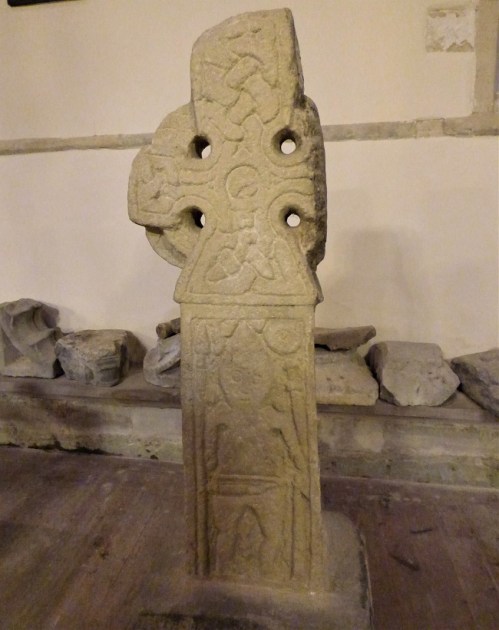
What we had really come to see at St Andrew’s church had very little to do with the church itself, except that many of the carved, tenth-century stones had been found, used long ago as building blocks within its walls. It seems almost criminal to think of such fabulous work being opportunistically ‘quarried’ from the surrounding landscape, but we know so little of the local story. The stones, though nominally Christian crosses, are carved with scenes of mythology and of the hunt… and they are classed as Viking.

The Vikings were invaders from Scandinavia. Their early incursions were short raids, but in the winter of 850, the army stayed in Britain and, over the years, their strength and presence grew. It is possible that the iconography of these eleven-hundred year old stones was seen as simply too pagan for the builders of the church. Or just inappropriate. Or perhaps it was a long memory of invasion that tore down the crosses. But as they were crosses, they became part of the church and were not simply discarded or broken. Leaving them for us, a thousand years later….curiously, just at the time when Stuart is exploring the symbolism of Norse mythology.

The crosses are distinguished simply by letters. Cross A is a ring-headed cross upon which a hunter has been carved. He is armed with a spear and the short sword known as a scramasax. He has two hunting hounds with him and below them is a majestic stag.
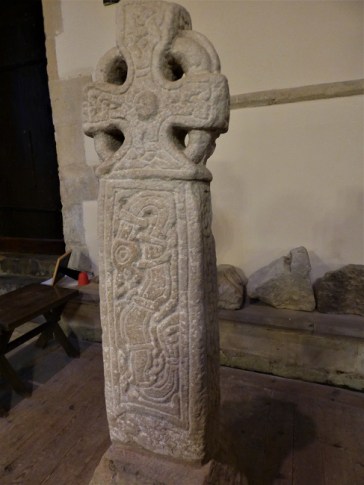
On the other side is one of the fabulous beasts, known as a ‘Jellinge animal’ because of its sinuous style. It appears to be some kind of serpent or dragon and it is bound. You cannot help but compare this creature, its power bound with cords, with the familiar depiction of St George, whose spear point holds the dragon. And whether you consider the dragon to represent the earth energies, the animal instincts, the unrefined ego, or… as some would have it, paganism conquered by Christianity… it is curious to contemplate the symbolic similarity.
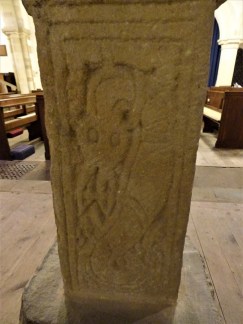
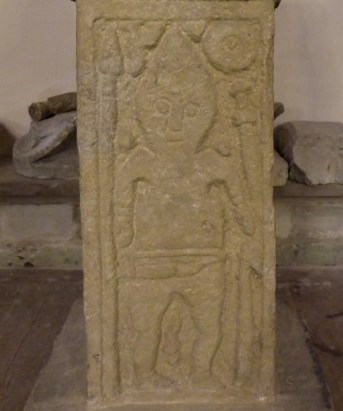
Cross B shows a similar beast on one side, while the other shows a heavily-armed warrior with a pointed helmet. It was removed from the church wall in 1949 and is known as The Middleton Cross. You can see the different hands at work on these two crosses… one the work of a skilled stone-carver, the other rather more simplistic in style.
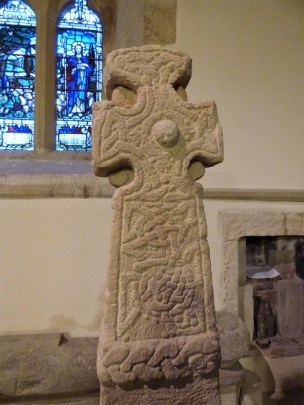
The third standing cross, Cross C, is badly worn but was once carved with ‘pagan animal heads’ according to the guide. The other face is still lavishly carved with interlacing.
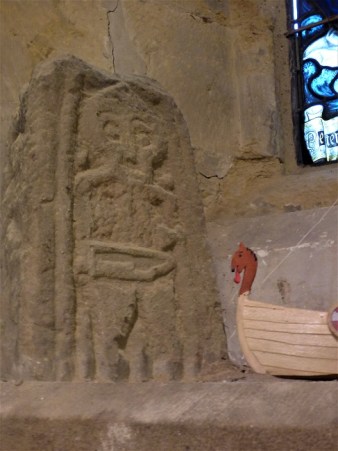
Crosses D and E are no more than fragments, but show the same pointed helmet on the warriors as on the first two crosses. I rather like the forked beard on Cross D… it reminded me of my son, whose beard now seems to want to fork naturally… and who was called ‘le petit Viking’ by the nurses in the French hospital where he was born, for his size, blond hair and blue eyes in a land more used to dark-haired babes.
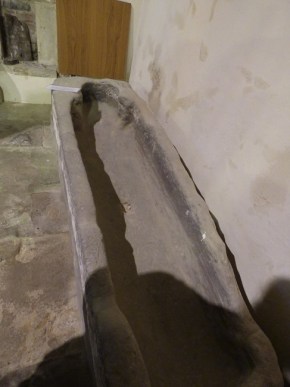
These stones are amazing to stand with… over a thousand years of history, and an insight into the art and culture of a people long ago absorbed into the life of the land in these parts. There are other stones too, fragments of decorative masonry, a stone coffin with a hogback lid… even a fireplace in the aisle that dates back to a time when it was used as a school and vestry and a trefoil doorway… Was it worth so many attempts to get in? Absolutely! But, there was still time to see one other place before we parted…

























 Sue Vincent's Daily Echo
Reblogged this on GrannyMoon's Morning Feast.
LikeLike
Thank you for sharing, Granny. Happy new year to you.
LikeLike
Happy New Year, Sue.
Interestingly, I’ve just finished the first draft of a novel set not long after the Great Invasion. The research was quite fascinating.
Lovely images.
LikeLike
I’ll look forward to that coming out… and hope you’ll come over with a guest post to talk about it, when you have a moment 🙂
LikeLike
These are amazing photos of the intricate detail by the stone carver so long ago. One would think they would have been worn almost smooth after such a long time. Great post, Sue! ❤️❤️❤️
LikeLike
We are so lucky to have so many survivals from so long ago…and not even behind glass 🙂
LikeLiked by 1 person
You are so lucky to live where these amazing historic sites are located.
LikeLike
I never forget that, Michelle. 🙂 x
LikeLiked by 1 person
❤️
LikeLiked by 1 person
Yes, fantastic.
LikeLike
Aren’t they? 🙂
LikeLiked by 1 person
Very much so!
LikeLiked by 1 person