Over the summer I’ve been trying to make up for lost time by getting out to as many medieval sites as possible to physically reconnect with the past. Last weekend I fancied a bit of an adventure, so we set off on a journey to deepest Shropshire to explore the extensive ruins of a rather beautiful abbey. It was a trip well worthwhile, because whilst being bathed in some glorious early autumn sunshine I got to connect with a vital part of the medieval world. So come and join me on a wander of discovery around a rather splendid place, and peer through a window into another world of prayer, austerity, and for some, great luxury.
Back in the Middle Ages again, and happy…
Situated on a rocky hillside near Shrewsbury between the Roden and the Upper Severn rivers, Haughmond Abbey can trace its roots back to the 11th Century, when the remote and then thickly wooded rural site attracted a group of hermits keen to escape from the world (I know how they felt). In the twelfth century the community benefitted from the patronage of two local nobles, William FitzAlan and John Lestrange, both powerful marcher lords defending the Anglo-Welsh border for the English crown. Religion was central to life in the Middle Ages, and the fear of one’s immortal soul spending an eternity in purgatory – or worse – drove wealthy people to invest in religious institutions as insurance for the afterlife. The way to do that was to support, enhance, or even to found an abbey or monastery whose inhabitants would pray for your soul and secure your place on the right side of the pearly gates.
After 1130, the community at Haughmond adopted the Augustinian Rule, which meant that strictly speaking they were canons rather than monks. Unlike monks, canons were all priests. They went out into the wider community rather than being an entirely closed order, and they lived less austere lives than some religious houses. For instance, they didn’t believe in wearing scratchy woollen clothing like other monastic orders, so instead they wore linen, a cassock lined with sheepskin or fur for warmth and a distinctive long, black hooded outer cope, earning them the name of ‘Black Canons’.
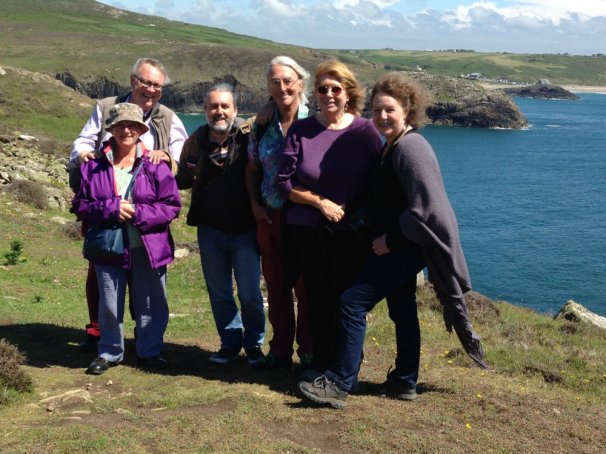
We were much later than planned leaving St Davids. All of us had a long way to go before we would be home as we had come together from the far-flung corners of the land. The weather was foul, with heavy sea-mist and rain making driving difficult so we chose the back roads instead of the motorway… it would take longer, but be less unpleasant…and we might even get a final glimpse of mountains if the fog ever lifted. And it did, just briefly, showing us places that at any other time would have demanded that we stop. As it was, it was late into the evening and night was drawing in before we got home.
It has taken weeks to share our impressions of the Silent Eye’s weekend workshop in Wales and even now, we have barely scratched the surface. It seems incredible that we manage to pack so much into these weekends… and yet, we do not rush, taking whatever time the place itself demands to experience it and sharing time to talk.
The countdown to the second chemo cycle has begun. On Wednesday they’ll check my bloods, on Thursday I’ll start on steroids again, on Friday I’ll have toxic drugs dripped into me and on Saturday I’ll take anti-nausea pills and, as they are what caused the constipation last time, I’ll have my liquorice at the ready. I promise I won’t eat too much of it!
I’m hoping it won’t be very much worse than the first dose but those in the know say the side effects become progressively more severe so I’m kind of expecting next weekend not to be great. But who knows?
I certainly didn’t expect to feel as well as I have this last week. The weather has, mostly, been pretty good, which always helps my mood. Yesterday it rained all day and I wasn’t out at all but on other days I’ve been out…
Well, it has not been a great week, what with the sky crying even more than she has…and she has been getting just a bit soggy around the edges, I have to say. Weirdly, I seem to set her off more than most things at the moment. She says…’cause I overheard her talking… that it is because she thinks I “must know” and she can’t help me understand better.
Well, clever-two-legsy-writer-person, I have news for you. If I already know, I don’t need it explaining, now do I? Hrmph! Honestly, that’s two-legses all over for you. Four legses don’t complicate stuff that much.
Which is how come I know anyway… whatever there is to know at the moment. Which is not, whatever she thinks, about what is going on with her dodgy mechanical bits… but all about how she needs to be looked after. I had a visitor. Now, I wasn’t surprised, ’cause she’s been thinking about my visitor a lot, so she was almost bound to turn up… I was just surprised she saw her too. That doesn’t usually happen. Must be all the pill thingys.
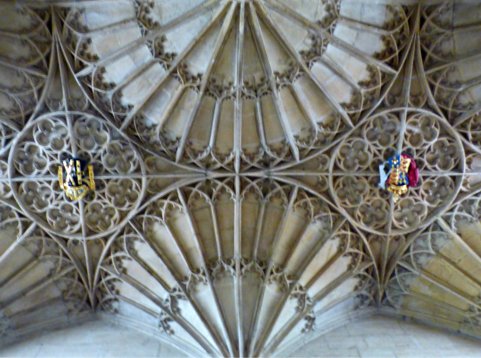
Behind the High Altar of St Davids Cathedral there was once an empty space, open to the winds. In the early 1500s, Bishop Edward Vaughan created a chapel there which, for me, is the loveliest part of the cathedral. The Holy Trinity chapel seems to be a very simple space of hewn stone; such is the sense of harmony there that the intricate carvings of the fan vaulted ceiling barely register as being ornate.
Instead, the eyes are drawn to the altar and to a niche through which one can just about see through to the High Altar and the shrine of St David. Both the altar and the niche use carvings far older than their construction…fragments of history that were recognised as such five hundred years ago. In the niche, a sanctuary light burns before the ancient carved crosses that frame the little window. Above the altar, the reredos shows St James, St Andrew, St Peter and St Paul flanking a scene from the Crucifixion, with a Latin text,”Behold the Lamb of God, who takes away the sins of the world”.
There is a sense of being enclosed here in an atmosphere of peace hallowed by centuries of prayer. Bishop Vaughan himself was buried in front of the altar. It seems an odd contrast… the churchman was responsible for many of the restorations and improvements that were added to the church in the 16th century and himself had an illustrious career… yet here he lies in an aura of simplicity.
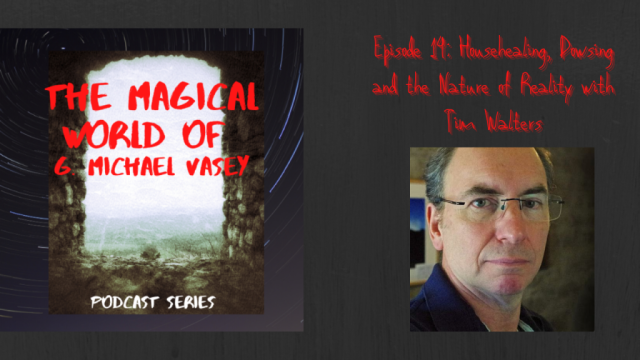
I had always thought dowsing was for finding water. My Dad used his rods for finding pipes and wires. I use the sticks to work with Earth energies. So, I was quite surprised to learn the Dowser and House Healer, Tim Walter, uses them to communicate with spirits! It turned out that this is how he had first seen them used.
I interviewed Tim for the latest edition of My Magical World podcast and it turned into a great conversation not just about dowsing but about entities and the nature of reality. Give it listen…
Please respect the copyright of all original material and images on this site. You are welcome to use excerpts, reblogs and links as long as clear, named credit and appropriate links back to this site are used. Written permission is required for all other reproduction.
Thank you.





























 Sue Vincent's Daily Echo