
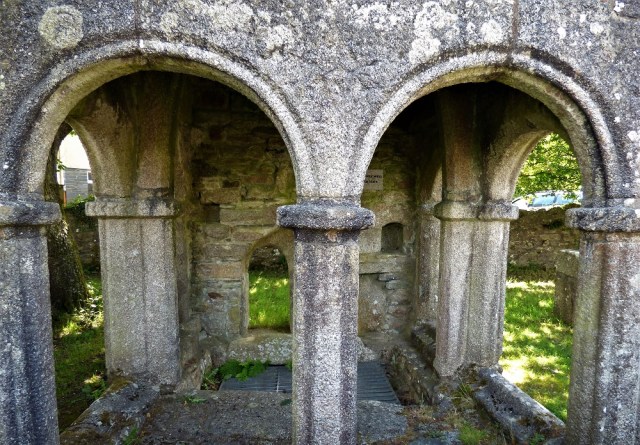
For once we had the forethought to ask the lady in the church for directions to our next port of call… the Holy Well in St Cleer. After our almost accidental visit to the Holy Well at Madron that morning, we felt we should see this one… and we were later to learn that the Mary Line runs straight through the well and the cross that stands beside it.
There is no saying how long this particular well has been venerated. The Christian rite of baptism and the shift in allegiance for the healing properties of water were a natural progression for many ancient wells where pre-Christian reverence had long held sway. Offerings have been found at our holy springs and wells going back to the earliest times, and there are thought to be over six hundred known sites still in existence here and a number of them have yielded offerings linking them to the Celtic reverence for the severed head. It is interesting, in that case, to consider that we still use the term ‘well head’…

Researching St Cleer’s Well threw up some interesting snippets. It seems there is some debate about whether the village was named after St Clarus to whom the church is dedicated. Clarus’ Feast Day is November 4th, which is also the Feast of St. Clether, who is also known as Cleer and Clederus. St Clether was the son of King Brychan Brycheiniog, who ruled in south Wales and his brother was St Nectan, whose hermitage still exists, in one of the most magical and beautiful of glens, close to Tintagel, where King Arthur is said to have been born. Clether ruled the area around Nevern after his father’s death and fathered twenty sons. We had seen the memorial to Maelgwn, one of his sons… the Maglicu stone… when we had visited St Brynach’s church in Nevern. When St Brynach brought the early Christian message to his court, Clether abdicated and himself became a hermit. Perhaps St Clarus was not ‘St Cleer’ after all?
Continue reading at France & Vincent
































 Sue Vincent's Daily Echo