
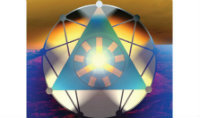
…The Tetrahedron is the magical symbol for elemental fire.
Fire has always carried with it a mystery.
From earliest times it was thought the proper preserve of the Divine.
For man to have gained this dangerous boon took especial cunning, courage and skill.
The fire-bringer in the old stories was a demi-god, a hero, a trickster…
In Vedic Mythology, which arose from the Indus Valley Civilisation, the fire sacrifice is regarded as a mental operation, an operation of the mind or of consciousness.
It has the aim of transcending the three worlds beneath the sun which are subject to the endless round of birth and death… and of reaching the realm beyond the sun where dwell the immortals.
Its practitioners are Agni (‘fire’) Vayu (‘spirit’) and Aditya (‘sun’).
Contemporary descriptions of Agni vary; some give him seven hands and tongues but only two heads, others depict him with three heads and as many golden bodies.

Whatever Agni actually looks like, if he can actually be seen, you would not perhaps expect to meet his like in the classical world.
And yet there is one figure whose ‘story’ bears comparison with that of Agni.
Continue reading: A Comparative Method…




























 Sue Vincent's Daily Echo
A tetrahedron is one of the Platonic Solids being a polyhedron composed of four triangular faces, three of which meet at each corner or vertex. It has six edges and four vertices. This geometric shape features a lot of symmetry. You can place any of the 4 faces on the table (that’s the orbit). Once a face is on the table, you can turn it in 3 different ways (that’s the stabilizer, since the face is a triangle, there are 3 rotations that keep it fixed). In total, there are 4 * 3 = 12 ways to rotate the tetrahedron.
LikeLiked by 3 people
Stuart is away this weekend, Jim…no doubt he wll respond when he gets back.
LikeLiked by 1 person
A very good symbol for the ‘Progenitor of Alchemy’ then…
LikeLiked by 1 person