Beckoning #midnighthaiku

A long road ahead

Spring waiting after winter

Beckoning us on

*


Posted in Photography, Poetry | Tagged , , | 14 Comments

A minor incident ~ Tallis Steelyard

Reblogged from Jim Webster, aka Tallis Steelyard:

Rumour insists that Maljie has a chequered history when it comes to vehicles. Currently she doesn’t command sole use of a sedan chair, but then few do. The bearers take a lot of feeding. Her sister, Margarita, travels at a fair pace in the dog cart but for longer journeys you need something more robust.

One long lazy afternoon at the Shrine of Aea in her Aspect as the Personification of Tempered Enthusiasm we discussed the perfect vehicle for Maljie. Admittedly this was in her absence which might have led to a more imaginative approach to the issue. The general consensus was that it ought to have at least two horses, although some felt that four was more appropriate. To put not too fine a point on it, most felt she needed a chariot and there was a general feeling that it should have scythes!

Continue reading at Tallis Steelyard

Posted in reblog | Tagged , , , | 7 Comments

Solstice of the Moon: Switching the Lights On

We had returned to Easter Aquhorthies for a second visit. It was still raining, but this time the sky was much brighter than the iron-grey deluge of the day before and there was already a sense of revisiting an old friend as we each returned to our stones. For myself, I was pondering some of the things we had learned here the day before… beginning with a rather obvious question from Running Elk.

“Where does the sun rise?” He was answered by silence. Twelve intelligent, fairly well-educated people had all apparently reached the same conclusion. The answer was so obvious that stating it was obviously going to turn out badly. Only the dog grinned. The sun rises in the east… that’s what we learn in school and that’s exactly what we think we see whenever we watch a dawn. Only, apparently, it isn’t. Who knew?

Well actually, I did. Except I didn’t know that I knew. It is one of those things simply taken for granted. Sunrise. East. Yet, my garden doors face east and I watch the sunrise most days. But thinking about it, I realised that while the winter sun rises directly opposite my doors, I only see the summer sunrise  by looking across the garden next door. At a guess, maybe forty-or-so degrees difference. So the sun does not rise due east, but in the eastern skies, or ‘east of centre’.

As an opening gambit, it was a masterstroke. I cannot have been the only one wondering what else I was simply taking for granted… and that one question opened the mind to considering possibilities that might otherwise have been overlooked.

Continue reading at France & Vincent

Posted in Ancient sites, historic sites, Scotland, Silent Eye weekend workshop, Solstice of the Moon | Tagged , , , , , , | Leave a comment

Two journeys, one destination (9) – Dunrobin Castle ~Steve Tanham

The beautiful vision of the ‘fairytale’ Dunrobin Castle, seen here from across the bay during our visit to Portmahomack, had tantalised us with the reported splendour of its architecture and gardens. Now, we had arrived at the gateway of its estate.

(1800 words, a twelve minute read)

(Above: Dunrobin Castle through a long lens…)

Dunrobin Castle is the most northerly of Scotland’s great houses and the largest in the Northern Highlands, having nearly two hundred rooms. It has been home to the Earls, and later, the Dukes of Sutherland since the late medieval age. It lies just north of the beautiful coastal town of Dornoch, on Scotland’s far northeastern coast. It is said that, in terms of Scotland’s history, Dunrobin is ‘about as connected as you can get‘.

Continue reading at The Silent Eye

Posted in Steve Tanham | Tagged , , , , | Leave a comment

Solstice of the Moon (Part 3) ~ Running Elk

Reblogged from Stepping Stones:

Day Two (Continued)

Following a rather delicious soup stop, we headed off for some light refreshment in the form of Symbol Stones. These mysterious artefacts of the Picts, with their admixture of Christian and Pagan symbolism, remain largely unexplained due to a lack of written records. The Gael provide the only evidence of who the Picts were, and that appears to be more legend than fact.

Shamelessly stolen
from tyrianterror at
Megalithic Portal

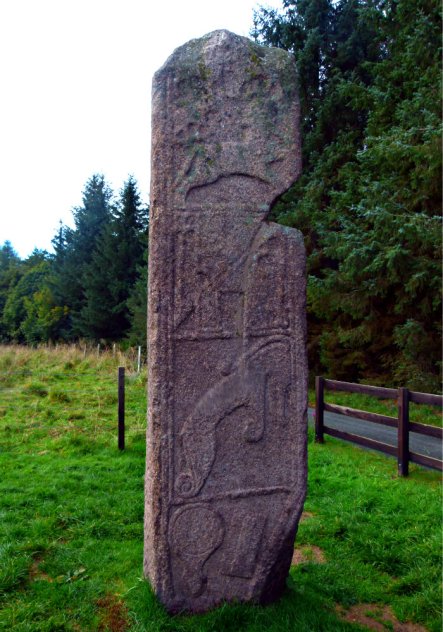
The Brandsbutt Stone, having been found in pieces making up part of a boundary wall, is not in its original location. It may not have travelled far, however, as traces of a stone circle, long gone, remain hidden a few yards away, under the well-manicured grass.

The stone is unusual in that it contains an Ogham inscription. Translating offers no insight, and it may just be 6th-century vandalism…

The main symbol, the so-called “V-rod and crescent”, is accompanied by a “Z-rod and serpent”.

Continue reading at Stepping Stones

Posted in reblog | Tagged , , , | Leave a comment

Around the flames

The year turns towards winter, pulling first a blanket of leaves and mist over its face before veiling itself in frost and snow. It is a time when many traditions remember the dead, the past or the holy. On a morning such as this where the world seems silently shrouded in a grey pall, you can see, even now in our concrete-bound lifestyle, how our forebears saw the wheel of life reflected in the landscape and the seasons. You can see, too, how they bound the two together in celebration and reverence, seeing the same strands of inner life woven through all aspects of the outer.

I used to love this time of year as a child. It was full of mystery and a half-understood connection through time and community to the long distant past and to the immediacy of the present in which children live. There was Hallowe’en to look forward to first. There was no trick or treating back then… but there was gingerbread and bobbing for apples, ghost stories and legends to share around the candle flames of the turnip lanterns, with their peculiar sweet smell that comes back to me as I write. None of these fancy pumpkins back then! I remember watching the skin of the turnip wrinkle and shrivel over the next days on the doorstep with the livid purples and the colour of decaying flesh.

Then there was Mischief Night… possibly the less said about that the better.. but it was innocent fun back then. And hot on its heels, the bonfire parties, street parties where small communities came together around the flames. ‘Health and Safety’ first sanitised, and now Covid has cancelled Bonfire Night, but the memories remain. Back then, mothers went into overdrive in the kitchens, baking potatoes and parkin, pie and peas and toffee apples.. and the bitter bonfire toffee that was as brittle as glass. Fathers and children built bonfires and organised fireworks… menfolk and flames seem to have a peculiar affinity and children can never resist the lure of fire.

There was a sense of connection. Parents and children became one interchangeable family, grandparents were shared, babies passed from hand to hand. In some ways we became tribal.. a single family joined in what was, essentially, a ritual. And it had all the power of everyday magic. Everyone knew their roles as if taking part in an intricate dance. They were not fixed, but mutable roles that changed with every movement, every pass, as the evening wore on… and the inevitable rain set in.

From this unchoreographed movement where each stepped beyond their normal, workaday self, around the living flames of the bonfire and under a sky punctuated by explosive light, a community was born or renewed. That sense of belonging and place carried over into the coming year and it was here, as much as anywhere, that support and friendship was born and sustained. Because we had shared something that was primal beyond the social event and had felt that kinship with each other and the elements.

The twin gods of Health and Safety have a lot to answer for. And, with the country now once again in lockdown, as socially distanced as we were once close, so does the virus.

I wonder how many of our small traditions will be lost because of the virus? How many little rituals will fall by the wayside? How many gaps will be left in our folk history… and, more importantly, perhaps, in the community that folklore should be serving?

There are few, if any, celebrations in the year now where a community will come together as we used to for Bonfire Night… where the true nature of ‘family’ extends beyond a narrow gene-pool to embrace everyone. Times change, customs come and go, but the human need for each other remains.

Posted in Life | Tagged , , , , | 41 Comments

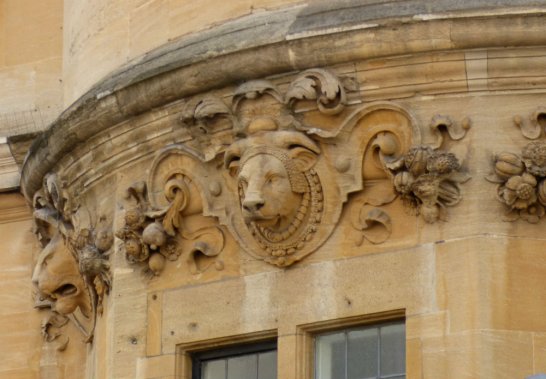
Clues #midnighthaiku

Meanings and symbols

Arcane stories set in stone

Barefaced mysteries

Scattered clues to tantalise

Or was the artist laughing..

*


Posted in Photography, Poetry | Tagged , , , | 16 Comments

A Spine-chilling Wander in Chillingham Castle ~ Alli Templeton

Reblogged from Medieval Wanderings:

Nestling deep in the heart of rural Northumberland, Chillingham Castle is a little bit special in many ways. I discovered this uniquely wonderful seat of pure English eccentricity a couple of years ago when we were on holiday, and I hope to return next year and write a post all about its rich and turbulent history. But for now, I fancied writing about castle ghosts to mark All Hallows’ Eve, and you can’t beat Chillingham for a good haunting. In fact, it’s been dubbed the most haunted castle in Britain. So come with me on a very different kind of castle wander: one with a ghost in virtually every room.

Chillingham Castle, home of so many lost souls…

We start in style, in the baronial Great Hall. A highly evocative and atmospheric room, it’s furnished with all kinds of artefacts including ancient armour and weapons, a sprawling dinner table that stretches nearly the whole length of the room, a tapestry depicting a battle scene and some mischievous spirits. Caretakers often report objects being thrown around by unseen hands, as cups, goblets and plates clobber them on the back as they lock up for the night. And it’s not just the crockery that moves around unaided.

Continue reading at Medieval Wanderings

Posted in albion, reblog | Tagged , , , | 15 Comments

Solstice of the Moon: Stone of the Maiden

P1300289

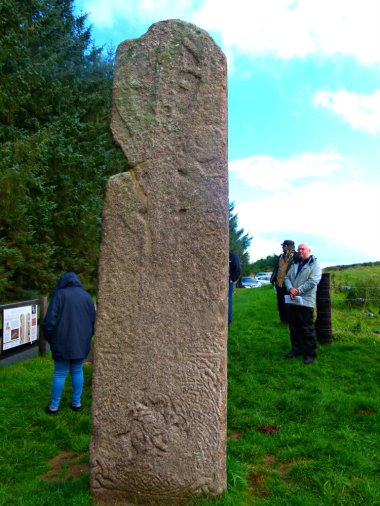
Once upon a time… twelve or thirteen hundred years ago… there lived a fair maiden. She was, it is told, the daughter of the Laird of Balquhain. She was betrothed and very soon to be married. On the eve of her wedding, she went down to the kitchens, rolled up her sleeves and set about making bannocks to serve to the wedding guests who would be arriving from far and wide.

As she worked, a dark stranger came into the kitchen and, seeing the mountain of flour, said that he could build a road to the top of Bennachie before she would finish her task. Now, Bennachie was sixteen hundred feet high and two miles distant. The maiden laughed and the dark stranger made her a wager… if he could build his road before the bannocks were baked, she would marry him instead of her betrothed. The maiden, certain of victory, laughingly agreed, but to her dismay, the stranger soon returned… the road was built and her forfeit must be paid. In horror, she ran, towards the wood of Pittodrie, seeking to escape. As she ran, she prayed for salvation, for she now realised that her pursuer was the devil in disguise. But her prayers were heard and as the devil seized her shoulder, she was turned to stone.

Unlike most legends, this must be a true story, for there was a paved road up Bennachie, of which parts still remain. It is still called the Maiden Road, and from the Maiden Stone a piece has disappeared, the same that was held in the grasp of the devil when the maiden’s prayer was answered.

***
P1300296

I have known about the Maiden Stone for a long time. It is one of those things you would really like to see, but never expect to actually see, so I was over the moon when I realised that it would be our next stop. Even though it was about to rain yet again, we had a little blue sky and a hint of sunshine… a little ironic when the worn designs would show up best in black and white on the photographs.

The Cross may once have been brightly painted and the quality and detail of the carving, even after thirteen hundred years of Scottish weather, are remarkable. The two sides of the Cross are carved with knotwork and keywork, even into the uneven contours of the edges. On the western face is a weathered Cross, suggesting that this was a Preaching Cross…a place where the evangelising brothers would come to teach the message of the Gospels. At the base is a roundel, framed within a square, intricately carved with interlacing and spirals. I have to wonder if this represents the Earth and its energies, surmounted by a Celtic Cross, symbolising the way to Heaven.

Above the head of the Cross is a figure with outstretched arms, in a pose similar to that of the crucified Christ. He appears to be holding on to two ‘fish-beasts’. I take issue with the official idea that this depicts Jonah and the Whale. There was, I believe, only one whale in that story and the idea that they carved two ‘to make the design symmetrical’ seems a bit far-fetched. On the other hand, a fish has long been a symbol of Christianity, and Jesus, if it is indeed He who is depicted, was called a ‘fisher of men’. To go by some of the carvings we see,  Celtic Christianity was too close to the old religious symbolism to be unaware of such things and seemed less inclined to dismiss the shadow of the old ways.

The  red granite pillar stands almost ten feet high, and was once a little taller… you can see how erosion has destroyed the top edge of the design on the eastern face. This is a great shame, as one centaur is odd enough in Britain, let alone the three that are thought to have been there before the rains came. That is, if they are centaurs. They certainly look like the Greek combination of man and horse, and have been found painted in contemporary manuscripts. In the Mysteries, the centaur has its own symbolism, as the higher human virtues transcending the nature of the beast within. But this is Scotland, where legends abound and even horses may not be what they seem.

There is the nuckelavee from the Orkneys, a half man, half horse beast that retains both heads. Its breath wilts crops and brings epidemics and the stories of its terrible effect paint it as the worst of the equine demons. It is a sea creature, though, and will never come ashore when it rains, so we were safe on that count. Then there are the kelpies, shape shifting creatures that may appear as humans or as beautiful black horses that will carry their riders into deep waters…where they drown. In Aberdeenshire, some are said to have manes of serpents… but we were far from the lochs in which they live. The dullahan is a not a horse, but rides one, carrying its own head and whip made of a human spine. It is a bringer of death and the only thing that will drive it away is gold. We were probably safe on that score too, if only for the nature of the company.

Continue reading at France & Vincent

Posted in Ancient sites, History, mystery, Photography, Scotland, Solstice of the Moon, Spirituality, symbolism, The Silent Eye | Tagged , , , , , , , , , | Leave a comment

October Book Reviews from D. Wallace Peach

Diana Wallace Peach shares two posts, each packed with reviews of the books from her 60-book Autumn Reading Challenge.

In her first post, amongst others, she reviews Marcia Meara’s A Boy Named Rabbit, and The Last Pilgrim by Noelle Granger.

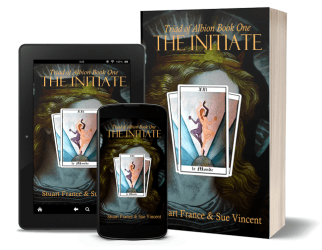
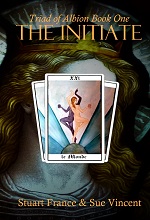
In her second post, alongside books by Pete Springer, Jill Weatherholt and others, Diana also reviews our book, The Initiate…

Visit Myths of the Mirror to read all Diana’s October Reviews

Posted in Books | Tagged , , | 9 Comments