
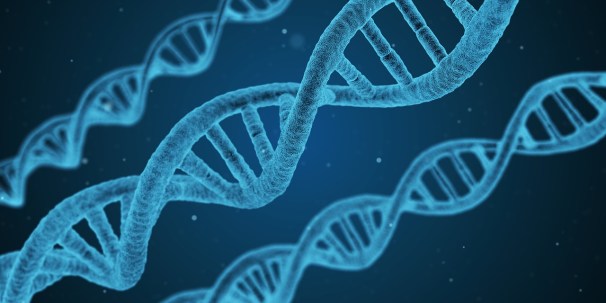
Image: qimono at pixabay
I awoke with an odd thought playing around the corners of my mind. “…You could, theoretically, extrapolate the whole of human evolution and history, every conversation and story that had ever been or would be, from a single human cell.” Not a new idea… it must have been used in any number of science fiction tales, but it was a fairly unusual thought for me to wake with… I am no scientist. But, in those brief moments before the dream faded, with spirals of luminescent DNA curling around me, I knew exactly why it could be done and how to do it.
As the dream escaped, exorcised by the damnable alarm-clock, I tried to follow the wisps of thought that remained, but as consciousness returned, I kept on coming up against two major obstacles. Even supposing you could access and extrapolate the data in the cell, you would need some kind of super-computer in order to extract and process all that information. If you were writing a story, you would have to fall back on setting it in the far distant future or introduce alien technology… all a bit passé really. And anyway, you would be hard pushed to beat the Total Perspective Vortex from The Hitchhiker’s Guide, in which the whole of reality is extrapolated from, ‘say, a small piece of fairy cake’.
But, supposing you did? Supposing you wrote the story or, even better, built the technology to do it in reality? Science is advancing at a phenomenal rate… especially in the technological arena. It isn’t beyond the bounds of possibility…though, maybe not yet awhile. Supposing we had the technology… what would a computer actually read or predict?
History would be no more than a collection of facts. Events and people that have changed the world would be illogical to a computer as emotional responses would be read as no more than a print-out of chemical changes and imbalances.
It has already started… between the algorithms used by sites online to choose our preferences from data gathered from our browsing history, comments and presence, to…I noticed yesterday… emails ‘reading themselves’ and telling the writer what emotional impact the missive might have, based upon the programme’s analysis of the email’s content.
Now, I send a lot of emails. I noticed that with each one I sent, an emoticon was displayed telling me how the programme interpreted the tone of my words. And, in every case, the programme got it wrong. And why? Because I am a terrible writer, incapable of expressing myself clearly? Because, apart from official letters, I tend to write as I speak… complete with all the pauses, filler words and colloquialisms that editing software flags up as dispensable or just plain wrong? No. It is because the programme understands human language… but not humans.
The programme cannot tell the difference between banter and anger, between a joke and a complaint or, for that matter, between poetry and a collection of grammatical errors. It does not understand how relationships work, or the private jokes that grow from intimacy. It does not understand friendship or love… or at least, not beyond the dictionary’s definition. It doesn’t understand people at all… it only has knowledge and that is not even close to being the same thing.
A machine might be able to calculate probable responses based on algorithms and pre-programmed statistics, but it would never understand the feats of which the human heart is capable.
Hope, leaps of faith, gallantry, self-sacrifice, empathy, artistry and inspiration… none of these would make sense to a machine that cannot feel and cannot be moved. Now, it is also theoretically possible that future artificial intelligence could be ‘taught’ to ‘feel’ by reproducing the neural messages and stimuli that are known to have a specific effect on human behaviour. They will be able to learn to simulate emotion and offer what appears to be a genuine emotional response. But machines operate by logic… and that cannot always be said of people.
One young man risks his life to save many… that could be seen as a logical, though heroic, response to a situation. A man, upon whom his whole family depends, risks his life to rescue a drowning kitten? Not quite so logical. The body-chemistry created by such emotions may be measurable and reproduceable, but these are the acts of apparent madness that make us human. The courage to calculate the odds and say, ‘to hell with them’. The love that will give all for another. I very much doubt that any machine would see, let alone be able to reproduce or understand, the glorious, illogical, unrealistic beauty that is the human heart and spirit.





































 Sue Vincent's Daily Echo
Absolutely right. We humans are unique and even we cannot understand each other at times. So what chance a computer or a computer generated program has of doing so!
LikeLiked by 1 person
The physical machine is probably easy enough to replicate… but the rest? We would need to understand ourselves first.
LikeLiked by 2 people
Not even that. Machine has lot of limitations, the brain, none! But rightly said we need to understand ourselves first.
LikeLiked by 2 people
The movie I Robot sums this up where a machine calculates the survival chances and a young girl dies as it saved Will Smith’s character because the odds were better.
Machines can analyze data, but as you say, not tone, banter or anger. So many things from education to health are determined by tick lists, not individual appraisal and although there are amazing advances in technology, IMHO you can’t beat hands on and a one on one.
LikeLiked by 1 person
The nuances of life, empathy and emotion are lost on mechanical minds.
LikeLiked by 2 people
Exactly.
LikeLiked by 1 person
Reblogged this on Chris The Story Reading Ape's Blog.
LikeLike
Thank you for sharing, Chris xx
LikeLiked by 2 people
My pleasure, Sue 🤗❤️🤗
LikeLiked by 1 person
💖
LikeLiked by 1 person
Pingback: Man vs machine? — Sue Vincent’s Daily Echo – yazım'yazgısı (typography)
I think this cuts both ways, for I don’t understand the machines either!
LikeLike
You have a point there, Jaye 🙂
LikeLiked by 1 person
Thanks, Sue. Once again – you thoughtful woman – you’ve hit the nail squarely on the head. Us humans are full of such amazing emotions and contrariness. Don’t you just love ’em…(well most!!) Hugs xx
LikeLike
We are amazing creatures…and forget it so often.x
LikeLike
So what you’re saying is IF computers were human they’d be psychopaths?
LikeLike
I don’t think they ever could be human… only fake it. they could be programmed with a moral code… but would always lack empathy.
LikeLike
I agree with your summary, Sue. No machine will ever “be able to reproduce or understand, the glorious, illogical, unrealistic beauty that is the human heart and spirit.” I like that. ❤
LikeLike
I cannot see how they can 🙂
LikeLiked by 1 person
The complexities of human interactions, with each other and their environment are far too entangled to be programmable, no matter what today’s crop of ‘A.I. theorists’ think. Even if a storage system could be built in the first place it would have to start as an ’empty vessel’ akin to a baby’s birth, and even then there’s all the ‘stuff’ that comes to wee beastie in-utero to be considered. Then it would have to be aged as a child ages. The issue then becomes what culture will this ‘child’ be raised in. What conscious and sub-conscious biases will it learn and have to unlearn?… the list goes on and on. 😀
I think it might be possible at some point, when an organic ‘brain’ can interact directly with it’s environment, that is without human intervention or direction/coercion/persuasion … but then, what would this new being think of us? 🙂
LikeLike
I agree and were I to be around long enough, fully expect near-perfect ‘brains’ to be developed. They may even, as the current theories ave, be able to upload human memories to preserve them. But, humanity’s antics might well be seen as the destructive behaviour of spoiled children by a ‘perfect’ and logical autonomous mind.
LikeLiked by 1 person
I do agree and I do fear for us if A.I. ever really does take over because the will see us dangerous, mad and deranged….even when we assume we are quite normal 💜 I think Imogen Heap is saying what you are saying, she may be coming at the subject from a different angle but it’s similar. ( The voice of the computer)
LikeLike
I wonder if machines ever dream?
LikeLike
It’s a intriguing though isn’t it. I almost hope they do💜
LikeLike
❤
LikeLike