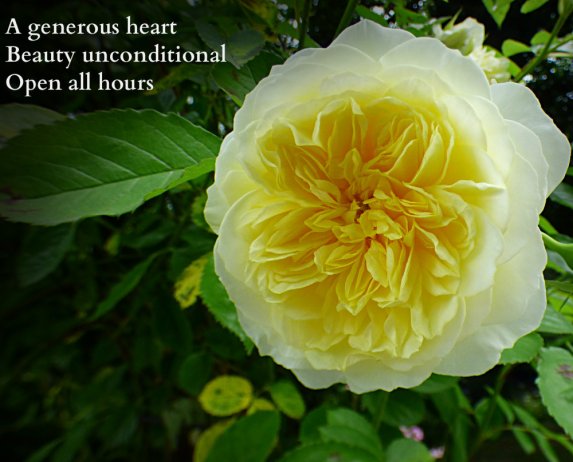
Writing this, I came up against one of those thorny questions in language; how may syllables in ‘hours’? It is not the only word to be so confusing, nor is there any definitive help in the dictionaries. Opinions vary, so does pronunciation depending upon regional or national accent…and so does the usage of those poets upon whom we might depend to point the way. Shakespeare, for example, seems to use it as both monosyllabic, disyllabic and sometimes as whatever floats the reader’s literary boat.
There are other words that offer the same problem… things like ‘fire’ and ‘flower’. In poetic forms where syllable count matters, they can be a nightmare for the writer…and a big red target for critics whose pronunciation or rendering of the poem differs from that of its creator.
In the established ‘English form’ of haiku… itself a variant and interpretation of the much older and more complex Japanese form… the 5-7-5 ‘rule’ of syllabic counting is approved as the norm. It is not, however, the only way to write haiku and other forms are both accepted and celebrated. Indeed, the Japanese may well have composed to a traditional count of seventeen, but the language counts sounds, not syllables.
…Although the word “on” is sometimes translated as “syllable”, one on is counted for a short syllable, two for an elongated vowel or doubled consonant, and one for an “n” at the end of a syllable. Wikipedia
Instead of agonising over syllable counts and tearing your hair out as you write, or pointing the proverbial finger at those poems which seems not to conform to ‘the rules’, perhaps we should, instead, look at the thoughts and layered ideas a verse contains and see beyond its form to its heart.
Poetry is an echo, asking a shadow to dance. Carl Sandburg




















 Sue Vincent's Daily Echo
i so agree with just accepting the poem as is. i’ve struggled with the ambiguous syllable issue myself.
LikeLiked by 1 person
It can be a real pain. You know how you would pronounce it…but will anyone else ? 🙂
LikeLike
Yes, why is poetry so mathematical? I love your idea of layered meanings in a verse… so true.
LikeLiked by 1 person
I think the metre and rhyme in poetry has a lot to do with the way it can be held in memory. A ‘catchy’ chorus in a song need only be listened to once or twice and it stays with you. If poetry is used as a vehicle for teaching, like we still do in childhood, lessons can be learned before they are even understood… and preserved without need for explanation when couched in symbolic terms. I think poetrystems from very early teaching methods and may be why storytellers were once so revered.
LikeLiked by 2 people
I absolutely agree… it must have been so difficult to learn and create poetry when you can’t write it down.
LikeLike
Oddly, when you can’t write it down, it sticks. I wrote a number of song lyrics that way and still remember them thirty years later.
LikeLike
Lol! I wish I could say the same… I think I was at the back of the queue when memories were dished out! 😂
LikeLike
Pingback: Open #midnighthaiku — Sue Vincent’s Daily Echo | O LADO ESCURO DA LUA
Thank you for sharing 🙂
LikeLike
Great idea and information. Thx. 😉
LikeLike
G;ad you enjoyed it, Michael 🙂
LikeLike
Reblogged this on Die Erste Eslarner Zeitung – Aus und über Eslarn, sowie die bayerisch-tschechische Region!.
LikeLike
Thanks, Michael 🙂
LikeLike
Makes me glad I don’t rhyme!
I was thinking about “fire” which I pronounce as both one and two syllables, depending. Songs are very liberal about the whole sounds and syllable thing and I’ve heard “I” last three beats to the bar!
LikeLiked by 1 person
You seldom notice quite how much youfit pronunciation to rhythm… until it catches your attention. A breath can be a beat in a rhyme… but readers may not see that on the page.
LikeLiked by 1 person
Good syllable pounts raised Sue!
LikeLike
They can be a pain, can’t they?
LikeLike
I must sit looking like an idiot sometimes… tapping my fingers whilst counting them lol!
LikeLiked by 1 person
No comment…I do to 😉
LikeLike
😆
LikeLiked by 1 person
Reblogged this on anita dawes and jaye marie.
LikeLiked by 1 person
Thanks Jaye x
LikeLiked by 1 person
Far too early in the day for technicalities… see you later!
LikeLike
Just enjoy the roses then 😁
LikeLiked by 1 person
Lovely!
LikeLiked by 1 person
Magnificent, Sue. 🙂 — Suzanne
LikeLike
Thank you, Suzanne.
LikeLike
Beautifully written Sue. Words are tricky, and good points about counting syllables in certain words when you’re trying to stay true to a haiku. Is it flower or flow er? 🙂 xx
LikeLike
Words can be lethal weapons…or make a poet tear their hair out 😉 xx
LikeLiked by 1 person
Well said! 🙂 xx
LikeLiked by 1 person
Fuunily enough, I enccountered thi syllable problem recently when writing a haiku. As you mentioned, words can be pronounced in different ways so it confuses the issue!
It’s the rhytm and flow of the haiku that I love, so am not bothered if it is one or two syllables awry!
LikeLike
I don’t think we have to be too bound by the rules. It is the essence of the thought and how it can be expressed that matters.
LikeLiked by 1 person
Yes, exactly 🙂
LikeLiked by 1 person