
We had no idea where we would be taken for the final visit of the day. We suspected an ancient site as the area is just strewn with them. A brief glance at a map of prehistoric sites had left me wishing we were going to be in the region for at least the whole summer… you would need it to have any chance at all of seeing surviving remnants of our ancestors. We were not disappointed. A short drive and a shorter walk and we found ourselves at the neolithic burial chambers of Dyffryn Ardudwy.
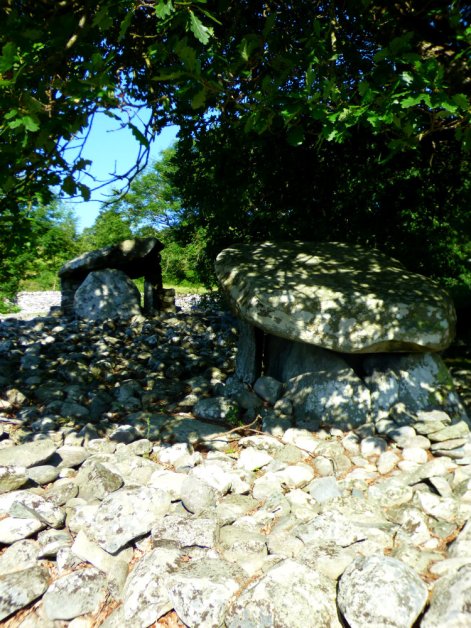
It is immediately impressive and unusual, though the brilliant sunlight reflecting on white stone and the deep shadows cast by a stand of oaks made it difficult, at first, to take in the full scope of what we were seeing. Small rocks cover an area around a hundred feet long by fifty feet wide. It is roughly trapezoidal in shape and, once again, reminiscent of the ceremonial stone axes that played such an important part in the culture of our ancestors.

Aerial image showing the shape of the enclosure, half hidden beneath the trees. Image: Google Earth
These axes, particularly those made in the most renowned ‘factories’ were traded across the country and even through Europe. So many have been found unused, buried as grave goods or offerings, that they seem to have been much more than a mere practical tool. These ‘axe factories’ where the stone was quarried and crafted all seem to be in areas where the stone itself has special beauty of properties…and they are always in areas where major stone circles and monuments remain.
You have to wonder why. Was the stone itself prized for its qualities, or was it more to do with the location from whence it came? What did the shape represent. a mere stylising of a more practical form or did it hark back to early and symbolic representations of the womb of the goddess? That we will never know… but the shape itself crops up far too often at these sites to be ignored.
There are two burial chambers set within the field of stones. The smallest, set to the west and facing east, is the oldest. In fact, it is amongst the earliest of such tombs in the country, dating back possibly six thousand years. To put that in perspective, it was already ancient before the Great Pyramid was conceived.
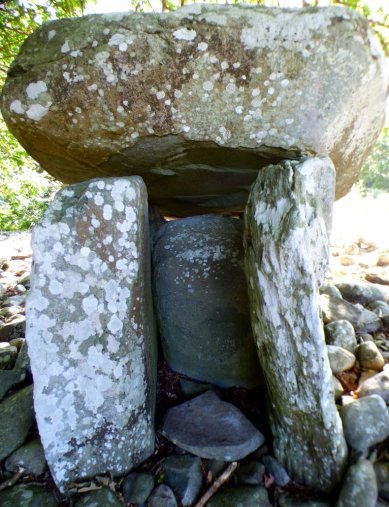
There are many dolmens and traces of the ancient past around the village and a glance at the map shows some startling alignments across the landscape. The church of St Dwywe within the parish was built upon one ancient mound. A straight track from the church runs past the cairn of Cors-y-gedol to another cairn on Moelfre that aligns with the summer solstice. On the hills above Dyffryn Ardudwy, a line of standing stones tracks across the mountains. There can be no question of the importance of the area to our ancestors.
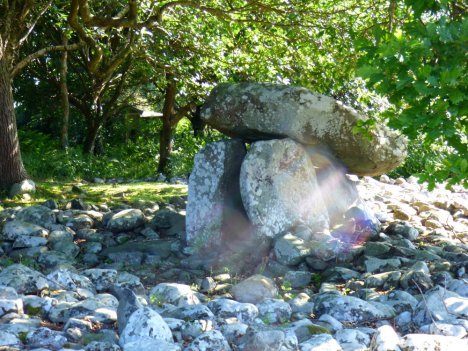
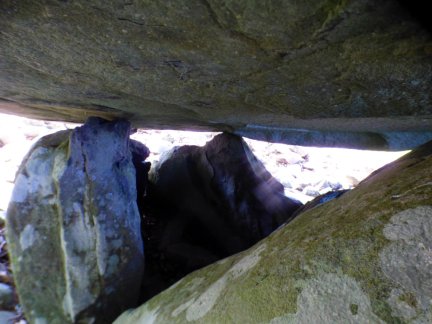
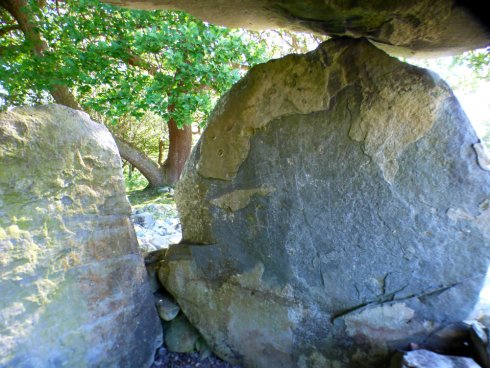
The smaller, older chamber is a classic shape, with tall pillars at the eastern entrance. They support a massive, sloped capstone and between them, a blocking stone still stands, closing the chamber. In front of the blocked entrance is a shallow ‘V’ shaped ‘pit’. Excavations in the 1960s found no bones within the chamber, but fragments of deliberately broken shouldered urns and polished stone plaques were found in the pit.

When it was first constructed, the smaller chamber was enclosed within a round barrow. Almost all dolmens were so enclosed, the shape of the barrow changing over time. Most had a passage or forecourt that gave entrance to the tomb which was often used for multiple burials, with bones being added and removed over the years. It would seem that to our ancestors, their ancestors still had a part to play in the life of their communities.
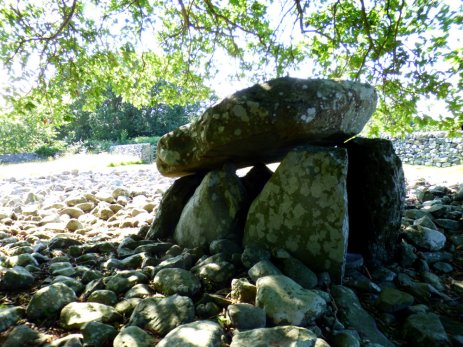
The most curious feature of the western tomb, though, is the enigmatic carving that adorns the stones… stones that would have been buried and out of sight. Except, perhaps, to the dead. We have come across this too in many places and it suggests that these were not ‘just’ burial places, but houses of the dead, where the dead were seen to have a life after their own fashion.
Continue reading at The Silent Eye


































 Sue Vincent's Daily Echo
Awesome photos. It looks like a place well worth a visit
LikeLike
It really is worth a visit and there are many other ancient sites within that area too.
LikeLiked by 1 person
Reblogged this on .
LikeLiked by 1 person
I am always astonished that these ancient places still exist, forgotten and hidden away as they are. Will anything we leave behind last as long, I wonder?
LikeLike
I have asked myself that question and although doubtless some things will survive, it is likely to be the precious objects rather than our everyday lives and deaths that make themselves known to future archaeologists.
LikeLiked by 1 person
Reblogged this on willowdot21 and commented:
This wonderful post from Sue Vincent is just so good , and it needs to be shared. 💜
LikeLiked by 1 person
❤
LikeLike
This makes me hungry to go in search of our ancestors!💗
LikeLike
Thankfully, in Britain, their footsteps are never far away. ❤
LikeLike
Yes we can feel them sometimes 💜
LikeLike
Yes… we can ❤
LikeLike
🤗💜
LikeLiked by 1 person
Reblogged this on Die Erste Eslarner Zeitung – Aus und über Eslarn, sowie die bayerisch-tschechische Region!.
LikeLike
🙂
LikeLiked by 1 person