
The first in a series of guest posts by author Paul Andruss…
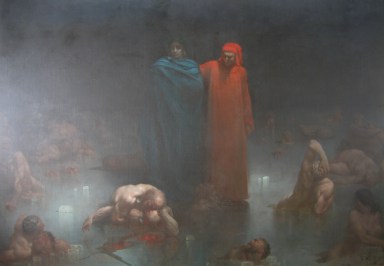
Gustave Dore: Painting form Inferno: Dante and Virgil 1885
Have you ever wondered what a psychopomp was?
What do you mean no!
If you think the fact you just don’t care is ever going to stop me, then think again!
A psychopomp is an animal or person that guides the newly dead to the afterlife. In Greek and Roman mythology it was the messenger of the gods, Hermes or Mercury (same god – different names).
In Norse mythology, the Valkyries (choosers of the slain) perform the role. Odin’s twelve handmaidens swept battlefields on their sky-steeds, often thought of as ravens not horses, collecting the souls of the heroic fallen to take to Valhalla – the Hall of Heroes- where they will feast until Ragnarok: the end times; the Twilight of the Gods.
Ancient Ireland was matrilineal – a child belonged to the mother, not the father. They sensibly believed while no child could ever be sure who its father was, there was no doubt about the mother. Women were free to divorce, take lovers and have children by many different men. Unlike in the classical world, women inherited property, could choose to keep it separate from her husband during marriage and took it away with her after divorce. This was probably because the Irish thought themselves descended from the goddess Danu.
Matrilineal descent may also account for the bizarre Dark Age custom of Irish kings presenting strangers with their nipple to suck when offering protection. For by symbolising the mother suckling a helpless infant, it represented the most sacred and unbreakable bond there was.
Given motherhood was supreme it is not surprising one of the most powerful deities was simply called Morrigan, meaning Great Queen. She was the goddess of plenty, increase and battle. Her bird was the raven – a carrion feeder most often seen on the barren field after harvest and the battlefield after slaughter.
The very earliest known settlements from around 11,000 years ago, such as Gobekli, Catalhoyuk and Jericho, already feature vultures in the cult of the dead. Some cultures still practice sky burials allowing carrion birds to consume corpses. The raven is the closest bird Northern Europe has to a vulture. Its reward for guiding the souls of the new dead is the flesh left behind.
Because of her association with the raven, Morrigan is seen as a psychopomp. As is the British god Bran or Vran, whose name means raven. The story of Bran is found in the first branch of the Mabinogion- a collection of Old British stories surviving in the ancient Red Book of Hergest and the White book of Rhydderch.
Bran goes to Ireland to rescue his sister Branwen (White Raven) from an abusive marriage. When Bran is slaughtered, his followers cut off his head to bring it back to Britain. Each night for seven years Bran’s head entertains them. At last begging for rest, Bran instructs the men to bury his head under Tower Hill in London to protect the country from invasion. According to one legend, King Arthur dug up Bran’s head because he wanted to be Britain’s only protector.
Another Celtic psychopomp was Gwyn ap Nudd, the Lord of Annwn – the Celtic underworld. The leader of the wild hunt, Gwyn ap Nudd scoured the skies for souls with his hell hounds. He later became the King of the Fairies.
The Celts had a funny conception of the underworld. It was like this world but much happier. The Celts believed so strongly in the afterlife they left debts to be paid in the next life. They believed people could move between realms. Not only could living heroes visit there, but dead heroes could return to here.
It is not clear whether the Celts believed in reincarnation or the transmigration of souls from one body to another, as often claimed. In tales, the dead heroes return as flesh and blood looking exactly the same as before they died.
In Dante’s medieval poem the Divine Comedy, the ancient Roman poet Virgil acts as Dante’s psychopomp – although Dante is not dead. Dante chose Virgil because of the poet’s vivid and knowledgeable description of the underworld in his epic poem the Aeneid.
Accompanied by Virgil, Dante visits the circles of Hell and Purgatory before Virgil hands him over to his idealised love, Beatrice, to guide him through heaven. Dante fell in love with Beatrice when she was 8 and he was 9. She died at the age of 24.
Being a pagan, Virgil cannot accompany Dante into heaven. He is not eligible because he died before Jesus redeemed mankind. So, like unbaptised babies, virtuous pagans get to occupy the first circle of hell. Okay it is one of the more pleasant neighbourhoods… but it certainly makes a point! And not a particularly pleasant one at that!
Contrary to the idea of a flat earth, Dante knew the world was a globe. He descends deeper and deeper into the bowels of hell. Then, on the other side of the planet, ascends into Purgatory – a huge mountain thrown up by the impact of Satan falling from heaven. Called the Antipodes, Mount Purgatory is the only landmass on the far side of the world. Although I am pretty sure Australians will have something to say.
On top of Mount Purgatory is the Garden of Eden. Above it the circles of heaven rise up to where God sits in the Empyrean, or the highest heaven. Each level of heaven represents a different choir of angels, corresponding to those whose job it is to push round the planets and otherwise order the cosmos. In many ways Dante’s description of the circles of heaven correspond to Gnostic beliefs dating from the very foundation of Christianity, and regarded as heretical for almost as long.
About Paul Andruss:
 Sue asked for a brief biography. I genuinely don’t know what to say.
If I were a musician I would be Kate Bush or the Beach Boys’ Brian Wilson; but without the mental issues or dependency on prescription drugs. For Brian not Kate! I can talk about anything except myself, so let’s talk about my work.
I’ve written 4 novels, Finn Mac Cool, and the (Harry-Potteresque) Jack Hughes Trilogy. ‘Finn Mac Cool’ and ‘Thomas the Rhymer’ are available for free download. Hint! Hint!
As with many writers, I began with no formal skills; was working long hours and could not spare family cash to pay for professional help like courses or editors. Unlike sensible people, I did not write short stories to build up my writing skills but went straight for an epic (Finn is 180,000 words). Big mistake!
Finn took 4 years to write and another 2 to realise how badly it was written. So I started learning proof-reading and editing, and started taking more notice of how other authors construct their work.
‘Thomas the Rhymer’ came about after watching a Harry Potter film. I thought I can do that! Just goes to show how wrong you can be. Damn these big ideas!
After ‘Thomas the Rhymer’, the sequels ‘Daughters of Albion’ & ‘Thirteenth Treasure’ were a lot of fun to write. I knew the characters and where I want to take them.
‘Thomas the Rhymer’ took 18 months from concept to first draft; another year to get it to agents, and 18 months with agents. It was well received by some but not taken any further.
I later learned rejection can have more to do with an agent’s belief that publishers won’t take the risk, rather than a comment on quality. Publishing is in crisis. A bit of research shows it always has been. After discovering this, I decided to go down the indie route. These days, authors have ever-expanding learning curves. Writing is just the tip of the iceberg.
Before leaving rejection letters, about which everyone can contribute! I used to take comfort from this story while crying myself to sleep.
As the author of ‘Vernon God Little’ walked away from the stage with the 2003 Booker Prize every major Literary Agency asked. ‘Why didn’t you send it to us?’
To each and every one, he replied… ‘I did!’
They had all ignored it. Yet ‘Vernon God Little’ also won the Bollinger Wodehouse Everyman Prize for Comic Fiction, the Man Booker Prize for Fiction, and the 1st Novel Award in the Whitbread Awards.
Download a free copy of Paul’s book, Thomas the Rhymer HERE

Connect with Paul:
Blog Facebook Twitter @Paul_JHBooks Google+
E-Book versions of Thomas the Rhymer are available FREE here
Learn the Story of Thomas the Rhymer
If you would like to be my guest, please read the guidelines and get in touch!



























 Sue Vincent's Daily Echo
Reblogged this on The Feed By Our Pantheons Way and commented:
I love it!
LikeLiked by 3 people
Thanks, Troy.
LikeLiked by 1 person
Always a pleasure.
LikeLiked by 1 person
Sue and Troy (Cianaodh) thanks so much. I am getting on to this before dinner and then I will check out the rest of your excellent posts later tonight Sue. You are a Star .Ta!
LikeLike
My pleasure, Paul 🙂
LikeLike
Excellent post as always from Paul.. have shared of course.
LikeLiked by 1 person
Thanks, Sally. Paul has a few more coming out this week too 🙂
LikeLiked by 1 person
Great he has hit the jackpot.. his first for me comes out Friday morning and then once a month.. I have told him he is lucky that such beautiful and talented women are such fans…. hugs
LikeLike
I believe he may appreciate us..when he stops laughing 🙂
LikeLiked by 1 person
Reblogged this on Don Massenzio's Blog and commented:
Check out author Paul Andruss via Sue Vincent’s blog
LikeLiked by 1 person
Thanks ever so much for sharing this, Don 🙂
LikeLiked by 1 person
You’re welcome
LikeLiked by 1 person
Reblogged this on Stuart France.
LikeLiked by 1 person
Fantastic post and most intriguing! I’m loving Paul’s posts. 🙂
LikeLike
I’m glad 🙂
LikeLiked by 1 person
Pingback: Psychopomps We Know And Love - Our Pantheons Way