
The final post on our visit to the Abbey of St Albans a few years ago. Parts One, Two, Three, Four, Five and Six can be found by clicking the highlighted links.
As it has taken me a week to write about half a cathedral, I thought I should share the story of the saint to whom the Abbey is dedicated. The earliest surviving mention is by Victrius in AD396, but the best-known version of the tale of St Alban comes from the Venerable Bede, who died in AD735 and became known as the Father of English History after writing his great work, the Historia ecclesiastica gentis Anglorum (‘The Ecclesiastical History of the English People’).
The tale is set in Roman Verulamium, now St Albans, in the third or fourth century.
It is told that Alban was a pagan and, at a time when Christianity was proscribed, gave shelter to a priest, whose name has come down to us as Saint Amphibalus. Impressed by the man’s prayers and teachings, Alban was drawn to the new faith. When the authorities heard of the priest’s presence, men were sent to arrest him, but Alban donned his guest’s clothing and was taken in his stead.
The officials were sacrificing at their altars when he was brought before them and were incensed at his duplicity. First, he was scourged, but he remained steadfast. He was then given the ultimatum to worship the Roman gods or die in place of the priest he was protecting. Alban refused and was sentenced to death by beheading.
At the time of the execution, the whole town turned out to watch, clogging the bridge over the river and making it impossible for Alban and his escort to cross the water to the appointed place. Alban, embracing his destiny, prayed and the waters of the river parted, allowing them to cross to the other side.
The executioner was overcome at seeing the miracle, threw down his sword and knelt at Alban’s feet, refusing to slay such a holy man. He begged to be allowed to die in Alban’s place… or at least to die with him. The other executioners were reluctant to pick up the sword and argued amongst themselves while Alban walked up the hill with the crowd.
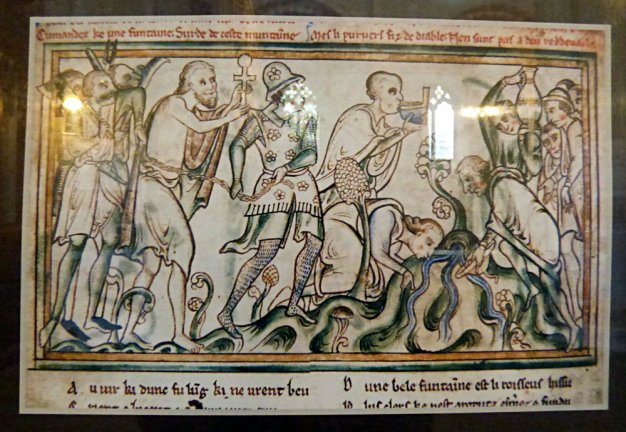
The appointed place was a flat hilltop, completely covered in wildflowers and very beautiful. Alban was thirsty and at his prayer, a pure stream welled from the ground. Alban drank and the spring returned to its natural source in the river half a mile below.
Alban’s hair was tied to a tree and he was beheaded where he stood. The first executioner, who had refused to do the deed, was also beheaded.
At the very moment when Alban’s head was struck off, the executioner’s eyes dropped from his head, to prevent him from seeing what he had done. Some tell that the severed head continued to speak in praise.
The judge had expected both victims to recant. Impressed by both Alban and the soldier, who had chosen to die rather than abjure their faith, he ordered an immediate end to the persecution of the Christians and the story of Alban passed into sanctified legend.
The place of the execution became a site of pilgrimage and eventually a church… later the Abbey… was built on the site. It remains a place of pilgrimage to this day.

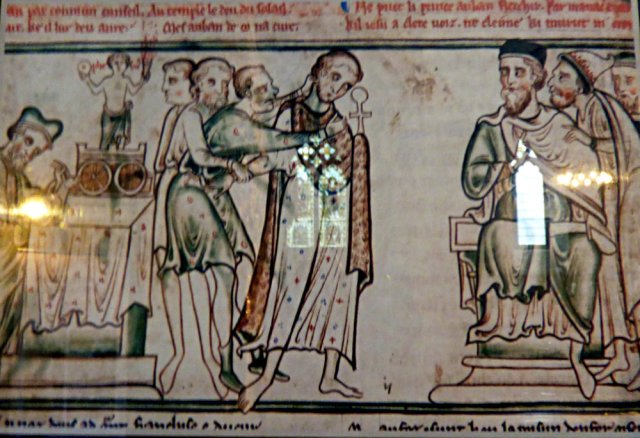
The images were taken in the Abbey where pictures of a mediaeval manuscript tell the story of the saint. The illustrated manuscript was made by the mediaeval chronicler, Matthew Paris, a monk at the Abbey in the thirteenth century. The first picture shows Alban, carrying his distinctive cross, being brought before the judges, while behind him (left) we can see one of the Roman idols.
The second picture shows Alban in chains, amid a field of wildflowers that curl around his feet, while the crowd bring vessels and drink from the waters that seem to spring from the roots of a tree.
The final picture shows the fatal moment, with Alban’s head suspended by his hair. The executioner’s eyes fall into his hands… and Alban’s soul ascends to heaven in the form of a dove.
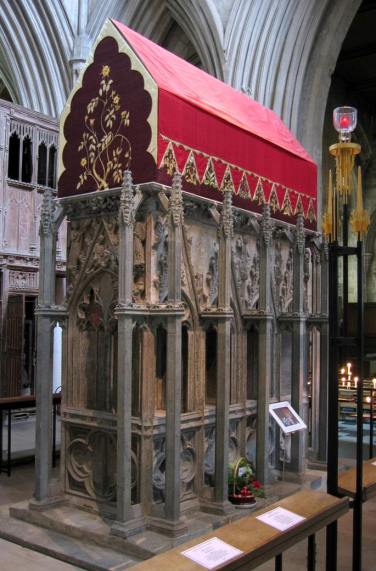
Shrine of St Alban, St Albans Cathedral. Image by Michael Reeve via Wikimedia Commons.





























 Sue Vincent's Daily Echo
This is a fascinating story that I did not know, Sue.
LikeLike
Many of the early saints have intriguing stories… and whether you read them literally or symbolically, there is plenty to mull over.
LikeLike
I never knew the story, Sue. Thanks for telling us.
LikeLike
It is surprising how few do know it, Mary, considering his place in the nation’s religious history. And whether or nor we subscribe to the faith he upheld, the Church shaped so much of the history of these Isles.
LikeLike
Thank you, for this wonderful journey, to a great church. Wonderful conserved, and with the spirit, like just built. Michael
LikeLike
It is indeed a lovely old place, Michael.
LikeLiked by 1 person
Looks fantastic. Thank you, Sue!
LikeLiked by 1 person