We could not leave Breedon on the Hill without mention of the Shirley family who left their mark on the little church in no uncertain terms. In fact, as soon as you enter the nave, your eye is immediately drawn to the relics of their presence that dominate the little church.
The Augustinian Priory, which had replaced the earlier Benedictine monastery at the start of the twelfth century, became itself a victim of the Dissolution in 1539. It was sold to a local man, Francis Shirley, head of a family of recusants… Catholics who refused the rites of the new Anglican church.
Francis’ grandmother was Anne Vernon of Haddon Hall, near Bakewell… a place we had explored in some detail and which had set us off on a voyage of discovery. That gave us a connection to the Shirleys and made the relics of their family rather more interesting.
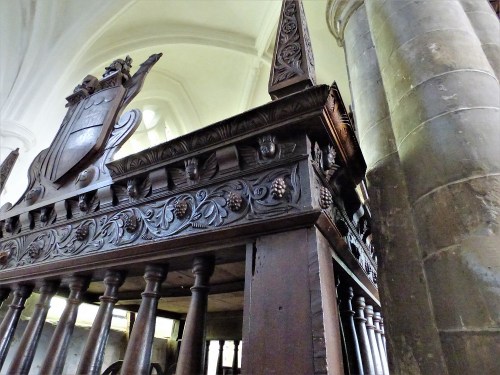
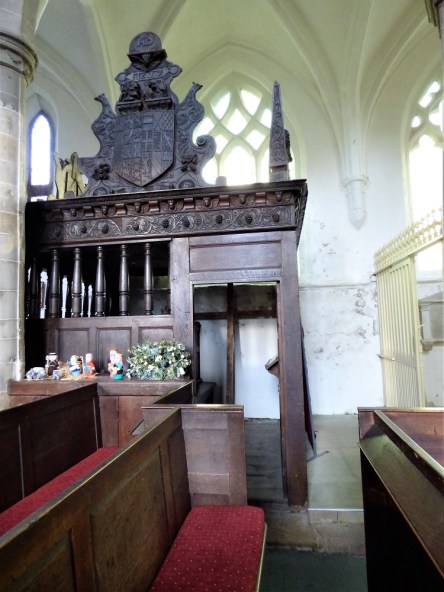
Not that they could be ignored. The Shirley family pew now occupies a large area of the north aisle. It would once have been sited within the main body of the church, allowing the family to worship with some privacy… and probably far more leeway for falling asleep during the sermons than the common folk.
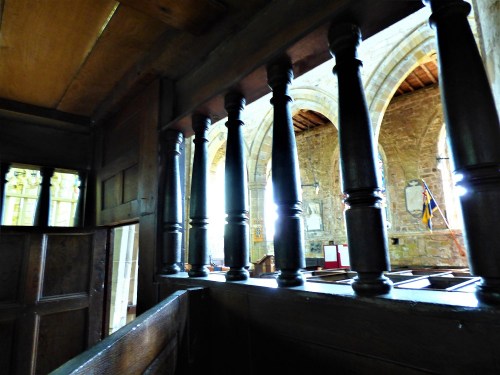
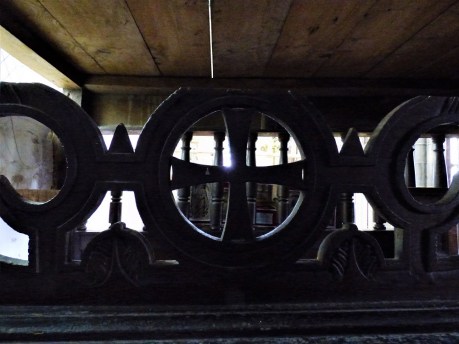
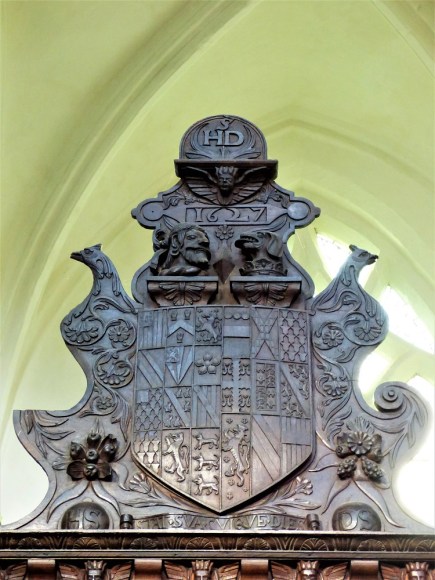
The pew dates from 1627 and is a huge, ornate affair. The interior is simple, containing just two benches and shelving for bibles and prayer books, but the outside is carved and screened, decorated with heads and surmounted by obelisks and a great shield bearing their coat of arms.
As if that were not enough to stamp their presence on the church, the rest of the north aisle is occupied by their monuments and memorials. And, although memorials are not usually where our interest lies… these are undeniably magnificent.
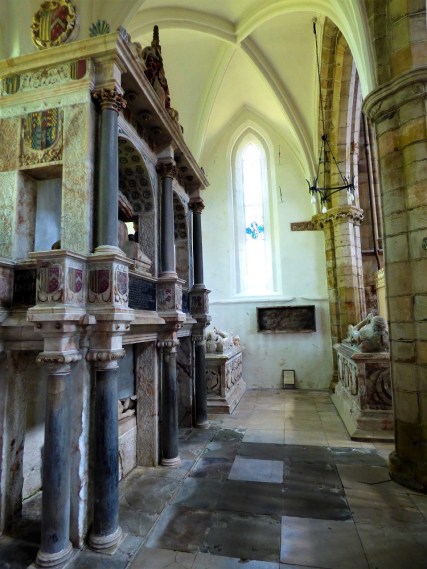
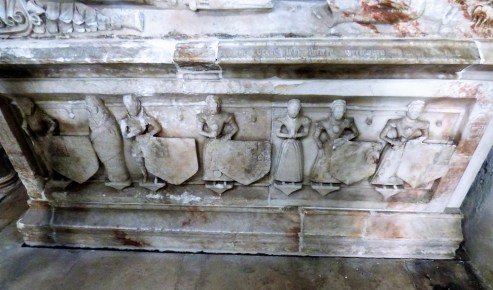
The oldest of the tombs, dated 1571, is that of Francis himself and his wife, Dorothy. The chest tomb shows the couple reclining together. It was carved by Richard and Gabriel Royley of Burton upon Trent. The workmanship is high quality and the alabaster beautifully carved.
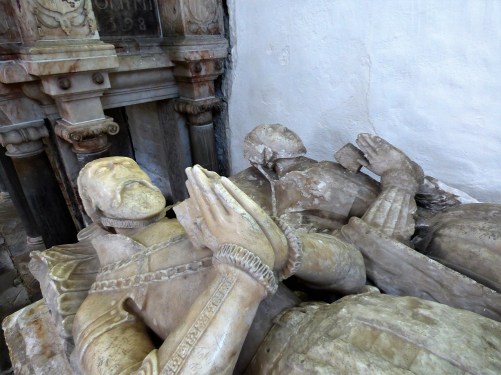
Francis’ effigy is in good condition, although that of his wife as suffered a fair bit of minor damage. Sixty years after Francis’ death, the tomb was renovated by his great-grandson, Thomas.
When they examined Francis’ body at the time, it was reported to be free of decay and remained in a remarkable state of preservation, with just a little blackening of one toe. When the repairs were complete, the body was shrouded and replaced in the tomb.
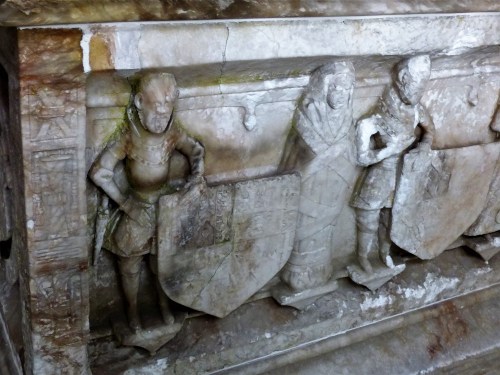
Around the base of the tomb there are ‘mourners’… though one at least appears to be beyond mourning, being wrapped in a burial shroud and tied with bands reminiscent of an Egyptian mummy.
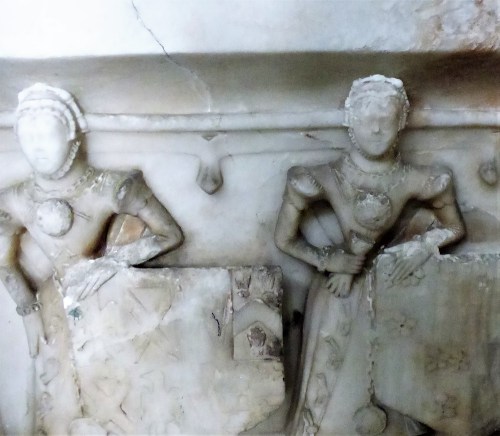
The work is incredible for figures carved on such a small scale, showing tiny folds in neck ruffs, every link in the chains worn around their necks and waists… and, my favourite detail, one woman holding a pair of gloves.
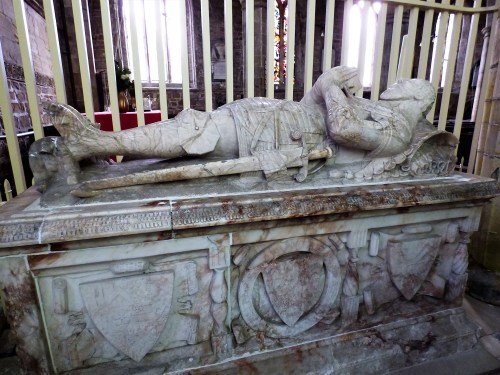
Close by is the tomb of John Shirley who died in 1570, though his tomb was not installed until 1585. It was made by the same sculptors as that of Francis and Dorothy, for the princely sum of £22… a year’s wages for a skilled tradesmen at the time, or the price of a small herd of cows.
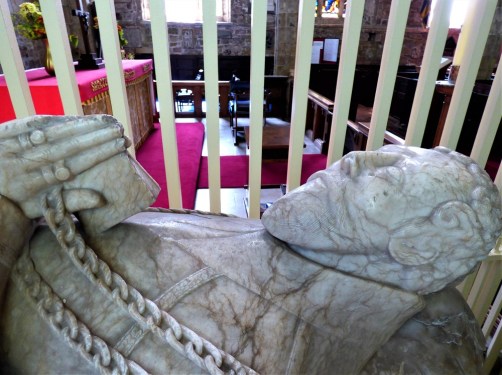
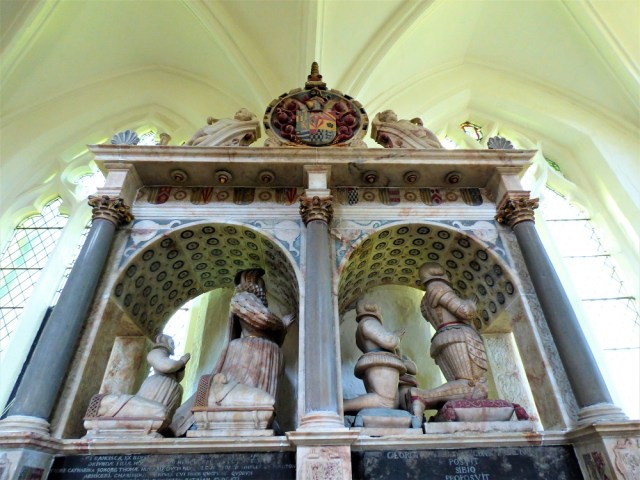
Without a doubt, though, the most impressive is the monument created for George Shirley and his wife. It stands three storeys high and is surmounted by the family crest. It is impossible to photograph well in its entirety… it is too big for the space and you cannot stand far enough back to get a clear shot. The best shots are obtained from the pulpit.
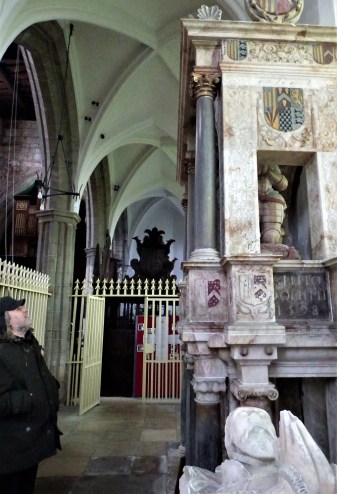
George Shirley was born in 1559 and was honoured with a baronetcy in 1611, by King James I. James has set up the hereditary Order of Baronets in England to reward those who had served him well with a rank higher than that of a Knight in one of the royal Orders and yet lower than that of a Baron. It was also an expedient move for the king, enabling him to raise funds, as each new baronet had to pay the cost of keeping thirty soldiers for three years… a total of £1095.

Sir George was the second baronet ever to be created in England. He received the honour after serving as Sheriff of Northamptonshire and undertaking a dangerous mission to Holland with Robert Earl of Leicester. He was also accounted a good and generous man, doing much to help and feed the poor.
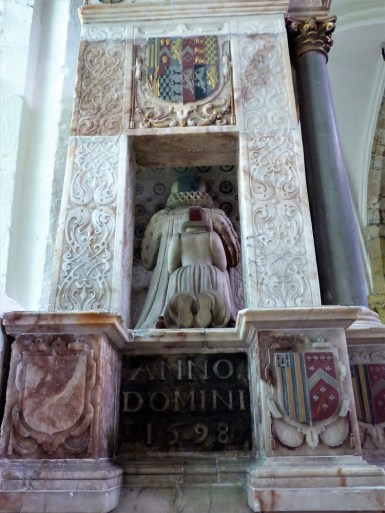
The tomb is dated 1598, but Sir George had commissioned it himself, over twenty years before his death in 1622. Its imposing size, the quality of the alabaster and the artistry speak volumes for the position and wealth he had attained.
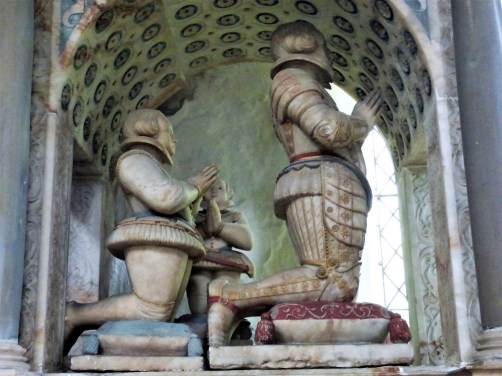
Beneath a carved and painted canopy, Sir George is shown kneeling in prayer with his young sons. Their garments and Sir George’s gilded armour provide an amazing glimpse through a window on time.
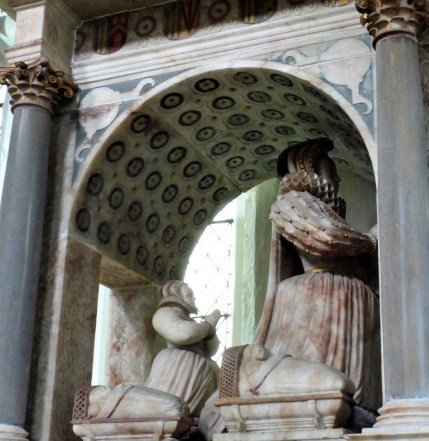
Behind him, beneath a second canopy, kneels his first wife, Frances, their daughter and two babes. Frances is thought to have died in childbirth at around twenty nine years old.

Unlike many contemporary monuments, the figures seem very lifelike and natural… even the babies in their tiny cradles.
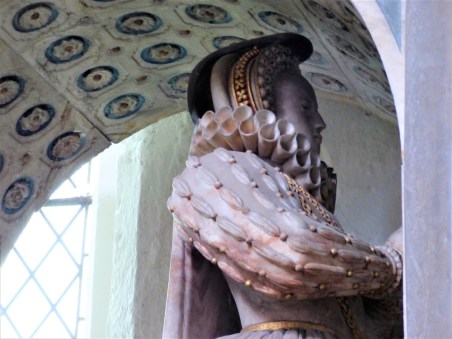
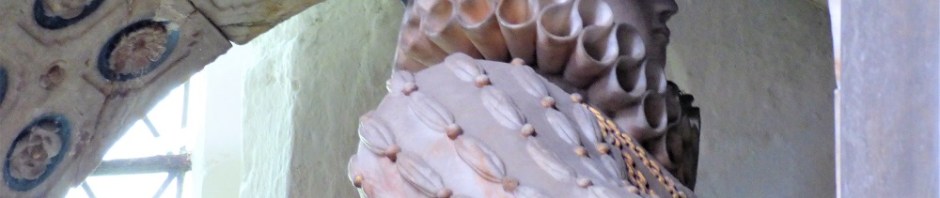
Frances herself is gorgeously coiffed and dressed… a fashion plate of her era and a testament to the sculptor’s art. The alabaster sleeves and ruff seem far too delicate to be made of stone. The artist seems to have deliberately chosen a pink-hued stone with which to portray her and every detail is perfect.
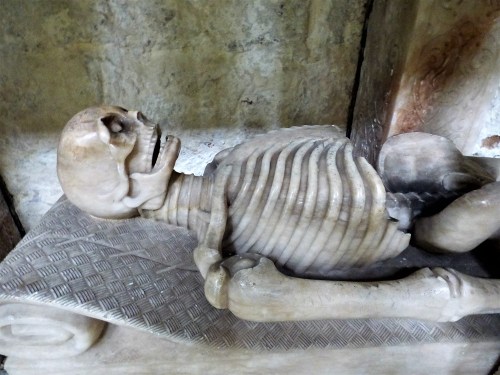
Not so the anatomy of the skeleton on the lower tier. Once again, the detail is incredible, if not entirely accurate. The inclusion of a cadaver of this type was not the norm at this time, but the message is timeless… no matter how great we become, how high we climb or how rich we may be, we are all equal in death.
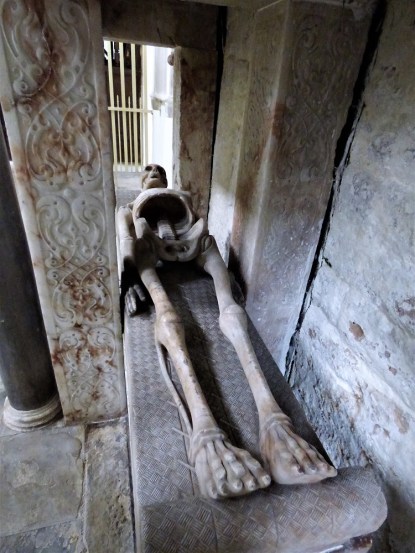
I always find a certain irony in these memorials and tombs. They are built with the express purpose of proclaiming the wealth and circumstance of their occupants. They are political statements of the position and influence of the families they remember and evidence of the ego’s search for historical immortality… and yet, the skeletons and cadavers immortalised in stone are graphic illustration that worldly success matters not at all in face of eternity.
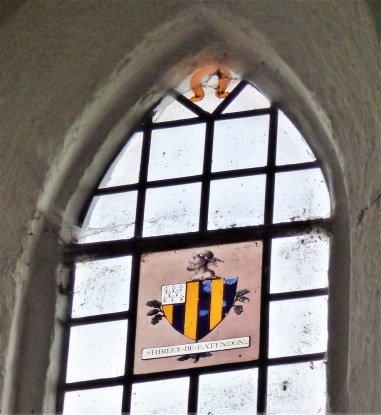
But I have to allow Sir George to indulge himself on this. His memorial is a work of art and a fabulous historical record. Not only that, the patronage of the Shirley family ensured the survival of this wonderful little church.
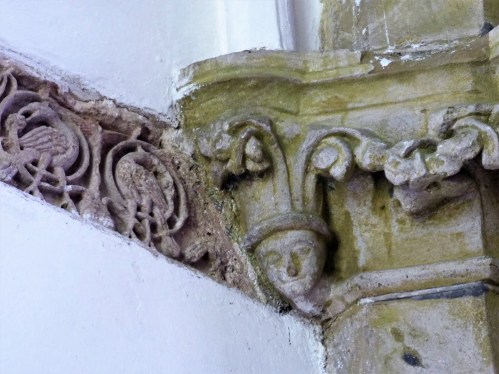
Without the Shirley family and their rise to prominence in the area, would we still have the site of the Neolithic settlement that became Holy Hill monastery, Breedon Priory and finally a parish church stuffed with Saxon stone and artefacts reaching so far back into our past? Perhaps Sir George and his family deserve at least this much immortality for their gift to the future.

You can read more about our visit to the church of Saints Mary and Hardulph at Breedon on the Hill by clicking the links: Parts One, Two and Three.































 Sue Vincent's Daily Echo
The architecture is incredible, Sue. I’d need to spend a few days there just to take it all in.
LikeLike
It would be worth it, Dorinda.
LikeLiked by 1 person
I can imagine. Just beautiful.
LikeLiked by 1 person
Magnificent carving, Sue. A worthy place to visit. Thanks for sharing. 🙂 — Suzanne
LikeLike
It is just incredible, this little church 🙂
LikeLike
Ohhhh another place to put on my ‘to do’ list… it’s stunning!
LikeLike
It really is, Josephine. A real belter of a church 🙂
LikeLike
Stunning. You don’t see anything like this anymore. I could spend a lot of time looking around.
LikeLike
Places like this one keep calling you back.
LikeLike
The sleeves and ruff on Frances are incredible.
LikeLike
The craftsmanship and artistry of these figures is just stunning when you see it up close, mary. I wish I could have got better pictures of them, but there simply is no space.
LikeLike
This place just gets more interesting with each post. The tombs are stunning. I think when I eventually travel to England, this is a place to visit. 🙂
LikeLike
This needs to be on your list 🙂
LikeLiked by 1 person
Absolutely. 🙂
LikeLiked by 1 person
May I thank you once again for all your efforts! A beautiful representation of history. Michael
LikeLike
Thank you, Michael. I’m glad you enjoyed this 🙂
LikeLiked by 1 person
Oh yes, really, Sue! Sorry, for the lack in commenting.
LikeLike
No worries, Michael 🙂
LikeLike
Beautiful carved detail. 😀
LikeLike
Fabulous 🙂
LikeLiked by 1 person
The architecture is absolutely stunning. Thank goodness the Shirley family could leave such importance to future generations.
LikeLike
Their agrandisement served us well at Breedon.
LikeLiked by 1 person
🙂
LikeLiked by 1 person