
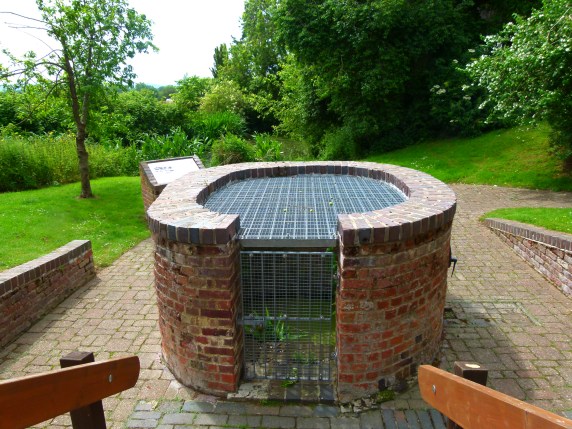
With the current ban on travel curtailing our adventures, it seems a good time to take a look at some of the many places we have visited over the years but have never written about or which have been mentioned only in passing. A little while ago, while out researching for the now-postponed April workshop, we paid a flying visit to Bierton. The village now melds with the outskirts of Aylesbury, but it has a long history, of which many traces can still be found if you take the time to look.
Amongst the earliest recorded occupants of the village were the Saxons and traces of a settlement remain behind the church. A tribe of the Belgae may also have lived there, of whom Julius Caesar wrote that they first came as raiders and later settled the land. There are the remains of a large, ditched enclosure that may have been their home.
The village is mentioned in the Domesday Book, compiled in 1086 at the behest of William the Conqueror as a survey of his new domain. At that time, the village was known as Bortone, which means ‘farmstead near a stronghold’, perhaps referring to the place once enclosed by the moat that still remains.
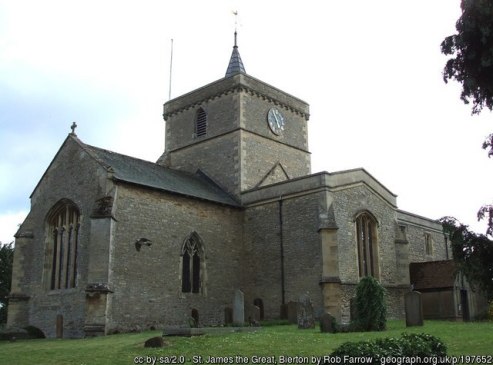
The current church of St James the Great was built in the thirteenth or fourteenth century, but as its font dates back to Saxon times, there was probably a church in the village for several centuries before its first recorded vicar, Robert de Thame, took office in 1294. Sadly, St James’ is one of the few churches in the area that keeps its doors locked so we have yet to get inside.
During the Civil War of the sixteenth century, Bierton was a Royalist stronghold while neighbouring Aylesbury became a base for Cromwell’s Parliamentarians. Some of King Charles’ troops were housed in the sixteenth century Red Lion, and local legend avers that the ill-fated monarch himself stayed in the inn opposite the church that still serves travellers on the highway.

The Red Lion was not the only inn though… at one time, the little village had seven public houses, many of them still stand although they have long since ceased trading and become private homes. Trade must have been brisk enough to support them all, as the village straddles a major road out of Aylesbury. Although Bierton had a toll gate and other routes were taken where possible, the village had the advantage of having a ‘wagon pond’ in which carters would soak the axles of their vehicles, to swell the fibres of the wood and keep them sturdy.

We had wandered out to Bierton to visit its well. For at least a thousand years, the well was the centre of the village and was its main source of water until the inter-war years when piped water was installed. The well is dedicated to St Osyth, a local princess and martyr.
Born in the now-deserted village of Quarrendon, Osyth was the daughter of Frithwald, a minor Mercian king and Wilburga, one of the daughters of Penda, the last pagan king in England. The little girl was raised by two of her aunts, both of whom were also later raised to sainthood. In their care, Osyth grew in faith and wished to become a nun. But it seemed her dream was not to be.
Legends say that when she was sent by her aunt, St Edith, to deliver a book to St Modwenna at her convent, Osyth fell into a swollen stream and drowned. Her body was found two days later but was miraculously restored to life by the prayers of the sainted ladies.

But even after such a miracle, and the stories of water springing from the earth where she passed, Osyth was not allowed to enter the church. Instead, she was forced into a political marriage with Sighere, King of Essex. The legends say that one day her husband heard of a magnificent white stag and set out to hunt the creature. While he was away, Osyth persuaded the bishops to accept her vows as a nun. Her husband, on his return, eventually gave in to her pleas and granted her land to found a nunnery. It was here, in AD700, that St Osyth was beheaded by invading Danes, yet still she picked up her head and carried it to the door of the convent.

Her body was carried back to the place of her birth, stopping on the way at Bierton, where the spring that welled up was dedicated to the saint. She was buried at the church in Aylesbury and her shrine became an unofficial site of pilgrimage. It was so popular with pilgrims that in 1500, on Papal orders, the church authorities had her body exhumed and reburied in secret. To this day, no-one knows where Osyth now rests.
Every town, village and hamlet has its stories. This old village, almost subsumed by urban sprawl, still keeps its well and its identity… and the centuries rest lightly in its memory, where legend and history walk hand in hand.

 Not a soul in sight. Just the wind and mist in a whispered hush making their way across the world. The chill of water in the morning air stands in place, as though no longer able to keep the relentless march of clouds.

 I remember it now. It was a hazy day, mid spring. I’m sure of it. She’d decided to explore the rocks a bit, then make her way to the Hills to a cabin we built. I remember telling her you can’t make a trip like that in a day. The cabin’s miles aways. Deep in those hills up there. Take a look! Nothing but tree spottin.
 How did your granny predict the weather? What did your great uncle Albert tell you about the little green men he saw in the woods that night? What strange creature stalks the woods in your area?
 She returned to the moor


 “That fucking idiot fell down where?” Pen’s father screamed, half up from his lounger, newspaper falling, fluttering.








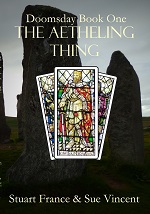




























 Sue Vincent's Daily Echo