
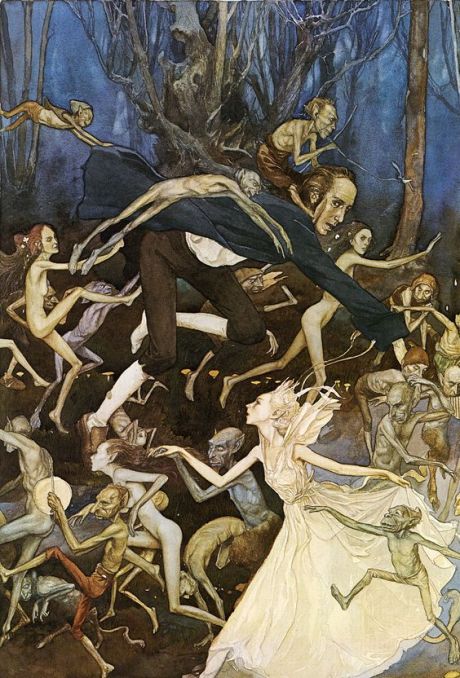
‘Caught in a faerie ring’ by Alan Lee
What are the faeries? This question is surprisingly difficult to answer. Since May 2016 I’ve been attempting to get under the skin of the question on my blog-site deadbutdreaming, where I post articles that engage with the phenomenon of the faeries from a variety of perspectives. Understanding the folklore is essential. The 20th-century disneyfication of faeries has tended to bury the real ontological value of a belief-system that took hundreds (perhaps even thousands) of years to develop. Most people accustomed to the Tinkerbell winged faeries of popular culture are usually surprised and shocked when they come across more visceral renditions of faerie creatures such as in the images of Brian Froud and Alan Lee. But as any study of the folklore will confirm, the faeries that have been a part of human culture for so long are a diverse cast of characters, usually taking humanoid form but always displaying an ambivalent set of moral codes in their interactions with humanity. The usual reductionist explanation for these supernatural entities is that they are simply magical actors, invented by storytellers in pre-modern rural societies for the sake of a good yarn. But this never seemed right to me – the faeries are too ubiquitous through history, and their presence is still attested to in thousands of modern day sightings and experiences. There must be something more to their phenomenology… something deeper.
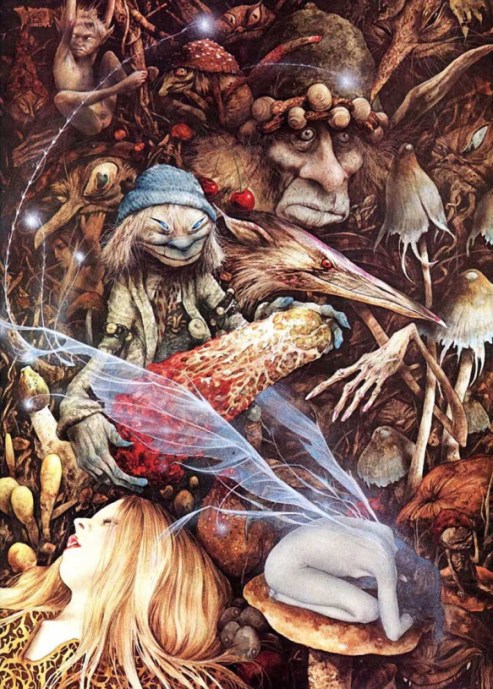
‘Some faeries with mushrooms’ by Brian Froud
Faeries have been a constant presence in folklore and mythology since at least the early Middle Ages, where they are intrinsic elements in cycles of stories such as the Arthurian legends and the corpus of Irish lore. Through to the 19th century there are thousands of folktales that incorporate them into plot lines, often overlain with themes of morality (or immorality) and dialectic motifs meant to instruct people about how a metaphysical otherworld interacts with our physical reality. These stories are fascinating – they can give us much insight into how previous societies envisioned the world. But what I find even more captivating are the anecdotes about faeries; testimonies that have not been converted into stories, but which give subjective first-hand accounts of faerie experiences.
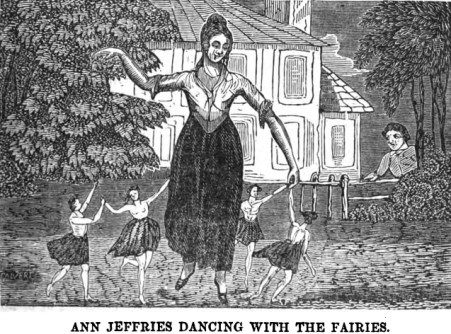
Anne Jefferies illustration from Robert Hunt’s Popular Romances of the West of England (1865)
There are many of these anecdotes, sitting alongside the stories in folklore, and which perhaps give a more incisive view of what the faeries might be. A prime example is the well-documented narrative of Anne Jefferies from 17th-century Cornwall. Anne was a servant in an aristocratic household, and during what seems to have been an epileptic seizure, she was transported by a group of diminutive faeries to an otherworld, where:
“She was in one of the most beautiful places — temples and palaces of gold and silver. Trees laden with fruits and flowers. Lakes full of gold and silver fish and the air full of birds of the sweetest song, and the more brilliant colours. Hundreds of ladies and gentlemen were walking about. Hundreds more were idling in the most luxurious bowers, the fragrance of the flowers oppressing them with sense of delicious repose. Hundreds were also dancing, engaged in sports of various kinds.”

17th-century English woodcut with faeries, burial mound (hollow hill with door), fly agaric mushroom and the face of a ‘spirit’ in the tree.
Faerie encounters such as Anne’s continue to be attested to the present day, usually culturally coded to the time, but still recognisable as engagements with a specific type of metaphysical entity. A recent survey by The Fairy Investigation Society includes c.500 encounter reports from all over the world. These may be subject to the vagaries of memory, but it is clear that the testimonies are honest appraisals of numinous events with faerie-types. What I’ve come to realise is that the faeries (much like their sci-fi kindred in the alien abduction phenomenon) are primarily interacting with human consciousness. This does not mean they are not real, but that they are manifesting within the realm of consciousness, which even the most ardent reductionist materialist has to admit is not understood by our physical sciences. For a variety of reasons, our consciousness is ‘altered’ and beings such as faeries are allowed into our awareness. I think David Luke’s three-part interpretation for interpreting metaphysical entity contact is the most incisive way to start to ask ourselves what might be happening:
- They are hallucinations. The entities are subjective hallucinations. Such a position is favoured by those taking a purely (materialist-reductionist) neuropsychological approach to the phenomena.
- They are psychological/ transpersonal manifestations. The communicating entities appear alien but are actually unfamiliar aspects of ourselves, be they our reptilian brain or our cells, molecules or sub-atomic particles.
- The entities exist in otherworlds and can interact with our physical reality. A numinous experience provides access to a true alternate dimension inhabited by independently existing intelligent entities in a stand-alone reality, which exists co-laterally with ours, and may interact with our world when certain conditions are met. The identity of the entities remains speculative.
My ruminations at deadbutdreaming attempt to cover these interpretations, while always keeping a foothold in the folklore. This leads down many different avenues, and I’ve so far discussed the faeries from a lot of perspectives: as nature spirits, inter-dimensional beings, Jungian archetypes, arbiters of death, aliens, witches’ familiars, manifestations of human evolution… even as muses for Syd Barrett’s faerie-inspired songs. I’ve enjoyed pushing some barriers in our understanding of what the faeries might be, because I do firmly believe that they are not fossilised relics of a folkloric past, but are a dynamic part of a metaphysical reality that may hold many deep, spiritual lessons for humanity. And judging by the recent upsurge of interest in them, it appears that the faeries are here to stay, functioning in some nebulous region where any interpretation of them is reliant on us finding a way to incorporate consciousness into physical reality. This is something that has eluded both philosophers and scientists for millennia, and so perhaps it is no surprise that the faeries – whatever they are – for the moment, remain an intangible part of our cultural zeitgeist.
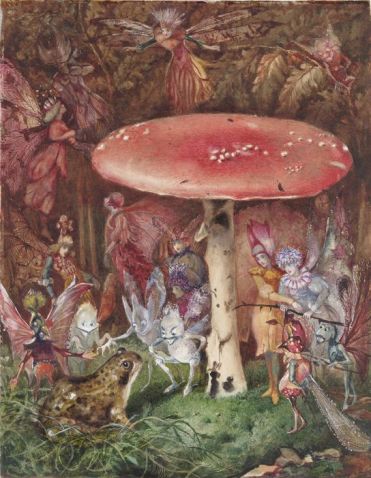
John Anster Fitzgerald, ‘The Intruders’ (c.1870)
About Neil Rushton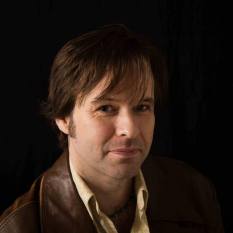
I’m an archaeologist by training, and gained a PhD from The University of Cambridge in 2002. In recent years I’ve developed my interest in the more esoteric aspects of folklore, and write about it on my blog-site and for a variety of websites and publications. I have one published novel, Set the Controls for the Heart of the Sun (2016), and am now writing a second, which takes the folklorist protagonist to a psychiatric hospital in 1970 in search of the faeries, with some cosmic results. You can find out a bit more about me and see my take on the writing process here.
Find and follow Neil Rushton
deadbutdreaming Blog Amazon Facebook: The Faerie Code
Twitter LinkedIn Ancient Origins
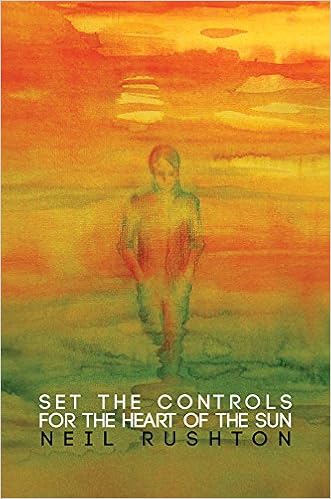 Set the Controls for the Heart of the Sun by Neil Rushton is an unnerving and unusual story about one man’s struggle to overcome perceived mental illness with the use of psychedelic drugs. Fantasy and reality intertwine leaving the reader never quite certain whether the author is recounting a hallucinogenic trip, a dream sequence, or something else altogether. Observations on the human condition will resonate with many as, to a backdrop of Syd Barrett and Pink Floyd, the author debates the merits of whether we are all in fact a little mad….”I’m not mad”… A compelling, sometimes uncomfortable but never dull read, it will leave the reader knowing a little more about themselves and the mysteries of the human mind.
Be my guest…
If you are a writer, artist or photographer…If you have a poem, story or memoirs to share… If you have a book to promote, a character to introduce, an exhibition or event to publicise… If you have advice for writers, artists or bloggers… or simply a story or an opinion to share…
If you would like to be my guest, please read the guidelines and get in touch!














 Sue Vincent's Daily Echo
Fantastic post, Neil and Sue. I love reading your articles on your blog about faeries and different perspectives of them. I have seen them in my garden. I was lying on a sunlounger a few years back when we had good summers, and one appeared from out of the lilac bush. Fully formed big face that grinned at me. I have seen them on and off from being a child to now. xxx
LikeLiked by 3 people
This is a very interesting article, Neil and Sue. I have never seen anything along the lines of fairies in my life but I do understand exactly what is meant by Disneyfication of fairies. When I first read The Elvin Hill by Hans Christian Anderson I was shocked at the description of the elves as quite evil creates with hollow backs.
LikeLiked by 2 people
Reblogged this on DENIS LEVIEUX PHOTOGRAPHE INFOGRAPHISTE.
LikeLiked by 1 person
Thank you for reblogging.
LikeLike
Thanks for this – much appreciated…
LikeLiked by 1 person
I enjoyed your post very much, Neil, and will now be venturing over to your site.
LikeLiked by 2 people
Thank you Alethea…
LikeLiked by 2 people
Fascinating…
LikeLiked by 2 people
There is a great fascination in fairies and the folklore associated with them. I found myself basing my own latest novel on a variation on the theme, and surprised myself with what came out.
LikeLiked by 2 people