
It is with the greatest pleasure that I welcome Noelle Granger to the blog. Author of the Rhe Brewster mysteries, Noelle is currently working on a new project…
Pilgrim Children
Plymouth, Massachusetts, is still tied to England! I’m not sure everyone knows about the Harwich Mayflower Project. An exact replica of the Mayflower will be built in Harwich, England, and sailed to Plymouth, Massachusetts for the 2020 quadricentennial. I got a notice of the Harwich Mayflower project from a friend who knew I was writing a historical fiction novel about the oldest surviving Pilgrim. Check out this project, designed to enrich the city of Harwich, at: http://www.harwichmayflower.com
My novel is about Mary Allerton Cushman, who died in Plymouth in 1699. One might quibble that she wasn’t the oldest. Oceanus Hopkins was in utero for the entire voyage, was born in Cape Cod harbor and outlived Mary by a few years. But she was a child on the Mayflower.
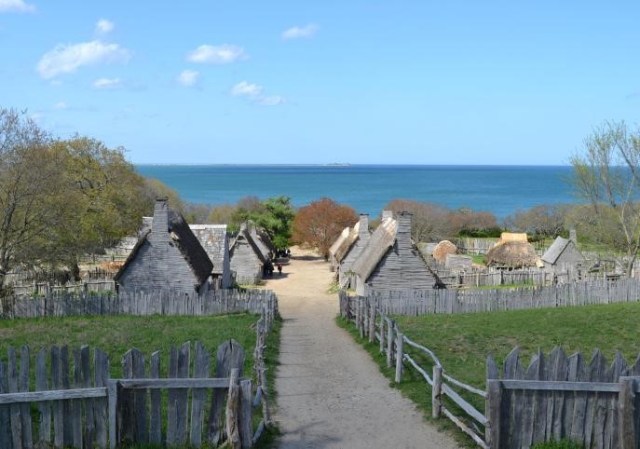
Because the story begins with Mary as a child of four, I’ve had to do a bit of research on Pilgrim children. Plimoth Plantation in Plymouth, Massachusetts, is a re-creation of the early colony and is a great resource of information (https://www.plimoth.org/ . I worked there for two or three summers as a guide (my home was only three houses down the street).
****
There were 32 children in the dank, dark, fetid quarters between decks on the Mayflower, where 102 passengers were crammed for the 66 days of the voyage. Surprisingly, most of the children survived the voyage; sadly, most of their parents did not. As today, the children of the Pilgrims (or Separatists, as they were called at that time) were important to their families, but in quite different ways.
Individual freedom. We give our children a lot of freedom today to choose activities and careers that interest them, but Pilgrim children had no freedom of choice. Those decisions were always made by their parents, a necessary thing if the colony was to survive.
Learning skills. Pilgrim children were taught skills they would need to survive and become a functional member of the colony. Thus a large part of their days was spent learning skills and working. Children at the age of four or five would run errands, fetch wood and water, and take care of smaller livestock, such as chickens.
Girls worked with their mothers, learning gardening; cooking and preserving food; tending to the younger children; sewing, mending and washing clothes and bedding; making candles and soap; and later, when sheep arrived, carding, washing, spinning, dying and weaving wool.
Boys worked with their fathers. This meant they spent time in the fields, preparing them for the growing season, planting seeds, weeding and harvesting crops. They tended the larger livestock and learned to hunt and fish. Woodworking was another skill they learned, everything intended to prepare them to be the head of a household once they married.
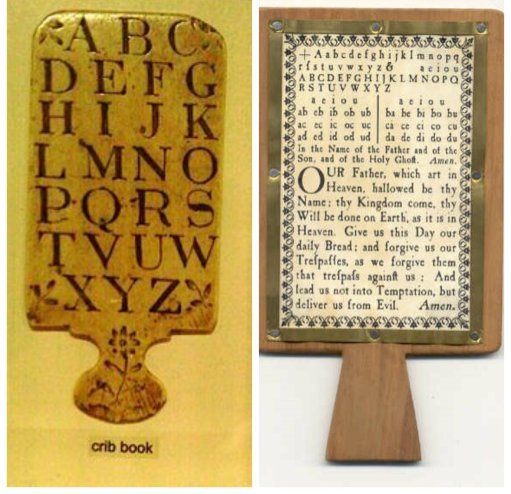
Formal education. The Plimoth Colony had no school, but that didn’t mean that children were ignorant of their numbers and letters. Both boys and girls were taught at home in the evenings and during long winter days when work was finished. The book they were taught from was the Geneva Bible, learning to read and copy long passages. The children may also have had hornbooks. Essentially a paddle, a hornbook was a primer consisting of a sheet containing the letters of the alphabet, usually mounted on wood or bone. The sheet was then covered by a thin, transparent layer of horn or mica. The hornbook may also have had a list of diphthongs or the Lord’s Prayer.
 Playtime: Pilgrim children did not have much time to play, but when they did, they played games that their parents deemed would improve their minds or physical skills. You might be surprised to learn that some of the games they played are still played today: marbles, ball and cup, hid (hide and seek) and hop frog (leap frog). Lummelen was keep away. They also played board games: Nine Men’s Morris (today sometimes called Cowboy Checkers) and Crosses and Naughts (tic tac toe). The girls might have a cloth doll called a poppet. All Pilgrims also liked riddles and jests (jokes) and gliffes (tongue twisters). Nevertheless, Pilgrim parents made sure that if the children were playing, it was because they had no work to do.
Clothing: By the age of five or six, Pilgrim children dressed much as adults. From the Society of Mayflower descendants and Plimoth Plantation, we have learned that Pilgrims did not dress in black or gray with exceedingly large white collars and cuffs, nor were there buckles on their hats and shoes.
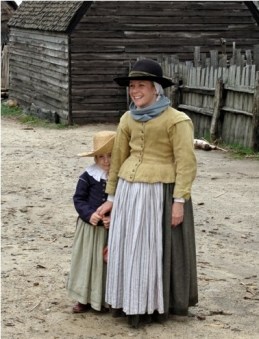
Girls wore ankle-length full skirts of a solid color similar to what their mothers wore. Some dresses were a single piece of a full skirt, gathered at the waist and a top with long sleeves. Others might consist of a bodice and skirt of different colors. Women wore bonnets, called coifs and biggins, to keep their hair clean, and aprons, when working. They might also wear floppy hats like the men’s or a straw hat to shade them from the sun in summer, both worn over their bonnets.
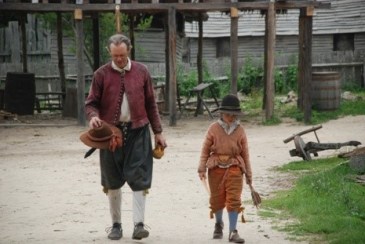
Boys wore clothing like their fathers in colors similar to those worn by women: long sleeve shirts buttoned down the center or loose fitting blouses and breeches. Breeches were baggy garments, secured at the waist with a belt and gathered below the knees with garters. Both men and boys wore stockings of solid color, and they wore hats. In the winter, they were similar to our hats stocking caps, the rest of the time large floppy felt hats.
****
As I learn more about these doughty, intrepid people, I am impressed with their similarities to today’s men and women. They were not saints, as my book will show, but they were singularly determined that their children would became active, industrious members of their growing community through working, playing and learning.
(Pictures courtesy of Plimoth Plantation)
****
 Noelle A. Granger grew up in Plymouth, MA, in a rambling, 125 year old house with a view of the sea. Summers were spent sailing and swimming and she was one of the first tour guides at Plimoth Plantation.
She graduated from Mount Holyoke college with a bachelor’s degree in Zoology and from Case Western Reserve University with a Ph.D. in anatomy. Following a career of research in developmental biology and teaching human anatomy to medical students and residents,the last 28 years of which were spent in the medical school of the University of North Carolina, she decided to try her hand at writing fiction.
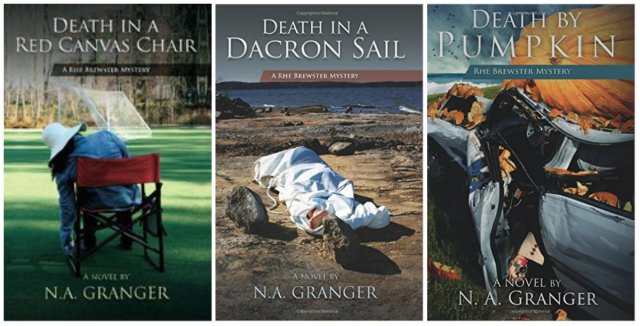
Death in a Red Canvas Chair was her first book and features an emergency room nurse as her protagonist. The book is set in a coastal town in Maine, similar to Plymouth, and she has used her knowledge of such a small town, her experiences sailing along the Maine coast, and her medical background to enrich the story.
She has also had short stories, both fiction and non-fiction,published in Deep South Magazine, Sea Level Magazine, the Bella Online Literary Review, and Coastal Style Magazine. Her second novel in the Rhe Brewster mystery series, Death in a Dacron Sail, was published in the summer of 2014. The latest in the series, Death by Pumpkin, has just been released.
N.A. Granger lives in Chapel Hill, NC, with her husband Gene, a physician, and is the mother of two children.
Noelle blogs at Sayling Away and you can find her on Twitter @rhebrewster, Goodreads and Facebook. Follow Noelle on Amazon for the latest updates and new books.





































 Sue Vincent's Daily Echo
Fascinating post and what an amazing project to build and sail the Mayflower. Looking forward to Noelle’s novel.
LikeLike
It is good to realise that the shipbuilding skills have not been entirely lost.
LikeLike
Thanks, Mary! I’m finding writing a historical novel very challenging!
LikeLiked by 2 people
Such interesting stuff here. Wonderful. ☺
LikeLike
I don’t live far from Penn…so I’ll be interested to see where Noelle takes this.
LikeLiked by 1 person
Thank you! I appreciate it!
LikeLiked by 1 person
I am really looking forward to this from Noelle! 😀
LikeLiked by 1 person
Me too 🙂
LikeLiked by 1 person
Thanks, PG. It will NOT be a mystery, although some of the research is proving to be misleading.
LikeLiked by 3 people
Ooh! I am even more intrigued now 😀
LikeLiked by 2 people
Thanks, Sue, for hosting me!
LikeLike
Very much my pleasure, Noelle… come back any time you like 🙂
LikeLike
Fascinating to read about Noelle’s new project. This article shows the mayflower link to Rotherhithe http://www.stmaryrotherhithe.org/index.php?option=com_content&view=article&id=4&Itemid=3
LikeLiked by 1 person
That’s a great article, Lizanne… thank you.
LikeLike
Thanks for the link, Lizanne – I love it when people find things for me!
LikeLiked by 1 person
My family were shipbuilders in Rotherhithe so I’ve always been interested in links to the Mayflower.
LikeLiked by 1 person
That’s pretty amazing, What a great history!
LikeLiked by 1 person
Pingback: Check out my guest post! – SaylingAway
Such great information on a misrepresented people.
LikeLike
Thank you so much, Vick!
LikeLiked by 2 people
Excellent guest post, Noelle & Sue! Sharing… 🙂
LikeLike
Thanks, Bette!
LikeLiked by 1 person
Thanks, Bette 🙂
LikeLike
Fascinating post, Noelle – and loved the picts. as well. I wonder when, where or how the convention of clothing pilgrims in black and grey outfits with the big white collars, etc. originated? Popularized by Hallmark, no doubt.
My mother disclosed, shortly before she died, that my roots trace back to Mayflower days (something about making sure I knew I was DAR eligible?), but I have never been inspired to learn much more. My late sister was fascinated with genealogy, but I admit I found it about as interesting as I do the “begats’ in the Christian Bible – important historically, but deadly dull reading. Your BOOKS, on the other hand, might get me interested in history yet!
xx,
mgh
(Madelyn Griffith-Haynie – ADDandSoMuchMore dot com)
– ADD Coach Training Field founder; ADD Coaching co-founder –
“It takes a village to educate a world!”
LikeLiked by 1 person
Great info, Noelle. I’m not surprised that kids are kids, though on the whole life then was more precarious than it is now. The photos are wonderful. How interesting to have Plimoth Plantation so near. 🙂
LikeLiked by 1 person
Perceptive comment, Diana, As I write, I can feel what it was like to be living on a razor’s edge. Anyone or all of those you loved could be gone in the blink of an eye, especially that first winter, when half of the Pilgrims died, mostly adults. There were a lot of rather quick remarriages, needed to preserve the colony.
LikeLiked by 2 people
I was wondering about the children who lost parents on the journey and afterward. I imagine they were taken into other families (?). Quick remarriages makes sense when survival is hanging by a thread like that. Intense. Can’t wait to read your book, Noelle. 🙂
LikeLiked by 1 person
The children who were orphaned were taken into other families. The widows and widowers remarried quickly. I have only just begun this book – I’m looking for a 2020 publication date.
LikeLiked by 2 people
2020! Get writing, girl! 😀
LikeLiked by 1 person
I didn’t know about the Mayflower sailing, Noelle. That will be quite some event. 🙂 It sounds like a lot of hours of research will be needed, but very enjoyable.
LikeLiked by 1 person
You have to know I LOVE research – spent so much time doing it in my former life!
LikeLiked by 2 people