

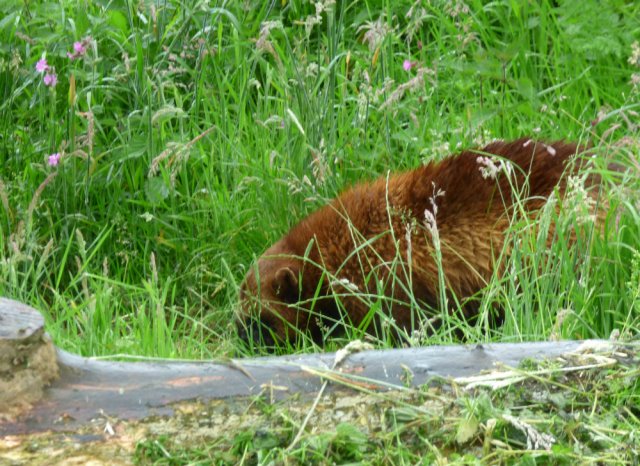
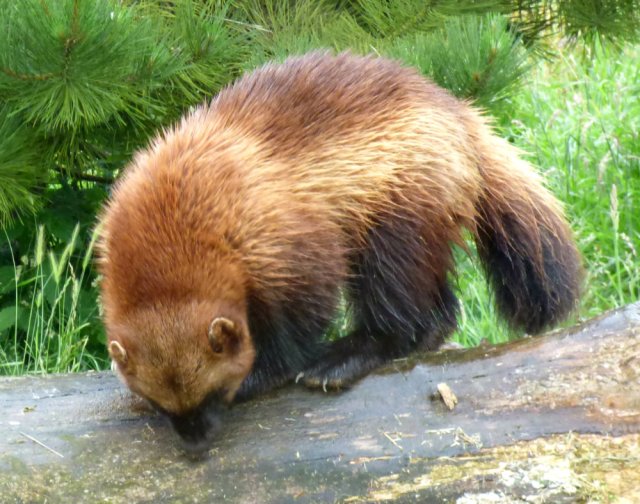
The wolverine is the largest land-dwelling member of the mustelidae family, that includes weasels, otters and badgers. It grows to around the size of a medium dog and i a fierce predator. An elusive creature, the wolverine, with a need for a huge territory in the wild, it is yet another of the many species of flora and fauna that have disappeared from these islands, though unlike the bear and the lynx, their demise is not thought to be of recent date.
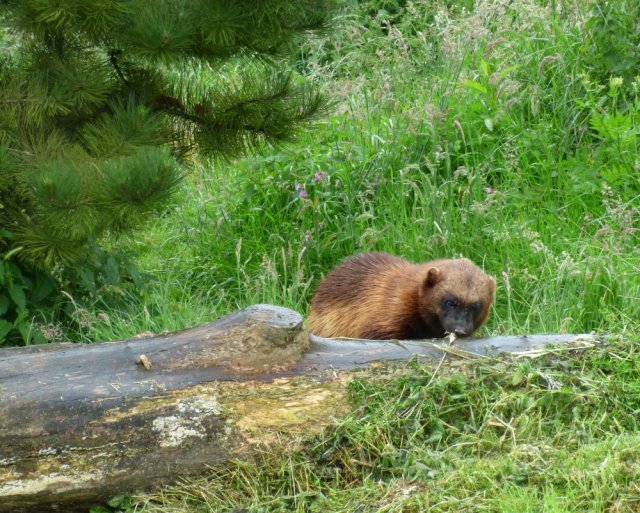
On the other hand, there are sporadic reports of sightings and, while most are probably a case of mistaken identity, ranging from mink to erythristic badgers, it is improbable, but not impossible, that a few have managed to elude observation for centuries and survive. Officially, though, they have been extinct in Britain and the southern European areas for a long, long time.

Bone pendant decorated with an engraved drawing of a wolverine, Late Magdalenian, around 12,500 years old Probably from the cave of Les Eyzies, Dordogne, France Photo: Johnbod
We do not know why they were lost from these shores, but given that they have been absent for perhaps thousands of years, it is likely that our current environment would be a challenge for them. Especially as we are already losing existing species at a rate that should make us stop and think.

Ours is a small country…an island protected by the seas from many things that might threaten a land-locked ecology. Yet, over the last 200 years we have lost over 400 species that we know about. To put that in perspective, I thought about my own family. My great grandmother was still alive when my sons were born. My mother knew her mother, my great-great grandmother. Flowers that she knew, butterflies, bees and birds she would have seen, no longer exist in this country.
There is a natural cycle of birth, growth and death that must apply equally to species as to individuals, but such a huge list of species in such a short time and in such a small place, must give us pause. So many more are under threat and it is not a list of obscure grasses and bugs that few of us would notice, but includes species we know and love, like hedgehogs, turtle doves and tortoiseshell butterflies. Other threatened species include dolphins, our red squirrel, water voles and skylarks and the wildcat, once found across Britain but now confined to parts of Scotland. And this year, England lost her last golden eagle after he had spent lonely ten years trying to find a mate.
I am no ecologist. I don’t have any answers, but I love this land and her creatures. Wouldn’t it be sad if we could no longer read Beatrix Potter to our grandchildren without explaining what Mrs Tiggywinkle used to be? Or share the Wind in the Willows without explaining what a toad was? And how, once upon a time, when we were young, such magical and beautiful creatures still existed in our world…























 Sue Vincent's Daily Echo
The same fight is going on all over the world, on every continent … Predators and any large mammals … and many of our favorite seas creatures … all endangered, many of them critically. We do the best we can and hope we’re not all preaching to the choir.
LikeLike
There is a growing awarenes and determination to redress the balance, thogh it is already too late for so many species.
LikeLike
It would be very sad if creatures continued disappearing. I imagine that global warming may be putting additional pressure on many of the species that are still clinging on. I read on a blog somewhere (I can’t remember where, unfortunately), about the reintroduction of beavers in one or two parts of Scotland. According to the post, it has been pretty successful, so perhaps not all hope is lost, at least for some species. 🙂
LikeLike
Even my red kites had to be reintroduced after being almost lost here… and they are very succesful and have taken their natural scavenging to help clear up roadkill and mankind’s discarded food. The beavers seem to be doing well too.The growing awareness that there is a chain that needs to be intact is a good thing. 🙂
LikeLiked by 1 person
It’s nice to think that creatures can be successfully brought back from the brink. 🙂
LikeLike
There have been some real success stories, thankfully 🙂
LikeLiked by 1 person
A poignant post, really resonated for a bygone time. Yet with some many abilities and resources, I am sure we could bring back environments and yet we carry on as we do.
Some scientists (not to sure which field exactly) are starting to consider the arrival of Humanity as actually an episode in the Earth’s history along the lines of one of the Mass Extinctions of previous eras.
Sobering thought.
LikeLike
here are a good many species that we are bringing back from the edge of extinction, but to many more that we are losing at a rate far faster than the naturally occuring extinctions should happen. Some scientists, basing their calculations on all the data available, now considr we could be facing a mass extinction event comparable to the one that killed off the dinosaurs. I wonder where mankind will be if that is true…
LikeLiked by 1 person
Since so many life forms rely on the activities of other life forms, probably not in a good place.
LikeLike
That’s the thing, Nature gave us a perfectly formed model that loses species when they become unvable. We’re destroying them long before that…and often for pleasure and profit…
LikeLiked by 1 person
Sadly so.
The history of this planet suggests that at some stage unless we ‘wise up’, our turn will come.
LikeLike
I think eventually that is pretty much inevitable, the way we are going. The planet will likely do well enough without us.
LikeLiked by 1 person
It has done this with other species before.
Pity really, we have a whole Solar System to explore and learn about.
LikeLike
You’d think that would be enough, but we know more about the stars than the creatures and plants that share our planet.
LikeLiked by 1 person
True. We have so much talent and abilities; we could do it all and have a so much richer World/Life
LikeLike
I think many are working on it… but will it be enough?
LikeLiked by 1 person
Maybe; just maybe.
LikeLike
We can hope.
LikeLiked by 1 person
Thought-provoking and sad, Sue. To me, there’s no secret why the creatures we share the world with vanish. Wittingly or unwittingly, I fear we are the cause and will also, eventually, be the victims unless we learn first to care for our home.
LikeLike
That is the most ridiculous part of it. Unless we do pull our proverbial socks up, we are part of that chain and will suffer with the rest.
LikeLiked by 1 person
It’s mind-boggling, Sue, that humankind thinks it’s independent of nature.
LikeLike
I don’t think most of us do, or not these days at least, but business still does…
LikeLiked by 1 person
Yes, we are part of the chain Sue, well said, and as such I think more should be done about it. Educating people is one answer. Instead of drivel led b list celebrities, dancing, singing or doing anything, we should have more programmes on the threats faced by our wildlife today and what we can do about it. We as a nation are living in a box and not looking over the lid to what is changing in our environment. I recently wrote to my msp, re fox hunting in Scotland, the reply I got was not satisfactory.
LikeLike
Ah, the dismissive missive. I’ve had a few of those…
I don’t think it is just at national level, more’s the pity. Individuals seem to be more and more aware that there is a problem, though not always aware of what they can do about it. Those whose bank balance depends upon ignoring the problem, though, continue to do so.
LikeLike
Indeed … sad it would be.
LikeLike
Too sad…
LikeLike
Are there any plans to reintroduce wolverines to the UK?
LikeLike
Thre have been one or two noises about it, but it is such a wide-roaming creature, and has been extinct for so long, that I am not certan we could provide the right habitat.
LikeLiked by 1 person