
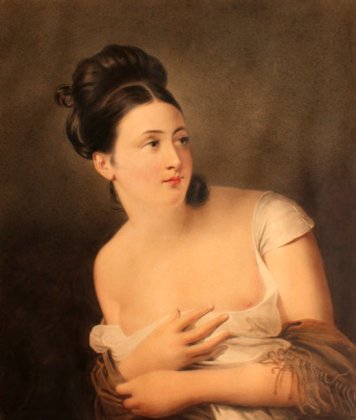
In my efforts to guide young poets and to help them avoid the pitfalls which have, in the past, come near to engulfing me, I wish to discuss further the problem of patrons.
Looking back a majority of my patrons have been ladies. I suppose some of this is because ladies read more, are more sensitive, cultured and interested in the arts. I have noticed in the past that where husband and wife were patrons of the arts, she would support literature; he would tend to support the performing arts, especially those where young ladies, dressed mainly in bespangled stockings, strutted and fussed their brief time upon the stage. Whether these young ladies spoke lines written by another or merely sang seemed to matter less than their pulchritude and the visible expanse of their bosom. I don’t complain or moralise, I merely report the world as I’ve found it.
As a poet, one comes to depend upon the patronage of ladies. Hence, to use a particularly unhelpful metaphor, if one has made one’s bed, one has to be prepared to lie on it.
Now I have mentioned before that one can find ladies of a certain age (and in all candour I have not yet determined exactly what that age is, save that it seems to be under eighty) who regard poets as raffish young men who are no better than they should be. It is an occasional problem and if dealt with firmly, early in the relationship, it should not spoil a fiscally advantageous association.
The problem really comes when the lady, rather than targeting you as a partner in her illicit and amorous liaisons, assumes you will be her ally in concealing them.
Obviously here I can hardly mention names, but let us call her Madam Dee. Madam Dee was a little younger than her husband, and threw herself into the cultural whirl. For a spell I would be at their house perhaps two or three times a week, acting as master of ceremonies for various functions. Now it was obvious to me that whilst matters were moderately restrained when her husband was in town, they were considerably less reserved when he was out of town. It did come to my notice that there was an inner circle within her set who would meet at her house for smaller but more ‘intimate’ soirees when neither I nor Master Dee were present.
Still I am a poet, not a priest of Aea in her Aspect as the Personification of Chastity. (Any thoughts I might have had in that direction were stillborn when I first heard the monotonous and repetitive chanting of the liturgy.) Madam Dee never flaunted her lovers in front of either her husband or I. Decorum as observed and the literary arts flourished in a soil gently watered by a nice mixture of love and nervous guilt.
It was the day of Madame Dee’s birthday that led to the final breakdown in our relationship. She had been organising the event for some days and I confess I had no small part in it. Unfortunately her husband had to be out of town on the day but it was agreed that his presence was not entirely necessary.
The day itself was, up to a point, an unparalleled success. I achieved a genuine triumph with some of the verses I delivered. Then there was to be a period of informal mingling during which I would encourage those who fancied themselves as poets, soothingly critique their verses and gently encourage them in the direction I felt their muse was leading them. To be fair this meant encouraging some to contemplate an actuarial career but still one does it tactfully.
Madame Dee had disappeared but then the guests were dispersed through the house and I merely assumed she was mingling. I joined a small group gathering on the upstairs landing, torn between joining a large group discussing the previous evening’s performance given by a local opera company, or another group who were discussing the disreputable antics of a mutual friend. It was at this point that Madam, in considerable dishabille, stuck an embarrassingly large amount of her anatomy round one of the doors off the landing and said, “Tallis, my husband has returned unexpectedly, delay him.”
A glance out of the window showed me his carriage coming up the drive, so what to do? A poet is never at a loss. I immediately gathered the two groups, the opera lovers and the gossips, together on the landing and said that Madam had commanded me to try a new game out on them. I would say a line, and tap a person near me. They would have to say a line of their own. They would tap a third person who would say a line which rhymed with my line and they would then tap a fourth person who would say a line which rhymed with the line spoken by the second person. Yes it seems complicated when written down but it’s just the simple scheme where line one rhymes with line three and line two rhymes with line four.
I started it off and people soon got the idea. To my surprise it was working rather well, but it gave rise to two further issues. Firstly, and from my point, positively, the sound of people having fun drew more people to the landing so soon the landing and the stairway leading up to it were full of people. Access to Madam was distinctly restricted. The second issue was less welcome. Sooner or later someone would fail think of a rhyme. This is inevitable. No matter how well read or educated a person is, under stress people find they can no longer think clearly. As an aside I suppose I should point out that this is one excellent reason for hiring a poet, we are trained to cope with this sort of pressure. When somebody failed to think of a rhyme the crowd insisted upon a forfeit. The lady in question merely removed one of her stockings. This was greeted with great good humour by the assembled throng, obviously assuming that they had all been invited to the sort of fête that up until now only the inner circle had attended.
Thus by the time Master Dee had arrived at the foot of the staircase, accompanied by a remarkably large number of coachmen and ostlers, the stairs and landing were full of people in various stages undress.
It was also at this point that I began to worry about the arrival of Mistress Dee. I had assumed that I was being asked to, as it where, hold the line, for as long as it took a lady to dress properly. Hence I expected that after two or three minutes she would appear, regal and radiant, and I could step back out of the public eye. Yet if the clock at the top of the stairs was to be believed, nearly a quarter of an hour had passed since I had been requested to win time.
To be honest there is only so much one poet can do, and I felt that I had done it. Master Dee, at the head of a wedge of burly men, pushed his way up the stairs. I faded prudently into the crowd, and made my way down the back stairs, (a route I was directed to by a chamber maid, thus proving my point that one should always be gracious to domestic staff.)
It appears that Master Dee broke down the door of the master bedroom in person, to catch his lady wife in passionate congress with an officer of mercenary horse currently in the employ of one of our more distinguished condottiere captains. At this point it appears that matters became acrimonious. Mistress Dee and her husband divorced. She married her mercenary captain, a Partannese brigand with affectations towards pedigree and breeding. In due course he returned home with his new wife and his troop of horse and overthrew his brother, taking over command of the family keep. Of course he died in some petty feud but Mistress Dee retained command of the keep and proceeded to rule a considerable area around it by a combination of womanly wiles, the ostentatious cultural superiority of her soirees, and the sheer terror inspired by the raids of her warriors.
Master Dee also married again. He took as his second wife a buxom young lady from the chorus to whom he was introduced after the performance of a popular musical comedy. Together they proceeded to produce a family of six sons and five daughters who even today cast a long shadow over banking in Port Naain.
Tallis Steelyard

Jim Webster here; as always my grateful thanks to Tallis Steelyard for the way he has most courteously stepped aside, and indeed and smoothed my path with an exceedingly elegant introduction.
But I shall not keep you long. In short, the third story in the much acclaimed ‘Port Naain Intelligencer’ series will be available for purchase on the 1st of March; ‘Tomb-yard Follies’ on Amazon UK and Amazon.com
To quote from the blurb:
“Mapping an old family graveyard was a technically complicated job Benor expected would take him some time. But then he hadn’t allowed for getting caught up in a world of intrigue, vengeance, and arbitrary justice.”
Previous stories from the Port Naain Intelligencer are:
Flotsam or Jetsam and A Much Arranged Marriage
 Tallis Steelyard, author of Lambent Dreams, (available for a mere 99p) is, ‘at least in part’, the responsibility of Cumbrian author Jim Webster.
Unlike Tallis who relies on the uncertain patronage of the denizens of Port Naain, Jim claims that in order to make a living he ‘sort of farms, sort of writes and sort of helps out where he’s wanted’. Sartorially and musically challenged, Jim is nevertheless married and has three daughters.
Jim is the author of four fantasy novels set in the Land of the Three Seas plus a number of longish short stories in both science fiction and fantasy genres.
Jim’s books are available in paperback (and make perfect gifts) as well as in e-book format.
In addition to Tallis Steelyard’s blog, you can find Jim and his books on his personal blog here, on Twitter @JimWebster6 and on Amazon UK, Amazon.com and Goodreads.











































 Sue Vincent's Daily Echo
Great reading! Thanks for posting.
LikeLiked by 1 person
I do enjoy Jim’s tales 🙂
LikeLiked by 2 people
Super stuff.
LikeLike
I have a soft spot for Tallis’ tales 🙂
LikeLiked by 2 people
I do, too.
LikeLike
🙂
LikeLike
admittedly it’s a bog in the west of Ireland but it’s still a soft spot 😉
LikeLiked by 1 person
I spend a lot of time wading through peat bogs 😉
LikeLiked by 1 person
I’ve been told it does wonders for the complexion
LikeLike
I don’t always mud slide…
LikeLiked by 1 person
but when you do, mud is properly slid! 😉
LikeLike
You must have been talking to the witness… 😉
LikeLiked by 1 person
my lips are sealed
LikeLike
ah… bribery too 😉
LikeLiked by 1 person
😉
LikeLiked by 1 person
Hahaha!
LikeLiked by 2 people
it’s no place to keep a poet 😦
LikeLiked by 1 person
Depends on their verse 😉
LikeLiked by 1 person
or worse, to be terse, their purse and the depth thereof 😉
LikeLike
…or their willingness to access that depth 🙂
LikeLiked by 1 person
The question has to be asked, why should a poet be asked to pay for anything? Their role is the outpouring of great art, not the bickering of squalid commerce
LikeLike
So I suppose said outpouring needs to have the resulting void filled with something…in simple fairness for gracing the world with his gifts… and wine is such an accommodating shape…
LikeLiked by 1 person
absolutely, and in wine there is truth and yet more poetry
LikeLike
Hahahah
LikeLiked by 1 person
Thanks for sharing this work. It was enjoyable to read.
LikeLike
There will be more from Tallis and Jim 🙂
LikeLiked by 1 person
Reblogged this on Kate McClelland.
LikeLiked by 1 person
A true lady and patron of the finer arts
LikeLiked by 2 people
Pingback: Of Kings and Kindness | ADD . . . and-so-much-more