
Church Going by Philip Larkin
With thanks to John Flanagan for reminding me of this poem by English poet Philip Larkin (1922-1985)
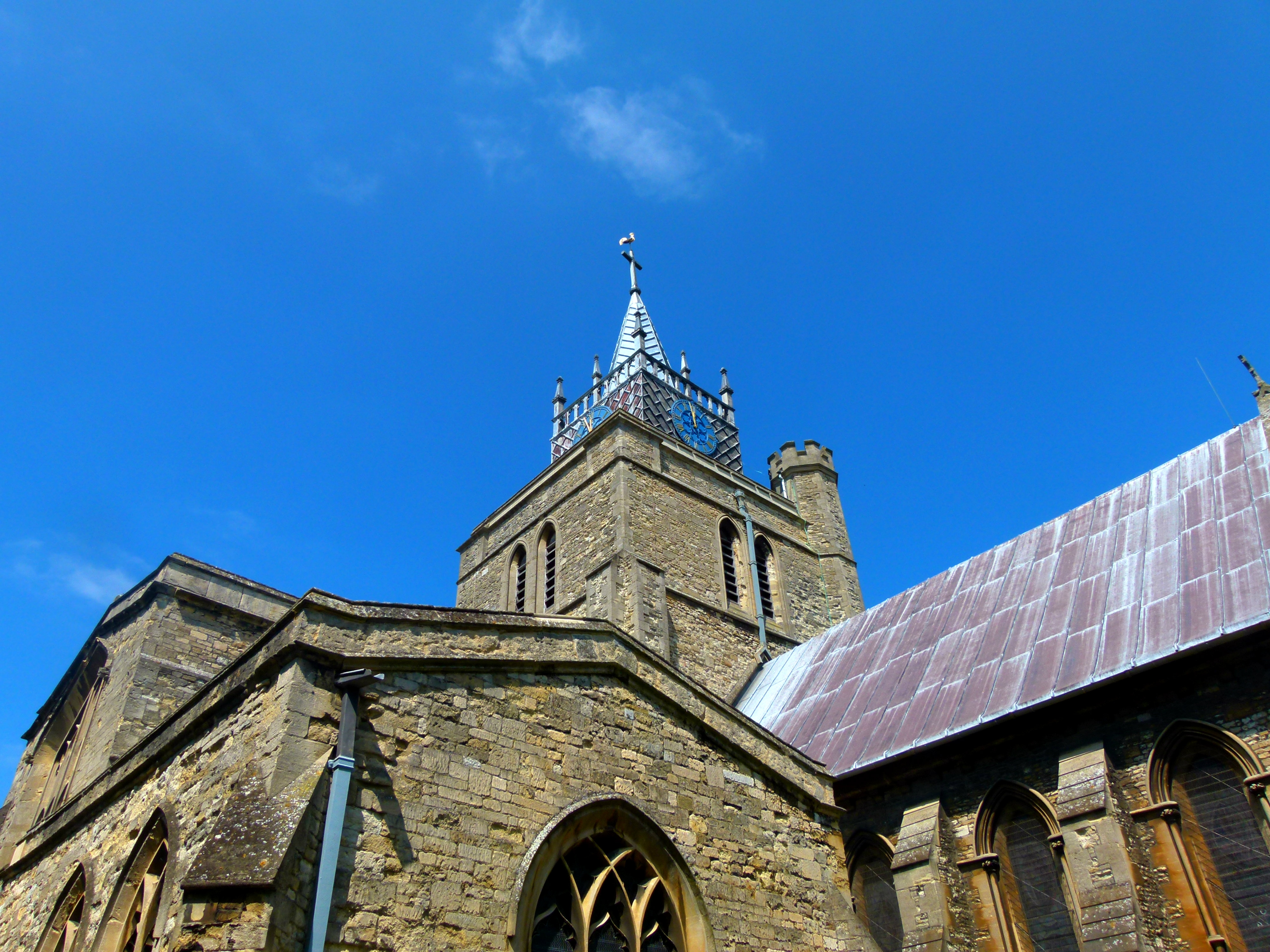
Once I am sure there’s nothing going on
I step inside, letting the door thud shut.
Another church: matting, seats, and stone,
And little books; sprawlings of flowers, cut
For Sunday, brownish now; some brass and stuff
Up at the holy end; the small neat organ;
And a tense, musty, unignorable silence,
Brewed God knows how long. Hatless, I take off
My cycle-clips in awkward reverence.
Move forward, run my hand around the font.
From where I stand, the roof looks almost new –
Cleaned, or restored? Someone would know: I don’t.
Mounting the lectern, I peruse a few
Hectoring large-scale verses, and pronounce
‘Here endeth’ much more loudly than I’d meant.
The echoes snigger briefly. Back at the door
I sign the book, donate an Irish sixpence,
Reflect the place was not worth stopping for.
Yet stop I did: in fact I often do,
And always end much at a loss like this,
Wondering what to look for; wondering, too,
When churches will fall completely out of use
What we shall turn them into, if we shall keep
A few cathedrals chronically on show,
Their parchment, plate and pyx in locked cases,
And let the rest rent-free to rain and sheep.
Shall we avoid them as unlucky places?
Or, after dark, will dubious women come
To make their children touch a particular stone;
Pick simples for a cancer; or on some
Advised night see walking a dead one?
Power of some sort will go on
In games, in riddles, seemingly at random;
But superstition, like belief, must die,
And what remains when disbelief has gone?
Grass, weedy pavement, brambles, buttress, sky,
A shape less recognisable each week,
A purpose more obscure. I wonder who
Will be the last, the very last, to seek
This place for what it was; one of the crew
That tap and jot and know what rood-lofts were?
Some ruin-bibber, randy for antique,
Or Christmas-addict, counting on a whiff
Of gown-and-bands and organ-pipes and myrrh?
Or will he be my representative,
Bored, uninformed, knowing the ghostly silt
Dispersed, yet tending to this cross of ground
Through suburb scrub because it held unspilt
So long and equably what since is found
Only in separation – marriage, and birth,
And death, and thoughts of these – for which was built
This special shell? For, though I’ve no idea
What this accoutred frowsty barn is worth,
It pleases me to stand in silence here;
A serious house on serious earth it is,
In whose blent air all our compulsions meet,
Are recognized, and robed as destinies.
And that much never can be obsolete,
Since someone will forever be surprising
A hunger in himself to be more serious,
And gravitating with it to this ground,
Which, he once heard, was proper to grow wise in,
If only that so many dead lie round.





































 Sue Vincent's Daily Echo
Thank You, Sue, for sharing one of the great works and thank you for the kind mention.
LikeLike
Really is my pleasure, John.
LikeLike
I haven’t ever had the pleasure of coming across this poem but have to say, I am profoundly touched by what Larkin has written here.
I kind of disagree with his certainty that churches will become obsolete, but there is something more in his words, a vague understanding that despite our belief or non belief, and despite our choice to seek or not seek, there exists a sanctity… faded but certain, that will always pervade…
Am I right in thinking this?
It’s such a beautiful, tender and honest poem.
Thank you so much for sharing it!
ff
LikeLike
I think, given time on the evolutionary scale there is a high probability that churches as we know them today will become no more than the relics of an ancient sanctity. Yet in the same way that the stone circles and ancient groves speak to us of a divinity whose name we no longer know and whose rites have been forgotten, there will remain a serenity and sacredness about the old places. It is in such places, from whatever faith and whatever era of human history that we can, ourselves, turn if we choose and reach out to peace, beauty and whatever we feel lies beyond the world.
My thanks go to John for the reminder. I hadn’t read this for years.
LikeLike
I know that Larkin, the man, has come in for a lot of stick over the years. None the less, the man was the vehicle for such poetry as this – melding his personal scepticism with an authentic sense of ‘something far more deeply interfused’ that will never fade no matter, as you say, how its expression in material trappings changes. The ending of ‘High Windows’ comes to my mind:
Rather than words comes the thought of high windows:
The sun-comprehending glass,
And beyond it, the deep blue air, that shows
Nothing, and is nowhere, and is endless.
LikeLiked by 1 person
Larkin has, as you say, taken some stick, and possibly rightly so as a man. On the other hand, as a vehicle through which such sentiments can flow he is a different matter.
That is a problem many face when art and artist become melded in the public consciousness, even more so with the celebrity cult that holds so many on pedestals these days.
His poetry has moments that are simply sublime and suffused with a very human vision of something beyond the mundane.
LikeLike